Roading tractors vs trailering puts massive wear and tear on your machines. Yet if you’re dealing with a standard rig, trailering your gear to your field can be a massive time suck that risks costly damage.
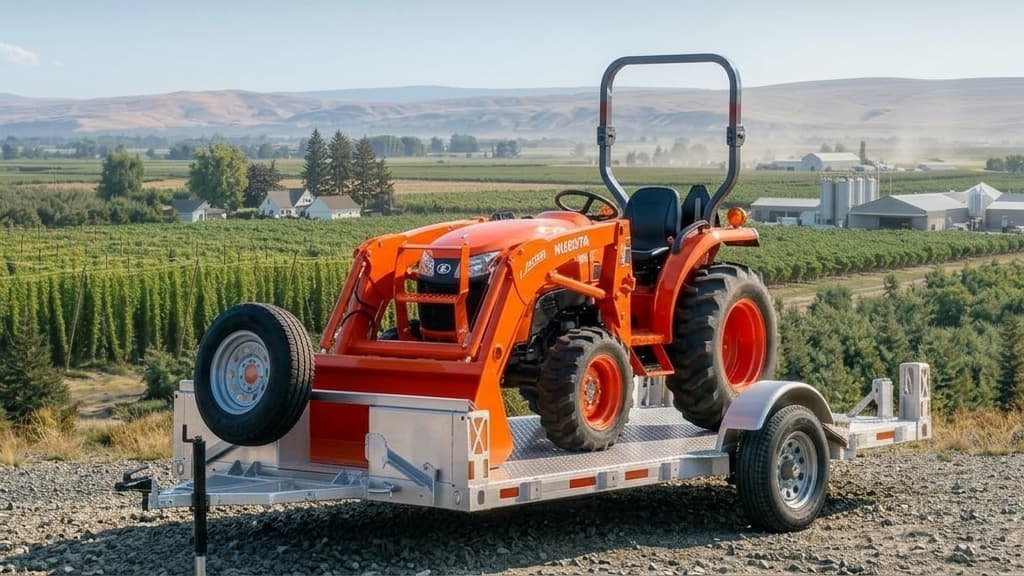
Hydraulic drop deck trailers from GoodMFG® give you a low-angle loading option that helps you move tractors and other equipment to and from your fields with ease. In less than 5 minutes you can be loaded and ready to go simply by driving your tractor directly onto the deck.
Having access to a trailer that is fast and safe to load gives you an asset that protects the service life of your tractor’s most expensive components.
table of contents
Cost Calculations: Fuel
How does roading tractors vs. trailering stand up in terms of fuel economy?
You already know “roading” tractors burns more fuel. A tractor running at 2400 RPM on asphalt is a fuel hog. A 3/4-ton truck towing 10K lbs. is far more efficient at highway speeds. Think $12 in fuel per 10 miles, vs. $3.50 in fuel.
Cost Calculations: Tires
Where roading tractors vs. trailering really shines? Protecting your tires, one of the most expensive and delicate parts of any tractor. The same is true for any other piece of farming equipment you might want or need to haul.
Asphalt is a cheese grater for soft ag rubber. Roading a tractor even 500 miles over its life can shave a full season off its tire utility.
Plus, if you’re working with R-1 tires, the vibration can loosen bolts, fatigue the operator, and create a safety hazard down the road.
Cost Calculations: Time
Time is your most expensive input. When you road a tractor at 15 mph, you turn a 10-mile trip into 40 minutes of unproductive “seat time.” How much is your time worth, or the time of the worker who may be taking it down the road? Compare 15 minutes to 40, and you get your savings.
Cost Calculations: Wear
Constant high-speed vibration fatigues bearings, seals, and the operator. You don’t incur wear and tear when you trailer your tractor to its destination. You incur roughly $5.00 in transmission and axle stress every 10 miles you road. Eventually all of those trips cause a big break that puts your tractor out of commission until the shop can get to you.
It All Adds Up
When you add up all the hidden costs of roading a trailer the comparison is clear. When you road, you spend roughly $57 per trip. When you haul, you spend $13.50 per trip. Roading always costs you more in real dollars, but farmers are always tempted to road instead of trailer because usually the trailer load and unload process is such as low, dangerous pain.
Avoid the Road
Trailering vs. Roading: priceless if you value your safety.
Driving a utility tractor on a 55 mph highway? Nightmarish.
Drivers are distracted. They’re racing by. They don’t understand a tractor can’t swerve or stop on a dime. They’re impatient, and aggressive as they zip past.
Every minute becomes a statistical gamble.
Every mile becomes a liability waiting to happen.
And if you road the tractor, who is bringing fuel, seed, and tools? You now need a second truck and a second driver to follow you, doubling labor and fuel costs for that move.
Avoid the Road
Before you put tires to the pavement, consider these four hidden costs of “roading” your trailer.
- Fuel efficiency. Roading a tractor at high RPMs costs roughly $12 per 10 miles, whereas hauling with a pickup and a trailer average only $3.50 for the same distance.
- Tire longevity. Asphalt acts as a “cheese grater” for soft ag rubber. Just 500 miles of roading can shave an entire season off the life of your R-1 tires.
- Mechanical depreciation. Every mile on the road adds approximately $5.00 in transmission and axle stress—wear and tear that don’t happen when the wheels are off the ground.
- Opportunity costs. Roading at 15 mph turns a quick hop into a 40-minute “seat time” drain. Trailering cuts transport time by over 60%, freeing you up for actual field work.
- Safety & liability. Moving a slow moving vehicle (SMV) on 55 mph highways increases the statistical risk of accidents and doubles labor costs by requiring a “follow vehicle.”
The Inventory Advantage
Rental houses who serve the ag market find that Good Trailers perform especially well because a drop deck makes loading a fast, easy “no-brainer.” They’re solid investments to either purchase up front or rent through the year, making them the asset you’ll want to have in stock this year.
Next Steps
Are you a farmer looking to add Good Trailers to your operation? Click here to find your nearest dealer! Can’t find a dealer? Contact us directly to arrange delivery & shipping.
Are you a trailer dealer or equipment rental shop that serves farmers? We are actively seeking dealer partners in Oregon and California. Contact our team to discuss next steps!
See also:
Protect Farm Inventory with Good Modular Storage
Mobile Workshops for On-Site Equipment Repair
Hydraulic Drop Decks for Equipment Rental Sites: Boost Profits & Safety
This resource was compiled by the GoodMFG® Product Team, drawing on 75 years of experience in hydraulic systems, heavy-duty transport, trailers, and modular structures.
P.S. – We build trailers every day, but we don’t run your crews. If there’s a specific logistical headache or a “field reality” we’ve missed, we want to hear about it. Help us refine the equipment that makes your day easier! Email our Marketing Lead at devan-h @ goodrv.com and let us know what we should solve next.