Aluminum trailers vs. steel trailers. Which is better?
Turns out, if you want the best haul money can buy, they real answer may lie in an engineered hybrid solution.
Both metals have their strengths and weaknesses. When the strengths are emphasized and the weaknesses are downplayed, you get superior durability and a long-lasting product with a low total cost of ownership.
If you’re going to make a trailer, we believe aluminum is best for the skin where weight and looks matter, and galvanized steel is best for the skeleton, where safety and strength matter.
table of contents
- Aluminum vs. Steel
- Hybrid Durability
- Smart vs. Light
- Key Takeaways
- Get Your Quote
Aluminum vs. Steel
At a molecular level, aluminum behaves very differently from steel when it’s placed under pressure.
Steel is an iron-carbon alloy prized for its high elastic modulus. This material property allows it to bear immense weight without deforming.
Aluminum is naturally more flexible and possesses roughly 1/3 the density of steel. It also possesses a superior strength-to-weight ratio and a unique ability to create its own skin: an ultra-hard oxide layer which prevents deep structural corrosion.
While steel is stronger, aluminum is virtually rust-proof.
Aluminum is also low maintenance, since it can simply be washed off with a garden hose.
By contrast, steel requires regular inspections and touch-ups, especially if it hasn’t been galvanized.
By the way, if you’re equating aluminum with a soda can, you’re falling prey to a very common “trailer myth.” The #5052 aluminum we use in our composite aluminum panels is sturdy and strong, resists dents with ease, and holds its structural integrity well. There’s nothing weak about it!
Hybrid Durability
Why choose between the weight of steel and the fragility of aluminum? We use #5052 Aluminum Composite Panels to create a dent-resistant, lightweight skin, then mount these innovative panels on a hot-dipped galvanized steel frame.
Hot-Dipped Galvanized Steel
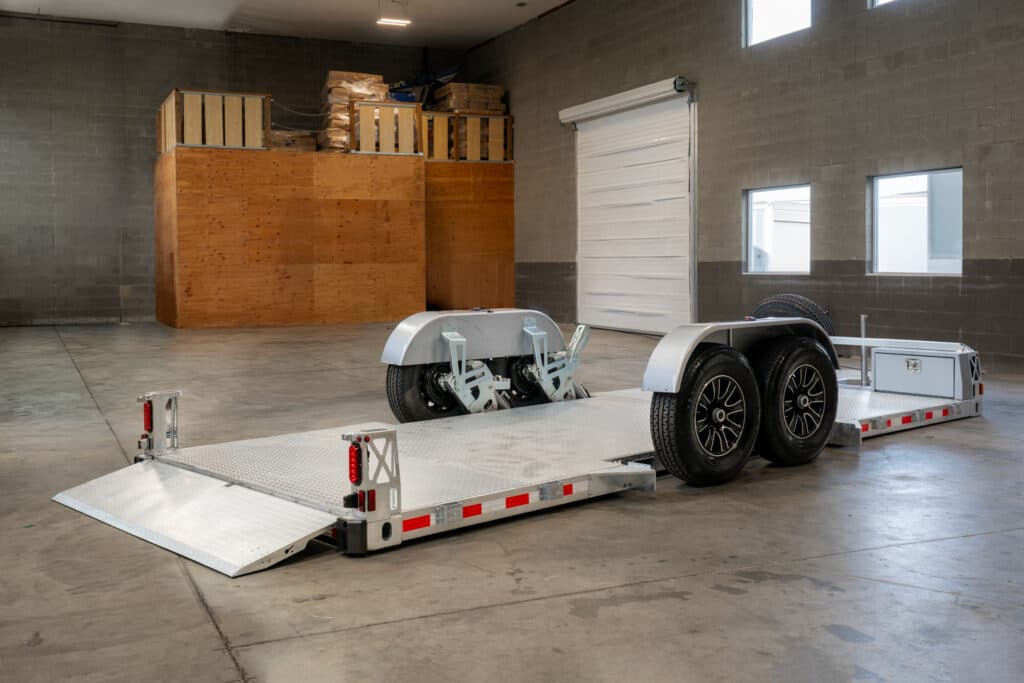
A zinc-bonded coating makes our galvanized steel frames corrosion-resistant. That allows you to benefit from an ultra-tough frame without having to worry your trailer will rust out from under you.
It’s not perfect of course. No dip-coating is. Eventually, you’ll see a little rust. The corrosion won’t spread nearly to the degree that it would on an undipped frame, though.
Standard steel is painted or powder coated. One rock chip creates rust.
Galvanized steel is different. The zinc metallurgically bonds to the steel. Even if scratched, the surrounding zinc “sacrifices” itself to protect the steel in a process known as cathodic protection.
You should get 20+ years of rust protection from our hot dip process.
Composite Aluminum Panels
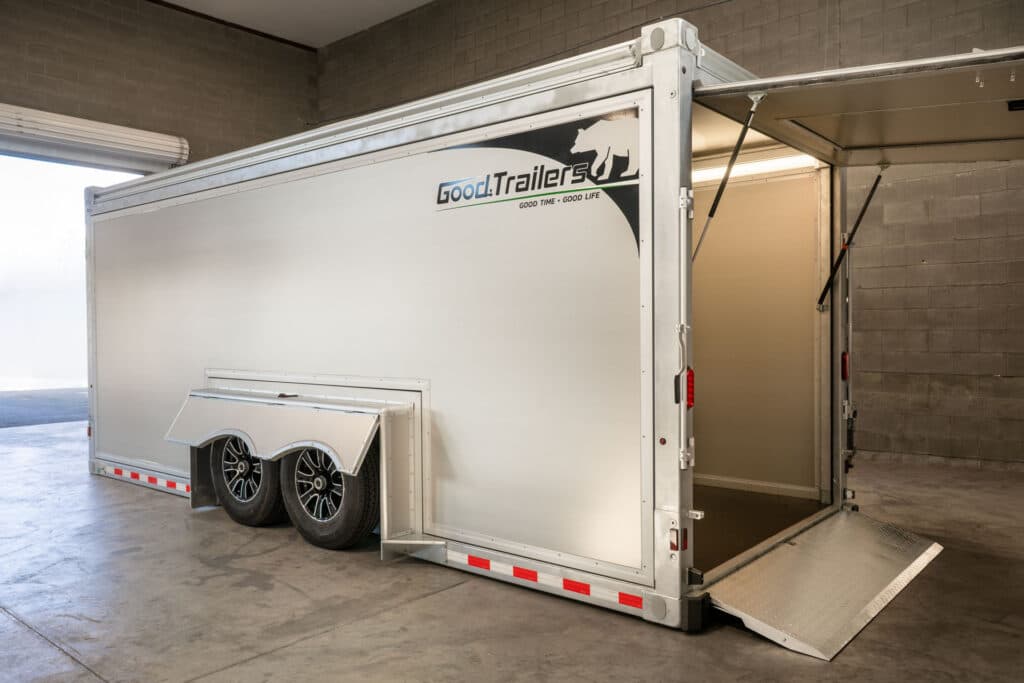
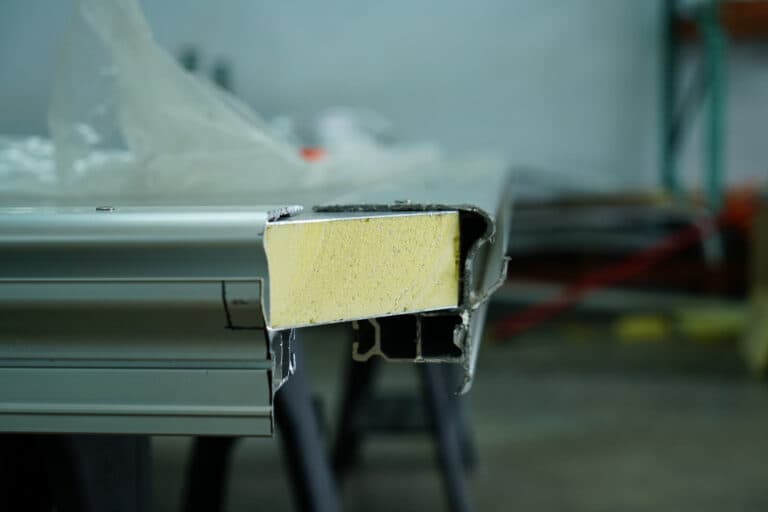
Our cargo trailers are built with patent-pending composite aluminum panels. We sandwich thick polystyrene foam between sheets of #5052 aluminum to create an insulated, durable panel that’s dent-resistant, lightweight, weather-resistant, and of course, rust-resistant.
Plus, we can make custom cuts in these panels without weakening their structural integrity, which allows us to place add-ons like D.O.T. rated windows.
Smart vs. Light
An all-aluminum trailer is definitely the lightest you can buy; roughly 33% lighter than an all-steel trailer. There are real advantages to keeping it light:
- Higher carrying capacity relative to GVWR, because the trailer weighs less.
- A lighter trailer is slightly easier on your gas mileage.
However, lightness isn’t everything. For example, a pure aluminum trailer can “work harden” after years of heavy-duty use. That means it starts cracking at the weld points. This is why some users opt for steel trailers: a higher flex point means your trailer is less likely to suffer from metal fatigue or stress cracks.
Since our hybrid approach means matching composite aluminum panels to a galvanized steel frame, our trailers are not the lightest on the market. However, they might just be the smartest.
By using composite aluminum panels for the body, we shed the unnecessary bulk of all-steel trailers. By keeping the panels on a galvanized steel backbone, we can ensure the trailer doesn’t flex or work harden over time like an all-aluminum trailer frame can.
Key Takeaways
If you remember nothing else, remember…
- The Strength of Steel. We use hot-dipped galvanized steel for the trailer’s “skeleton,” preventing the structural cracking which is common in all-aluminum frames.
- The Beauty of Aluminum. Our “skin” is made of #5052 Composite Aluminum Panels that employ a polystyrene foam core. Insulated, dent-resistant, rust-proof, and significantly lighter than all-steel alternatives.
- Sacrificial Protection. Thanks to the metallurgical bond of zinc in our galvanizing process, the frame uses cathodic protection to stop rust even if the surface is scratched.
- Insulated Durability. By sandwiching polystyrene foam between aluminum sheets, our composite panels provide an insulated, weather-resistant barrier that stays quiet and looks sharp.
- The “Smart” Weight. While not the lightest on the market, our hybrid design offers the perfect balance of fuel efficiency and long-term structural integrity.
Get Your Quote
Ready to experience the benefits that come from combining
Ready for the next step?
- Call us right now at (360) 889-9789.
- Find a dealer near you.
- Click the green icon to the lower right to chat with Tow-Bot.
- Or contact us to send a message using the form below!
See also:
3 Advantages of GoodMFG® Composite Aluminum Panels
Good Trailer Buyers’ Guide: Which Good Trailer is Right for You?
Comparing Good Trailers to Common Alternatives
This resource was compiled by the GoodMFG® Product Team, drawing on 75 years of experience in hydraulic systems, heavy-duty transport, trailers, and modular structures.
P.S. – We build trailers every day, but we don’t run your crews. If there’s a specific logistical headache or a “field reality” we’ve missed, we want to hear about it. Help us refine the equipment that makes your day easier! Email our Marketing Lead at devan-h @ goodrv.com and let us kow what we should solve next.