Double drum rollers and traditional trailers are a dangerous mix.
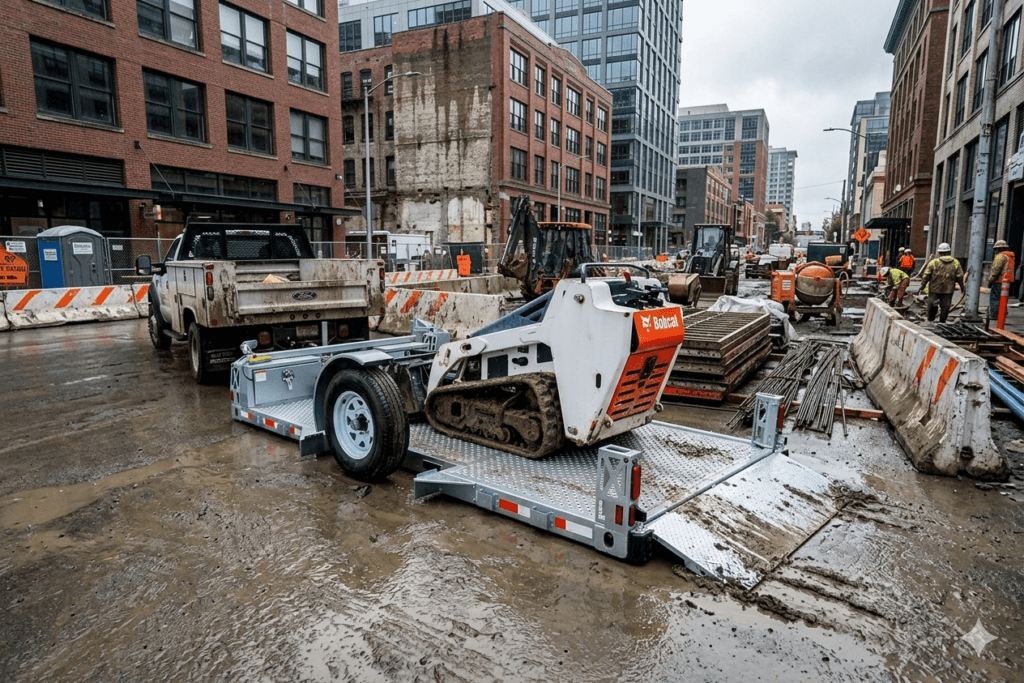
Every paving and landscaping contractor knows the pain. It’s 4:30 PM. It’s drizzling. And you’ve got a 5,500 lb. Bomag double drum roller to get up a pair of narrow, slippery trailer ramps.
One wrong move, and the machine crabwalks sideways, slips, or slides, risking catastrophe.
There’s a better way.
table of contents
Stop Slipping
Investing in a solution like the GT19FL can be a gamechanger. While it won’t solve double drum roller traction problems on its own (more on that in a minute), it will vastly improve the loading process in other ways.
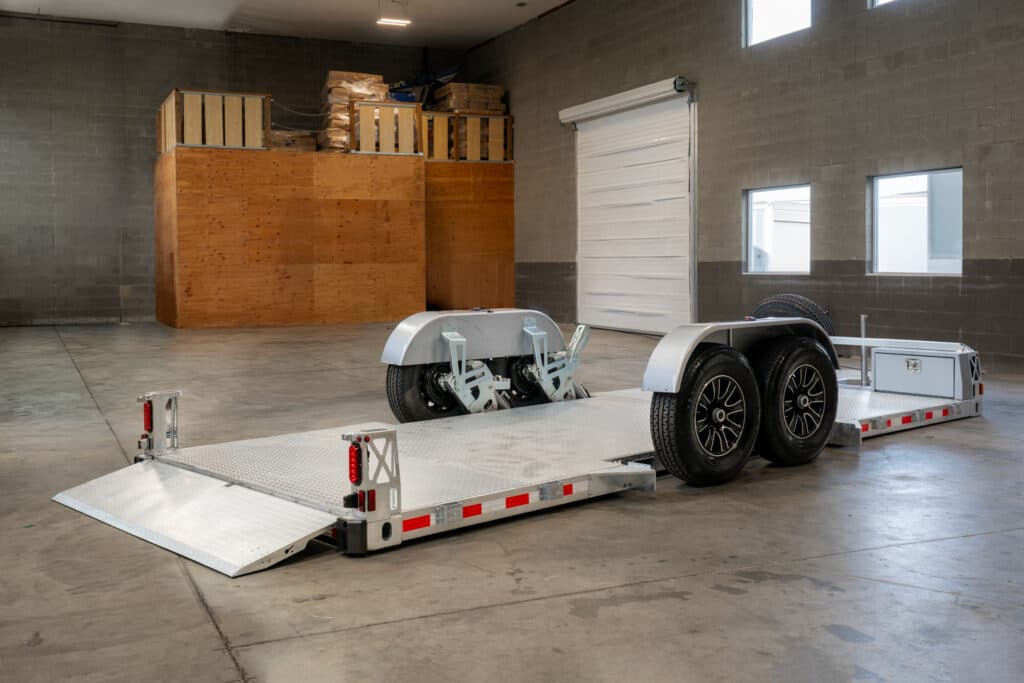
First, you eliminate the zero-over-center drop. Traditional trailers require the roller to crest a sharp peak at the top of the ramps. Double drum rollers are top-heavy, and they tend to rock violently as they do. This is the danger zone, the point where the machine is most likely to slide back or tip. Because the drop deck chassis lowers all the way to the ground and the deck sits as low as 5.2″, the transition becomes seamless.
These ramps are just 1’10” long and have a gentle 11° slope. This reduces the gravitational pull that tries to slide the roller backwards. While no solution guarantees 100% safety, the safety profile improves by a significant margin.
But even at 11°, smooth steel on bare aluminum treadplate can slip if it’s wet or muddy. If you’re going to be hauling double drum rollers you still need to embrace a couple of hacks like keeping thick recycled rubber mats or conveyor belt strips in your truck so you can lay them over our ramp. That gives the steel drum instant, biting traction. It also protects the finish on your Good Trailer.
Better Tie-Downs
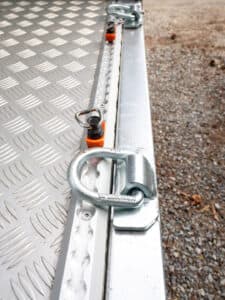
When the ROPS system is extended, finding secure tie-down points becomes a real headache. Pick the wrong ones, and you scrape your bars, water sprinkler lines, or articulation joints.
And unfortunately, you must tie these machines down perfectly if you don’t want to watch them bounce, vibrate, and shift all the way down the highway.
But even at 11°, smooth steel on bare aluminum treadplate can slip if it’s wet or muddy. If you’re going to be hauling double drum rollers, you still need to embrace a couple of hacks like keeping thick recycled rubber mats or conveyor belt strips in your truck so you can lay them over our ramp. That gives the steel drum instant, biting traction. It also protects the finish on your Good Trailer.
Dead Machine Solutions
Sadly, we can’t do anything about the giant PITA that is disabling the hydrostatic brake system when your drum roller goes dead. We can, however, eliminate some of the headaches associated with getting the roller back on the trailer.
First, we highly recommend crews like yours invest in our winch add-on. This one is shown on a custom flooring option for our GT19FL, but it gets the point across regardless.
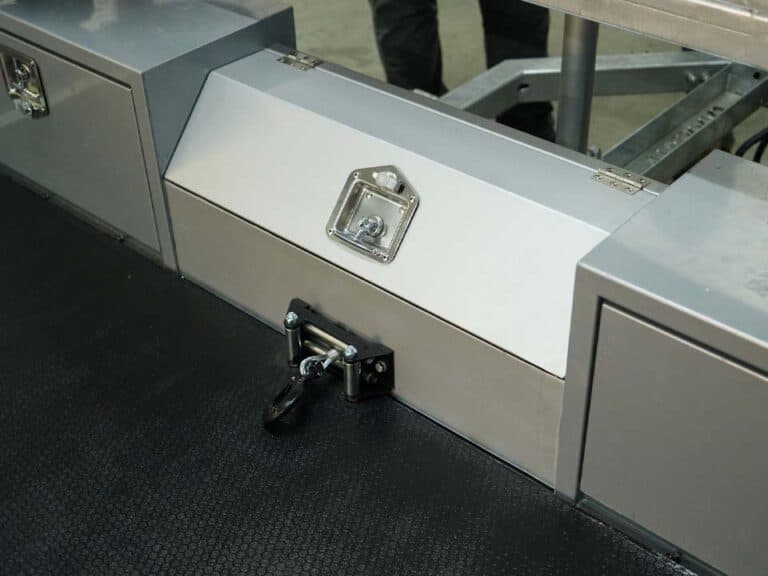
Once you’ve invested in the winch, you at least save significantly less time and sidestep some logistical nightmares. On a standard trailer, winching a dead 2.5-ton machine up a steep, high incline is terrifying. If the winch cable snaps, that roller becomes a 5,500 lb. mass moving at frightening and dangerous velocities.
The 11° angle on a Good Trailer requires far less winching force, which puts less strain on the winch and the cable, reducing your accident risk. And once the roller clears our short 22-inch ramp, it sits on a completely flat deck. You then secure it, raise the deck, hitch up, and go.
Which Good Trailer is Right For your Double Drum Rollers?
While our GT13FL model could carry some 1-ton double drum rollers, we generally recommend going up to the GT19FL model, since you’ll also be carrying full water tanks more often than not. However, the GT13FL can carry up to 5,055 lbs., which makes it a suitable solution for many models if you’re looking to save a little bit of money. The GT19FL offers 8,958 lbs. of carrying capacity for the heaviest in the 1 ton to 2.5-ton utility compact bracket, and offers some peace of mind for those who don’t like carrying their trailers to absolute capacity.
Either way, do account for the water tank, which will add up to 450 pounds of sloshing weight.
The GT19FL is suitable for many models, including models like the:
- CB 1.7 (~3,538 lbs.)
- CB 1.8 (~3,852 lbs.)
- CB 2.5 (~5,546 lbs.)
- DV23E/23CE (~4,960 lbs.)
- DV26E/26CE (~5,490 lbs.)
- Bomag BW 90AD-5 (~3,500 lbs.)
- Bomag 100 AD-5 (~5,300 lbs.)
- Dynapec CC1100 (~5,300 lbs.)
- Hamm HD 12 (~5,942 lbs.)
We do not recommend an enclosed drop deck for these rollers, as the ROPS system can make the transport height of a double drum roller far exceed the height of our enclosed trailer models.
Key Takeaways
TL;DR if you’re considering using drop deck trailers to haul your double drum rollers.
- Say good-bye to rock n’ roll. You can keep the Blue Oyster Cult, but skip the part where you grit your teeth as top-heavy asphalt rollers lean and rock while cresting the sharp peak created by traditional split ramps. Drop the deck to 5.2″, drive on, secure, raise the deck, hitch up, and go.
- Expand your margin for error. You shouldn’t have to tap your most experienced operator every time you want to load up. Standard ramps leave zero clearance for 39-inch-wide drums though, so that’s your only option if you want to stick to the norm. Upgrading to a Good Trailer gives you 75 inches of breathing room, and a load even an inexperienced operator can tackle.
- Get traction. Smooth steel drums have no inherent traction on wet metal treadplates. Lower the grade to a gentle 11° to reduce backward gravitational pull. Then, add thick rubber mat strips to provide an immediate grip.
- Account for water weight. A full water tank adds ~450 more pounds, which is why we recommend our 11,800 GVWR GT19FL with ~8,958 lbs. of carrying capacity for most 1-ton to 2.5-ton models.
- Get yourself a winch and some D-ring stake pockets. You’ll thank us when securement is a snap. You’ll also thank us when you’re standing in the pouring rain trying to get a dead roller up onto the trailer bed.
Protect Your Hard Work
- Call us right now at (360) 889-9789.
- Find a dealer near you.
- Click the green icon to the lower right to chat with Tow-Bot.
- Or contact us to send a message using the form below!
See also:
Reduce Undercarriage Repair Bills
Risk Mitigation on the Ramp: Seamless Loading & Unloading Solutions
Good Trailer Buyers’ Guide: Which Good Trailer is Right for You?
This resource was compiled by the GoodMFG® Product Team, drawing on 75 years of experience in hydraulic systems, heavy-duty transport, trailers, and modular structures.
P.S. – We build trailers every day, but we don’t run your crews. If there’s a specific logistical headache or a “field reality” we’ve missed, we want to hear about it. Help us refine the equipment that makes your day easier! Email our Marketing Lead at devan-h @ goodrv.com and let us know what we should solve next.