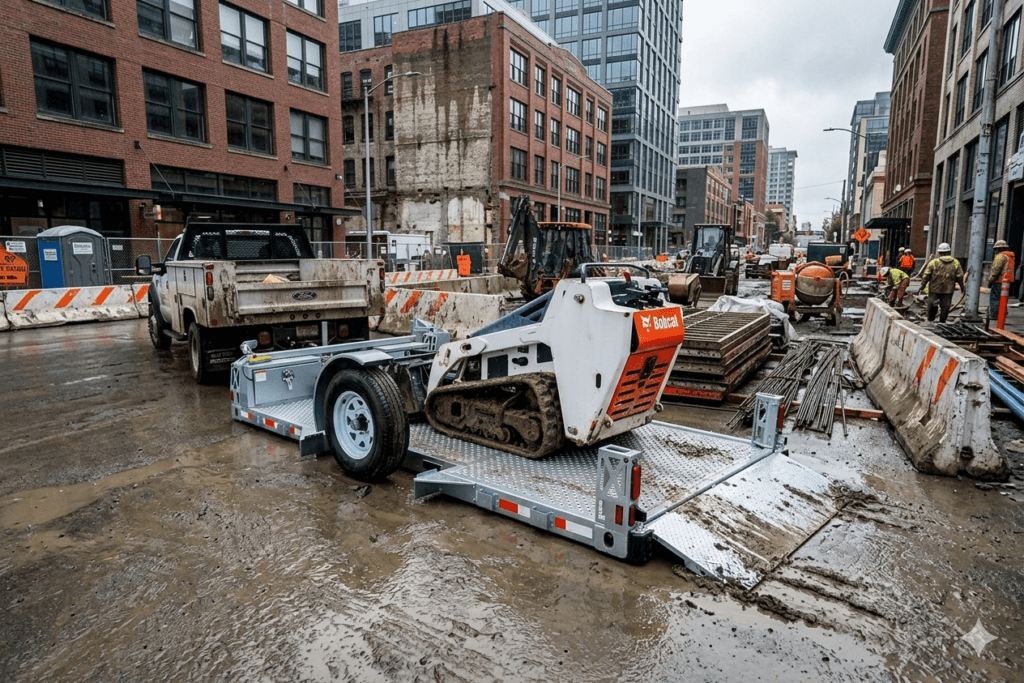
It’s 2:00 PM. It’s raining. And your only skid steer needs to get from Job A to Job B right now.
With a standard trailer, that means slick ramps, alignment anxiety, and a two-man loading crew. It’s a recipe for blown schedules, and sometimes $6,000 worth of undercarriage damage.
For contractors juggling multiple job sites, daily equipment moves require a completely different approach to transport. here’s how a drop deck trailer like the GT19FL eliminates the daily logistics bottleneck.
table of contents
The Multi-Job Shuffle
If you’ve got to move machines between two sites in one afternoon, every minute spent loading is a minute of lost productivity, which is, in turn, a minute of lost money.
Standard trailers take way more time than hydraulic drop deck trailers. With a standard trailer, you’re going to need to unpin heavy ramps, wrestle with chains, and get your gear loaded on a pair of narrow ramps that sometimes feel no safer than your average tightrope. Plus, you have to put two or more guys on the job.
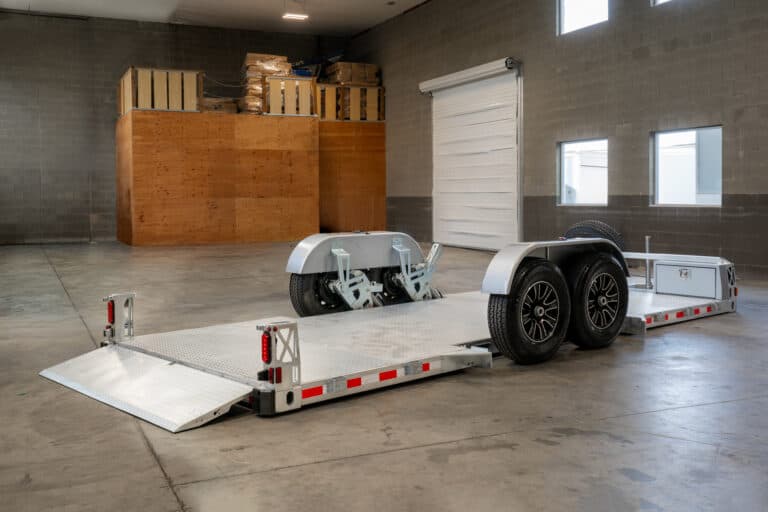
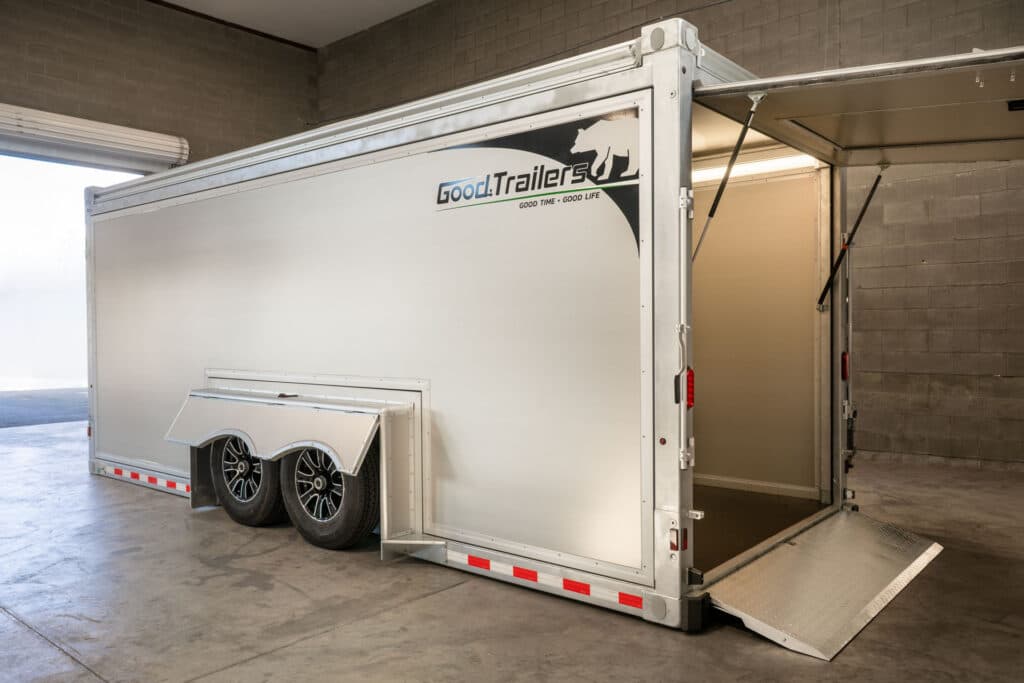
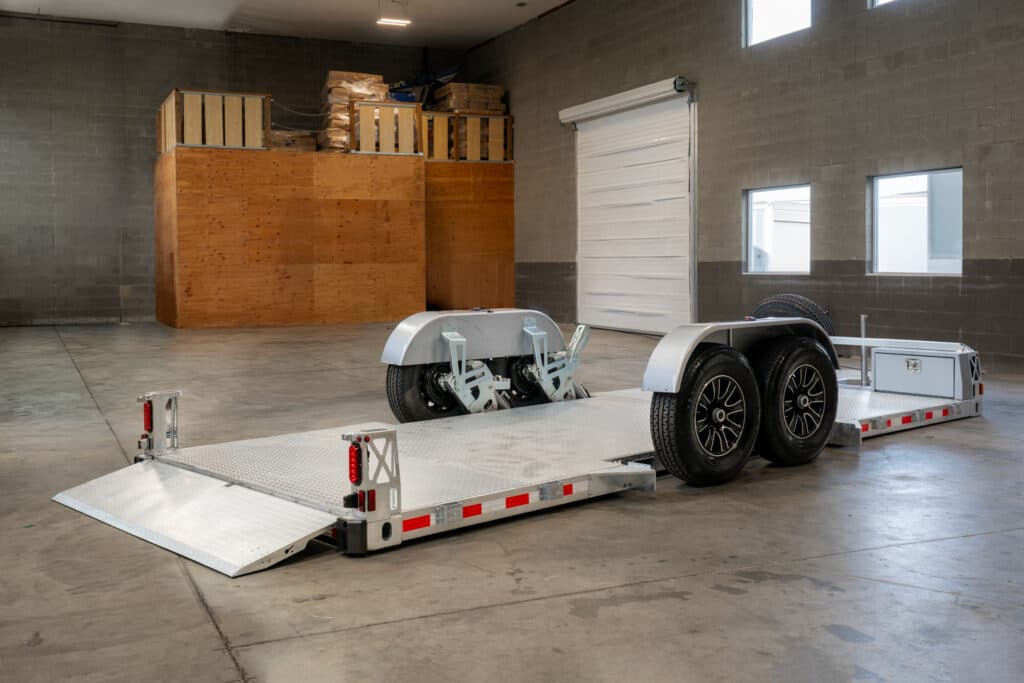
With the GT19FL you get a single operator drive-on experience. Lower the deck to 5.2″. Unpin and fold down the spring-assisted, full-width 22″ ramp. Drive right onto the trailer. Secure the equipment. Flip the ramp back up. Raise the trailer. Hitch up and go. You’re loaded and on the road in less than 5 minutes.
Rental Yard Savings
Tired of losing $300 per trip on pickup and delivery fees?
If you have your own reliable, fast-loading trailer, you can drive to the rental yard yourself, pop the gear onto the trailer, and then head straight to the job site. It saves money and prevents crews from sitting around waiting for a rental truck to show up at 10 AM.
Plus, when you bring the GT19AL, you eliminate so many other points of stress. A steep, slippery ramp on a standard trailer can make loading a finicky rented machine stressful. With a GT19FL, you get a stress-free experience that gets the rental to the job site that mcuh faster.
Equipment Protection
Undercarriage damage accounts for roughly 50% of equipment repairs. When every repair costs thousands of dollars, choosing a trailer that won’t scape up the chassis or create the circumstances which cut lines or cause structural damage becomes absolutely paramount.
The #1 place where those undercarriages are going to get messed up is on the apex of a steep, slippery ramp.
Drive-on loading at ground level solves that problem. The 11° angle of our 22″ long and 74″ wide ramp just isn’t sharp enough to cause the “breakover” point that causes so much damage.
We’re not saying you’re never, ever going to have a problem ever again. That would be a wildly irresponsible claim. Stuff happens, and we can’t account for every weird condition or operator’s bad day. We can say that you can cut the number of incidents by a margin so significant that the trailer will pay for itself fast, simply because it helps you avoid so many repair bills.
Attachment Protection
On a standard high-deck or tilt trailer, trying to safety chain down a loose attachment while balancing the machine can be a logistical nightmare.
Bringing a GT19FL to ground level gives you a stationary staging area. Organize and secure attachments at ground level, eliminating another job site hazard and creating a secure load that helps reduce in-transit liability or damage risks.
Small Wheel Logistics
Construction sites often require crews to move palletized finishing materials, commercial HVAC units, or industrial toolboxes. Using a forklift is a headache, but it’s often the only option.
Pushing a manual pallet jack up a steep standard trailer ramp becomes physically impossible. A 16° standard trailer ramp requires 551 pounds of force to move a pallet jack with 2,000 pounds of goods on board.
At the high end of 22° you’d need 749 pounds of force. Our 11° only needs 381 pounds of force, which means a single operator can realistically move the pallet onto the trailer with a battery-assisted electric pallet jack, or with help from a single other employee.
No CDL Required
When you choose a Good Trailer, you generally won’t require a CDL so long as you choose the right pick-up truck to haul it with.
Pair the GT19FL with F-250, and you remain under the 26,001-pound threshold that would require a CDL. Since it’s really hard to find reliable construction crew members who also have a Class A CDL, this can be a huge benefit.
Be careful though. F-350 trucks can get you into trouble. If your F-350 is rated at 14,000 pounds you can scrape just under the 26,001 limit because the GVWR on the GT19FL is 11,800 pounds. But if it’s any heavier, you’re going to have to lean on the more experienced crew member with the CDL after all, because you don’t want to get the 22-year-old new guy pulled over, and you don’t want to pay the $5,000 DOT fine either.
What Can You haul?
Need some examples of the types of equipment you can safely haul on a GT19FL?
- Mid-size track loaders like the Bobcat T595.
- Scissor lifts.
- Pallet jacks.
- Compact track loaders like the Kubota SVL65-2.
- Mini excavators like the Cat 302.7.
This list is not exhaustive.
We do recommend leaving some “weight wriggle room.” A machine’s dry weight on the brochure doesn’t include 400 pounds of mud packed into the undercarriage, a heavy hydraulic auger attachment, or a set of foam-filled tires. If you like to keep a healthy 1,500 safety buffer on your trailer capacity—which we highly recommend—the GT19FL is the perfect match for the industry’s most popular 3-ton workhorses.
If you typically haul smaller equipment, you can save some money with our GT13FL instead.
Caveats
Let’s be realistic. The GT19FL isn’t designed to haul a 12,000 pound industrial earthmover. If your daily fleet consists of monster-class machines like the John Deere 333G, you’re going to need a heavy gooseneck and a CDL.
But for 80% of daily construction workflows, contractors are generally moving small and medium frame equipment. With an estimated carrying capacity of 8,958 lbs., the GT19FL is engineered to be a perfect fit for the industry’s most common workhorses.
Key Takeaways
The TL;DR if you’d love to save time, money, and headaches on your job sites from here on out.
- Slash inter-site transit bottlenecks. Traditional trailers force a crew manually wrestle heavy ramps and secure chains. An integrated hydraulic drop deck allows a single operator to drive on and load out in roughly five minutes on average.
- Eliminate costly fleet delivery fees. Owning a rapid-loading trailer allows crews to pull equipment straight from the rental yard themselves, saving up to $300 in carrier fees per trip and eliminating 10:00 AM job-site delays.
- Protect undercarriages. The apex of traditional trailer ramps causes severe breakover scraping that accounts for half of all equipment repair bills. An 11° entry slope removes the geometric peak to eliminate chassis drag.
- Bypass CDL regulatory restrictions. Pairing the 11,800-pound GVWR GT19FL with a standard F-250 keeps the entire truck-and-trailer combo under the 26,001-pound Class A threshold, dodging critical driver shortages and DOT penalties.
- Lower pallet jack handling force. Pushing a 2,000-pound pallet up a standard 16° trailer ramp demands an exhausting 551 pounds of force. Dropping the incline to an 11° entry slope removes the geometric peak to eliminate chassis drag.
Get a Good Solution
- Call us right now at (360) 889-9789.
- Find a dealer near you.
- Click the green icon to the lower right to chat with Tow-Bot.
- Or contact us to send a message using the form below!
See also:
Creating Professional On-Site Spaces for High-Stakes Projects
Reduce Undercarriage Repair Bills
Risk Mitigation on the Ramp: Seamless Loading & Unloading Solutions
This resource was compiled by the GoodMFG® Product Team, drawing on 75 years of experience in hydraulic systems, heavy-duty transport, trailers, and modular structures.
P.S. – We build trailers every day, but we don’t run your crews. If there’s a specific logistical headache or a “field reality” we’ve missed, we want to hear about it. Help us refine the equipment that makes your day easier! Email our Marketing Lead at devan-h @ goodrv.com and let us know what we should solve next.