The trailer you choose could give you real competitive advantages…simply by virtue of their ability to either create risk or mitigate it.
Some trailers, especially traditional trailers, create risk. Hydraulic drop decks do the opposite, helping you create a seamless, predictable loading and unloading experience that helps you protect inventory, equipment, and people.
You gain the competitive advantage by reducing repair bills, replacement bills, and L&I claims. You lay the groundwork for passing Job Hazard Assessments with ease. You may even lay groundwork that helps you pass audits or reduce penalties.
With regulatory environments growing more complex than ever before, it’s worthwhile to consider the proactive procurements that can change the way you do business for the better.
table of contents
Eliminate the Variables that Lead to Risk
When you’re moving heavy equipment, touchy industrial gear, or materials that weigh several thousand pounds, risk is inevitable. When loading or unloading, several factors increase risk.
- Variance in process can confuse new or inexperienced employees. According to the 2026 Acrisure Construction Risk Report, less experienced workers are up to 5x more likely to be injured than seasoned workers, and seasoned workers are hard to find. 92% of companies report difficulty finding them…which means you need ways to compensate for inexperience, and you need to build them into every step in your process wherever, whenever, and however you can.
- High-angle ramps create tipping points.
- Lift gates create a scenario where up to 3,000 pounds may be lifted above an employee’s head.
- Tilt trailers create rollback or other issues when the tilt trailer snaps from the angled position to the flat position.
- Split ramps require precise tire placement.
- Most traditional trailer ramps are much narrower than the back of the trailer, requiring precision many operators do not reliably possess.
- It only takes a split second for something to go wrong.
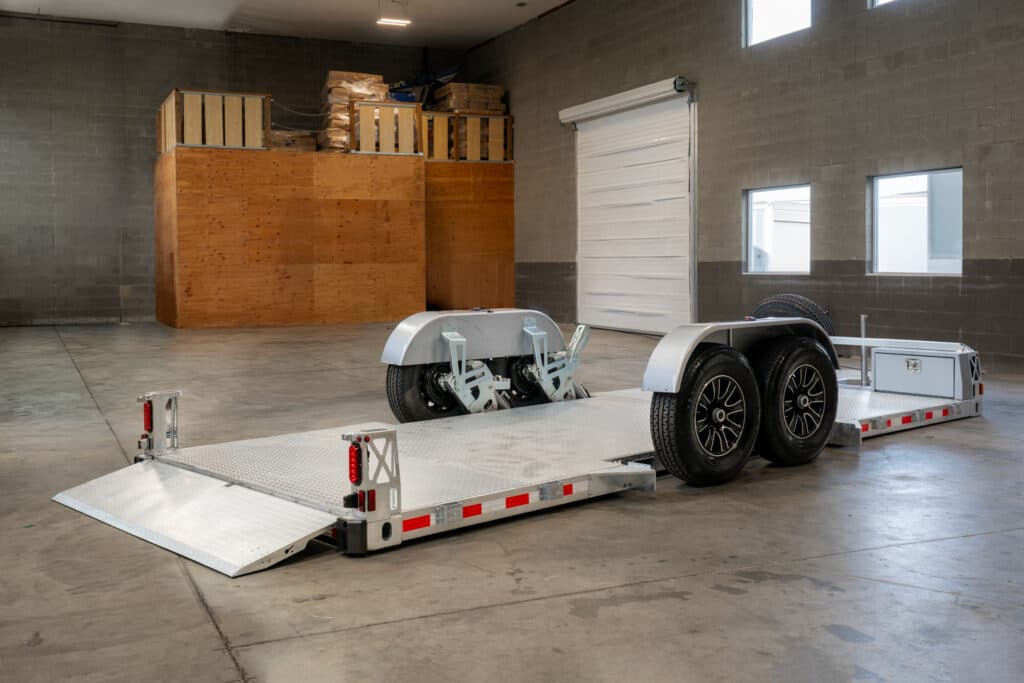
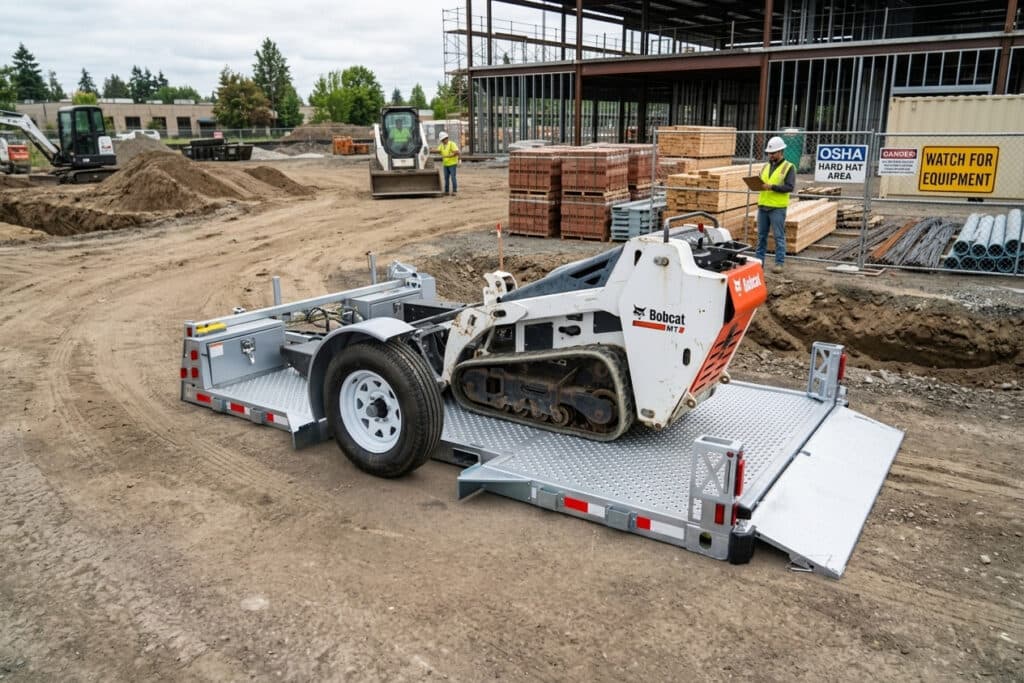
Good loading solutions should make the right way to load the only way to load. Hydraulic drop deck trailers do this by putting the trailer at ground level for drive-on or walk-on loading and unloading that does not require the operator to pay any special attention to balance or physics. There’s no need to deliver precise tire placement, or to rely on other crew members to help guide a piece of equipment on or off the trailer.
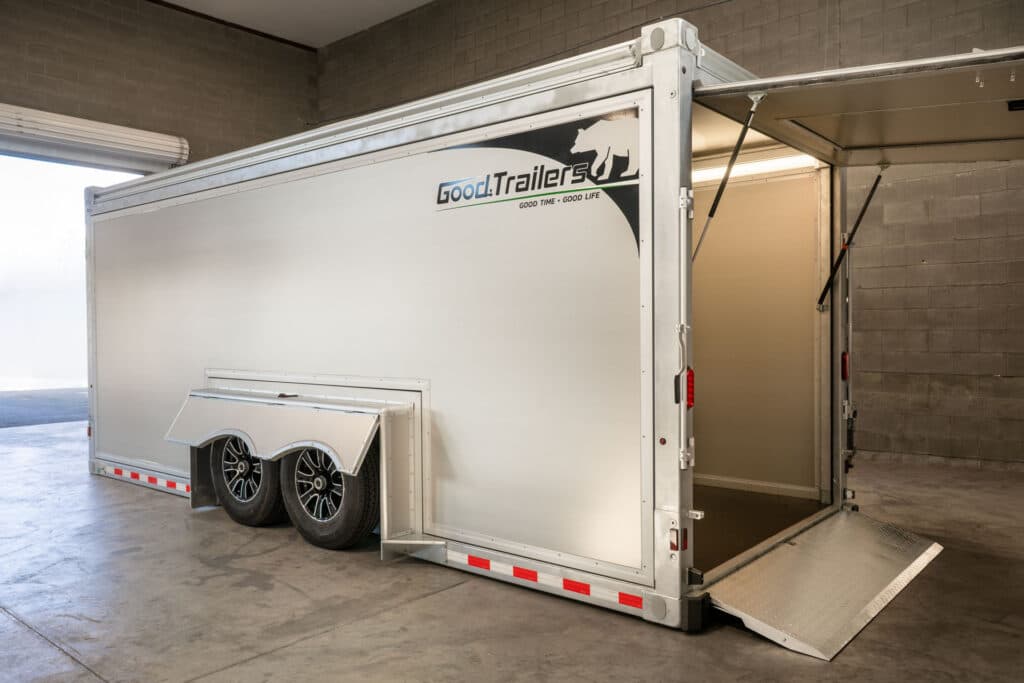
The hydraulic drop deck system on every Good Trailer works exactly the same way every time. Lower the deck to 5.4 inches. Unfold the wide 74″ ramp that covers the entire back of the trailer. Roll up the slight, 11° incline that spans just 1’10”. Position the equipment exactly where you need it to be. Secure it. Raise the deck. Hook up and haul.
By engineering predictability into the loading process, operations managers can ensure consistent execution across multiple crews, on multiple days, even if they’re tired, loading unfamiliar equipment, new, or overtaxed. Hydraulic drop deck trailers can help you create repeatable, controlled outcomes.
Protect Human & Material Capital
It goes without saying that accidents are expensive.
- Prevent just 1 instance of heavy equipment damage in one year and your trailer pays for itself.
- Prevent just 1 major injury and the trailer again pays for itself. A single significant worker injury can cause L&I premiums to spike by up to 30%, a penalty which sticks for up to 3 years.
- Damaged materials lead to lost time, job delays, unhappy clients, a reduction in your reputation, and a loss of future business. Preventing a single incident again ensures that your trailer becomes an investment and not just an expense.
Take a mid-size operation that relies on traditional trailers all year long. You start seeing massive, rolling financial leaks at work.
- Based on industry transport data and property damage averages, a typical regional outfit moving heavy equipment or industrial loads can expect to lose up to $75,000 a year in equipment damage caused by standard loading and transit mishaps.
- If a major loading dock or ramp failure occurs, that single incident skyrockets to an average of $167,000.
Some of these losses are “micro-losses” that feel small in the moment, like a ruptured hydraulic line whose replacement costs around $500. But this isn’t just an accident. It’s a constant, preventable tax on a fleet maintenance budget. Some are devastating. Bending a minor excavator arm could mean $20,000 in specialized repair bills.
Then there’s the lead-time penalty. If a specialized machine gets its undercarriage or hydraulic manifold crushed because it bottomed out on a steep ramp, an operations manager can’t just run out to the hardware store to fix it. A machine might wait weeks or months for repair while a specialized component sits on backorder. Meanwhile, you either pay a crew to stand around or pay an equipment rental company peak rates to rent a replacement.
A single drop deck trailer costs far less than any single incident will ever cost, and building a fleet of hydraulic drop deck trailers will help deliver these cost savings for years to come. It’s a sound financial investment for any fleet manager to consider.
Risk mitigation rarely sounds exciting until you start doing the math.
Ace JHAs
Do your projects require you to fill out Job Hazard Assessments (JHAs)? Then procuring hydraulic drop deck trailers essentially gives you a great answer to provide when you reach the “Hazard Identification” section.
You can note that you reduced an 18° to an 11° ramp, engineering out the primary rollover, tipover, rollbacks, and slip hazards. You give regulators exactly what they need to say yes to your project.
Demonstrate Good Faith Effort
If your company undergoes an inspection and regulators find a minor violation, drop deck trailers can save you a significant amount of money. OSHA inspectors in particular have explicit guidelines allowing regulators to grant up to a 25% reduction in fines based on good faith efforts to build a safety culture and reduce accidents on the job site.
Noting that you’ve invested in drop deck solutions because a lower center of gravity and a gentler ramp helps to minimize risky, steep loading and unloading set-ups can signal the presence of a proactive safety culture, which in turn could lower your fines.
This type of proactivity may also help you defend against a willful violation citation, instances where you as an employer are aware a danger exists but deliberately choose to do nothing. While we can’t promise hydraulic drop decks will eliminate every accident that could possibly happen, the fact that you spent capital to upgrade to drop decks to reduce that risk in the first place makes it very difficult for loading accidents or problems to be classified as “willful.” After all, you actively invested in equipment designed to help you solve the problem.
Upgrading to a lower profile deck offers permanent, auditable proof that your operation actively manages loading and unloading risks instead of leaving them to chance.
Key Takeaways
While considering your next trailer purchase, remember:
- Standardization eliminates risk. Traditional ramps introduce erratic variables like narrow tire placement and steep tilt angles. Drop-deck trailers enforce a single, repeatable, ground-level loading process across your entire fleet.
- Protect L&I premiums. Preventing just one serious loading injury can save your company from a 30% spike in L&I premiums that typically penalizes an operation for up to three consecutive years.
- Bypass lead-time penalties. Equipment damage means costly job delays and waiting weeks for backordered parts. A 5.4-inch deck height removes the steep “breakover” point that crushes low-hanging hydraulic lines and undercarriages.
- Simply Job Hazard Assessments (JHAs). Incorporating hydraulic drop decks allows safety managers to call out efforts to eliminate rollover, rollback, and slip hazards right on their JHA paperwork.
- Leverage OSHA good faith reductions. Proactively upgrading to drop-deck systems provides permanent, auditable proof that you’re investing into safety, which can help qualify your operation for up to a 25% reduction in regulatory fines.
Load Low, Haul Good
Ready to reap the benefits of proactive risk mitigation? Load and unload better when you add drop deck trailers to your fleet today!
- Call us right now at (360) 889-9789.
- Find a dealer near you.
- Click the green icon to the lower right to chat with Tow-Bot.
- Or contact us to send a message using the form below!
See also:
Hauling Palletized Goods Without a Loading Dock
Hauling Mini Excavators with Good Trailers
The 5-Minute Load: Hydraulic Drop Deck Trailers for Rental Yards
This resource was compiled by the GoodMFG® Product Team, drawing on 75 years of experience in hydraulic systems, heavy-duty transport, trailers, and modular structures.
P.S. – We build trailers every day, but we don’t run your crews. If there’s a specific logistical headache or a “field reality” we’ve missed, we want to hear about it. Help us refine the equipment that makes your day easier! Email our Marketing Lead at devan-h @ goodrv.com and let us know what we should solve next.