Undercarriage maintenance and replacement can account for up to 50% of a heavy machine’s total lifetime maintenance costs. That makes the undercarriage the single most expensive, complex, and vulnerable part of CTLs, skid steers, scissor lifts, mini excavators, and other pieces of heavy equipment.
But it doesn’t have to be that way. You just have to address the number one source of the damage. Many assume that damage comes from the dirt you dig or move. But a massive percentage of that damage occurs before the machine ever reaches the dirt. It happens right on the loading ramp.
Hydraulic drop deck trailers can help you protect the most expensive components of your heavy equipment.
table of contents
A Glance Beneath the Chassis
When a chassis gets damaged, you scrape more than the paint. What’s at risk:
- Hydraulic lines and fittings. A single deep gouge can slice a line. Result: immediate fluid loss, environmental jobsite clean-up penalties, and system contamination.
- Drive sprockets and tracks. Steel-on-steel impacts create micro-fractures. Result: accelerated track tension loss, thrown tracks in the field, and premature, multi-thousand-dollar replacement cycles for assemblies meant to last years.
- Exhaust and oil pans. Can crack. Result. Catastrophic engine oil starvation, sudden catastrophic power failure, and mandatory EPA-reportable hazardous fluid spills on your jobsite or staging area.
- Exhaust and oil pans. Can crack. Result: Catastrophic engine oil starvation, sudden catastrophic power failure, and mandatory EPA-reportable hazardous fluid spills on your jobsite or staging area.
- Drive motor casings. These can crack. Result: massive component replacement bills and weeks of critical machine downtime.
- Structural framing warps. On some machines, bent steering linkages and other components can prevent full operation of your machine. Result: severe machine dog-tracking, permanent hydraulic cylinder misalignment, and a massive drop in the machine’s eventual trade-in or resale value due to compromised structural integrity.
Escaping the Apex Trap
Traditional trailers create an inherent risk to your machine’s undercarriage.
That’s because loading a traditional trailer is really just an exercise in bad geometry. When a machine climbs a steep ramp and transitions onto a flat trailer deck, it has to pass over a sharp peak known as the apex.
If the machine has low ground clearance or a long wheelbase, it’s going to do one of two things most of the time.
If you get a high-centering or “teetering” event, the machine loses traction. The operator often has to violently rock the machine forward. The multi-ton machine suddenly “snaps” over the peak and slams down onto the trailer deck. This is a recipe for expensive damage.
If your machine bottoms out, the underbelly drags right over the apex, forcing the entire weight of the machine on the most delicate components.
You’re essentially moving several tons up a steep mountain peak to get to a flat stretch.
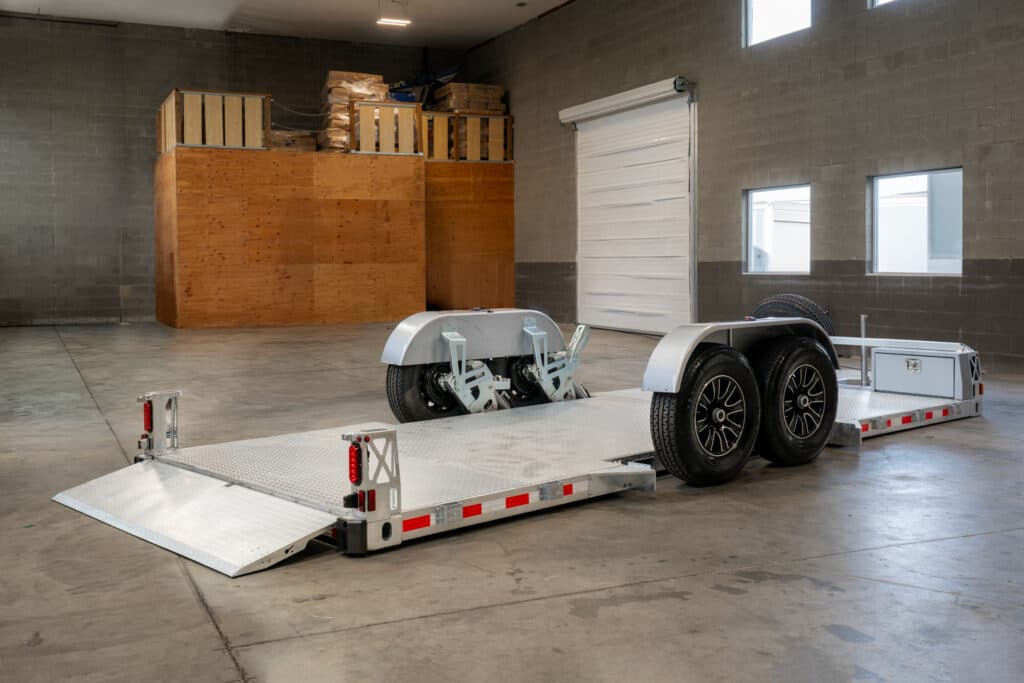
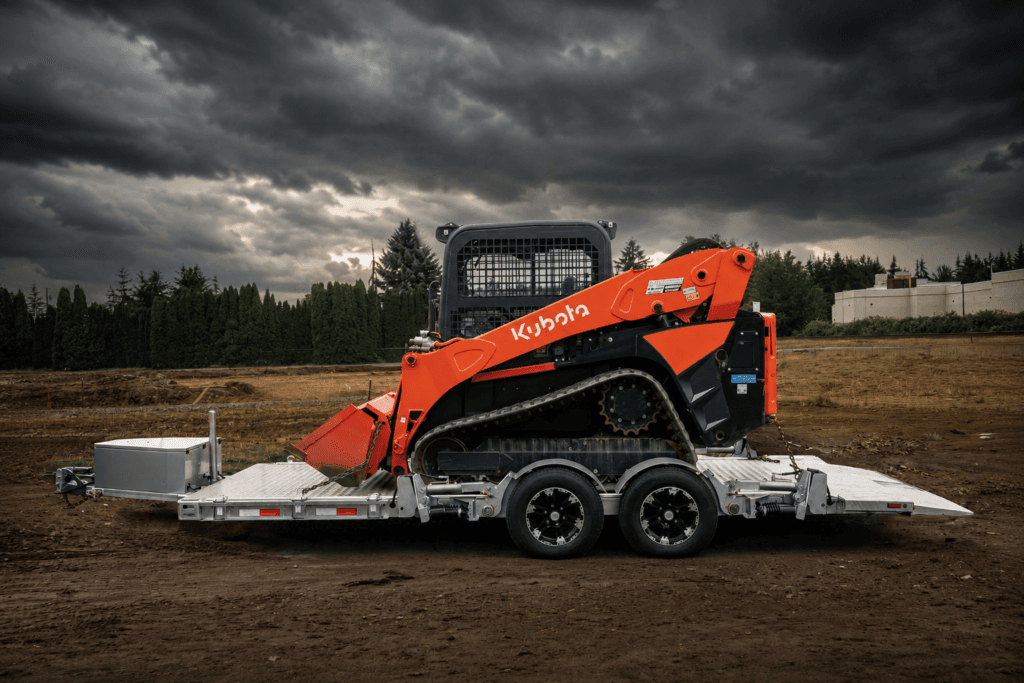
Now consider what happens when you use a hydraulic drop deck trailer instead. The approach and breakover angles are essentially flattened down to nothing. The machine glides seamlessly onto the deck. No apex, no teetering, no spinning tracks, and zero contact between the undercarriage and the steel frame.
A Better Way to Load & Unload
Because hydraulic drop deck trailers lowers the entire trailer belly flat to the ground while putting the deck at just 5.4-inches high, the approach and breakover angles are reduced to a near-flat, single digit gradient.
You drive over a 74-inch wide, 11° angle ramp that is just 1’10” long, instead of the traditional split ramps that require precise placement because they do not cover the entire back of the trailer.
Teetering, high-centering, and bottoming out become far less likely. So are other issues, like rolling backwards as you try to get up the ramp, or tipping.
By the Numbers
Industry data shows that undercarriage maintenance accounts for more than 50% of a machine’s lifetime repair tab. A mid-sized operation running a few CTLs or mini excavators usually budgets 10% to 15% of each machine’s value annually for maintenance.
For a $75,000 skid steer, that’s roughly $7,500 to $11,250 per year, per machine, with half of that going to rollers, tracks, sprockets, hydraulic lines, and the rest of the undercarriage.
That places the cost of one loading incident around $1,500 to $5,000 in parts, labor, and emergency jobsite downtime.
Because a hydraulic drop deck reduces the loading angle so dramatically, it effectively reduces loading-related undercarriage damage by up to 90%.
At current MSRPs, you see complete ROI in less than 16 months, and every year after that, the trailer starts making the company money. If you purchase 5-10 trailers to standardize regional operations, you see increased ROI due to operational uniformity. Every single load-out becomes identical. Human error drops to near-zero.
Key Takeaways
If you’re thinking about upgrading your trailer fleet this year, remember these important takeaways.
- The 50% maintenance sink. Undercarriage components represent up to half of a heavy machine’s total lifetime repair expenses. Protecting this single area drastically stabilizes fleet operational budgets.
- Defeat the apex trap. Traditional trailers force multi-ton CTLs and scissor lifts over a sharp geometric peak, causing low-clearance underbellies to high-center, lose traction, or slam violently down to the deck.
- Isolate vulnerable components. High centering doesn’t just scratch the paint job. It cracks drive motor casings, slices hydraulic fittings, warps steering linkages, and ruptures engine oil fans.
- The single-digital gradient. By dropping the trailer chassis completely flat to the ground, a Good Trailer replaces steep incline mountains with a gentle 11° ramp and an ultra-low 5.4-inch deck height.
- Proven financial ROI. When a single loading incident costs between $1,500 and $5,000 in parts, labor, and emergency downtime, standardizing a fleet with hydraulic drop decks delivers complete capital return in less than 16 months.
Load Low, Haul Good
- Call us right now at (360) 889-9789.
- Find a dealer near you.
- Click the green icon to the lower right to chat with Tow-Bot.
- Or contact us to send a message using the form below!
See also:
Risk Mitigation on the Ramp: Seamless Loading & Unloading Solutions
How to Choose the Best Trailer for Kubota Equipment
Moving Heavy Toolboxes Safely: The One-Operator Solution
This resource was compiled by the GoodMFG® Product Team, drawing on 75 years of experience in hydraulic systems, heavy-duty transport, trailers, and modular structures.
P.S. – We build trailers every day, but we don’t run your crews. If there’s a specific logistical headache or a “field reality” we’ve missed, we want to hear about it. Help us refine the equipment that makes your day easier! Email our Marketing Lead at devan-h @ goodrv.com and let us know what we should solve next.