Owning a Kubota means you’ve invested in world-class engineering, but finding the best trailer for Kubota hauling can be a challenge factory specs don’t fully solve.
The biggest risks when moving a nimble KX mini-excavator or a heavy duty SVL track loader isn’t the highway. It’s the loading ramp.
Standard high-angle ramps turn a routine equipment move into a high-stakes balancing act of risk. You could tip it. You could scrape the undercarriage. You could pay thousands of dollars in repairs, to say nothing of the injuries your operator could sustain.
Here’s how you find a trailer that matches the quality of your Kubota while making “breakover anxiety” a thing of the past.
This post covers general Kubota construction equipment. We also did an in-depth post on hauling Kubota tractors you might find interesting.
table of contents
Ground-Level Loading for Kubota Equipment
For most operators, loading Kubota equipment feels like the world’s most dangerous circus act. You’re either using a small ramp that covers maybe 1/3 of the trailer back, or a pair of ramps. Both sit at a high angle.
Nearly every piece of Kubota equipment has a center of gravity that makes it vulnerable to tipping under certain conditions…and pushing it up a 6-foot 15° to 18° angle to a 16-inch (or higher) deck height is likely to create those conditions.
The most dangerous part of the process is the breakover point: the exact second the machine’s weight shifts from standard trailer ramps to the trailer bed.
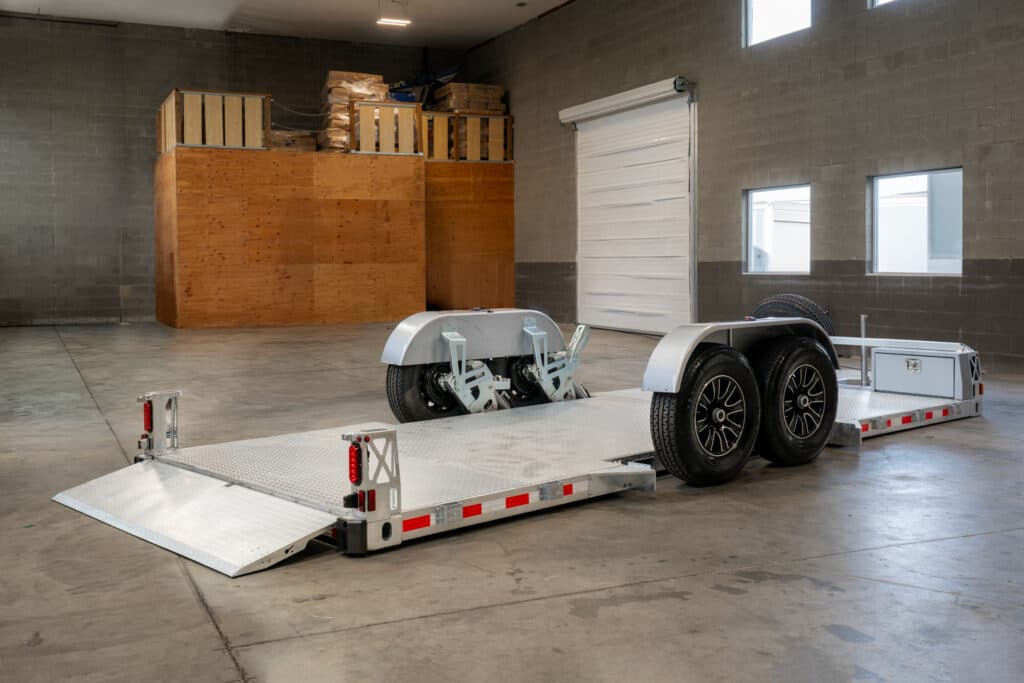
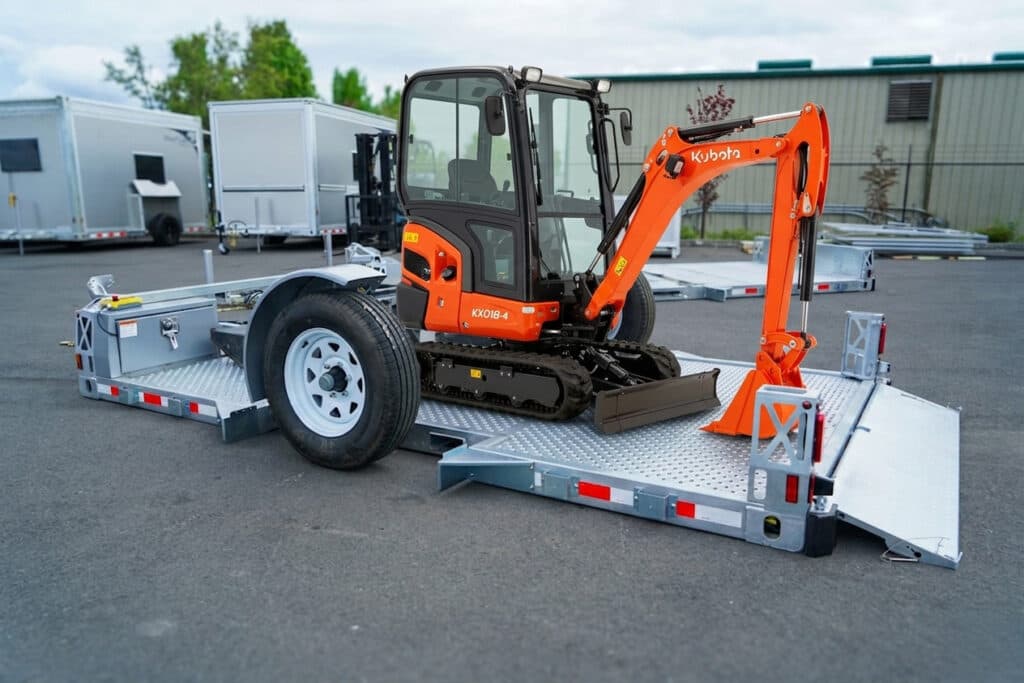
When you embrace hydraulic drop deck technology, you get to bring the trailer all the way down to the ground. You are dealing with a 1’10” 11° angle ramp that covers the entire back of the trailer. You’re traveling up to a deck height of 5.4-inches. This completely eliminates the climb.
You get a transition instead. Because the deck is so low, your machine’s tires or tracks are on the trailer deck before the rear tires have even left the ground. This keeps the machine level across the transition.
No tipping risks. Less risk of scraping up your undercarriage. No huge damage and repair bills. Your operators breathe easier, load faster, raise the deck, and hit the road quick.
Built for the Long Haul
Most Kubota owners want a trailer that’s prepared to last as long as their equipment does.
Many trailers are flimsy things, meant to last only a few years.
Our flatbed trailers are built on hot-dipped galvanized steel frames for rugged, long-lasting performance.
Which Good Trailer is Right for Your Kubota Equipment?
To figure out which trailer is right for your equipment, you need to know a little bit about Kubota naming conventions.
The numbers in a Kubota model’s name generally correspond either to the weight in metric tons or to horsepower, which can hint at the weight of the machine. Therefore, higher numbers are heavier or lower numbers are lighter. Using the charts below, you’ll be able to ascertain the highest series number you can make for each type of flatbed trailer in our lineup.
While our 7K GVWR trailers will haul many Kubota, our 11,800 GVWR model is better suited for the heaviest options.
What can you haul with the GT13FL?
- Excavators: Up to KX018-4.
- Track Loaders: None.
- Skid Steers. None.
- Stand-On Loaders: Up to SCC1000.
- Wheel Loaders: None.
- Tractors: Anything in the BX series.
- Backhoes: None.
What can you haul with the GT19FL?
- Excavators: Up to KX040-4.
- Track Loaders: Up to SVL75-3.
- Skid Steers: Up to SSV75.
- Stand-On Loaders: All Models.
- Wheel Loaders: Up to R430.
- Tractors: Anything in the L-Series.
- Backhoes: Up to L47.
Caveats:
Remember attachments and wheel filler can add weight. Always verify the total weight of your specific model and haul and compare it to the carrying capacity of your trailer. Note the interior dimensions of your trailer as well: some Kubota equipment becomes too long for the trailer when paired with some attachments.
Key Takeaways
If you remember nothing else, remember:
- Transition, don’t climb. Ground-level loading at a 5.4-inch deck height eliminates the dangerous “breakover” point, keeping your machine level and preventing tip-over accidents.
- Decode your Kubota. Use model numbers as a guide—Kubota naming usually reflects horsepower or weight in metric tons. This helps you quickly estimate which trailer capacity you need.
- Model compatibility. The GT13FL is ideal for BX-series tractors and small excavators (up to KX018-4) while the GT19FL is required for heavy-hitters like the SVL75-3 track loader and L-Series tractors.
- Built for longevity. GoodMFG® trailers use hot-dipped galvanized steel frames to ensure your trailer lasts as long as your Kubota, resisting rust and structural fatigue.
- Don’t forget the “extras.” Always account for the weight of attachments, cab upgrades, and tire fluid. These “hidden” weights can require a trailer with a higher carrying capacity.
Get Ground-Level Loading for Your Kubota
Protect the Orange with ground-level loading.
- Call us right now at (360) 889-9789.
- Find a dealer near you.
- Click the green icon to the lower right to chat with Tow-Bot.
- Or contact us to send a message using the form below!
See also:
Hauling Mini Excavators with Good Trailers
Moving Scissor lifts with Good Trailers
This resource was compiled by the GoodMFG® Product Team, drawing on 75 years of experience in hydraulic systems, heavy-duty transport, trailers, and modular structures.
P.S. – We build trailers every day, but we don’t run your crews. If there’s a specific logistical headache or a “field reality” we’ve missed, we want to hear about it. Help us refine the equipment that makes your day easier! Email our Marketing Lead at devan-h @ goodrv.com and let us know what we should solve next.