There’s a world of difference between towing a small utility trailer and hauling a large piece of heavy equipment at highway speeds. When you’re out on the Interstate, physics becomes a far less forgiving partner. Every bump gets magnified. Every lane change becomes a test of your equipment’s stability.
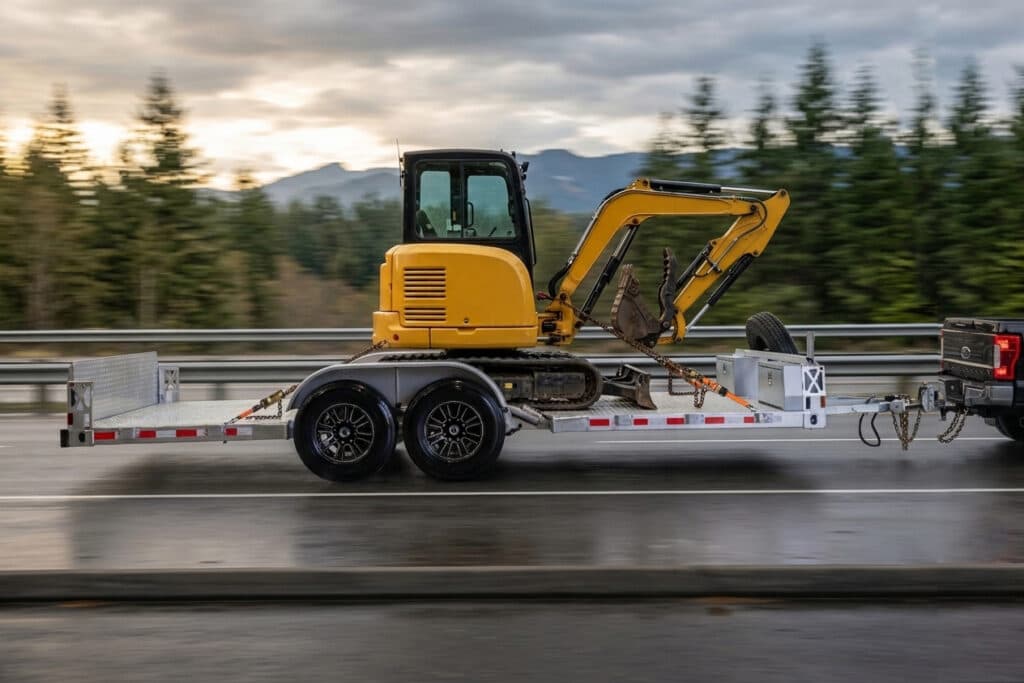
Fortunately, there are some steps you can take to make highway hauling easier and safer. Some would be true for any trailer you might use. Others are solutions that Good Trailers by GoodMFG® provide to construction companies, equipment rental companies, and others who might need to drag a scissor lift or mini excavator down the highway at roughly 60 mph.
table of contents
Highway Hauling: Challenges
Hauling heavy equipment presents four key challenges at highway speeds.
- Fishtailing. Trailer sway, also known as fishtailing, is the #1 killer on the highway. High speeds, crosswinds, and sudden steering adjustments can cause a trailer to oscillate. If the trailer’s center of gravity is too high, or the weight is too far back, this motion can get worse and worse until it flips your truck.
- Brake fade. Heavy equipment can double or triple your stopping distance while putting an enormous amount of strain on your brakes. On long descents, constant braking can cause the pads to overheat, which in turn destroys their ability to create friction…sometimes with deadly results.
- Tire blowouts. Hauling heavy loads at high speeds creates immense heat in tire sidewalls. A blowout at 60 mph with a 5,000 lbs. load is a catastrophic event. Push it up to 70 mph, and you’ve got a guardrail-destroying rollover on your hands.
- Shifting cargo. Some trailers are just downright hard to load right (but not ours, see below). If a piece of heavy equipment isn’t perfectly centered, that “off-center” load can pull the truck toward the ditch at high speeds.
Highway Hauling: The Position Advantage
Steep, shaky, high-angle ramps can limit where you position your machine. If you can’t get the machine to sit far enough forward because of the ramp hinge, you end up with a tail-heavy weight distribution that can create real problems once you’re hauling at speed.
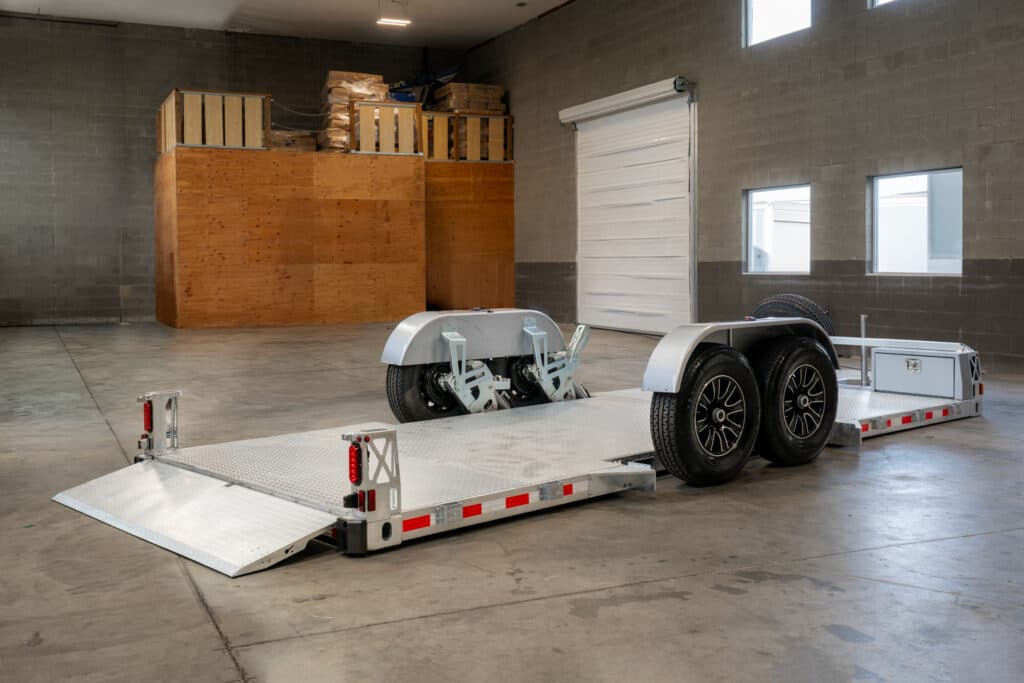
Since Good Trailers use patented hydraulic drop-deck technology to drop to the ground, you can maneuver the equipment into position with ease, placing it right where it needs to be to achieve the 60/40 weight distribution that keeps you safest on the road. You always want 60% of the weight in front of the axle in order to prevent fishtailing.
Hauling & Energy Management
Hauling heavy equipment at speed means generating a great deal of kinetic energy. You don’t want a frame that flexes, you want one that can absorb the force.
Good Trailers are built on robust galvanized steel chassis that act as single units. When you hit a pothole in a cheap trailer, it wobbles and bounces. When you hit the same pothole in a high-quality Good Trailer, it absorbs the energy through the suspension, not the frame.
Additional Tips for Safer Highway Hauling
The posted speed limit is not the speed limit you should be worrying about. Your trailer has a speed limit of its own.
Most trailer tires are only rated for 65 mph. And even in a top-tier Good Trailer, exceeding the tire’s speed rating is a fast way to a big blow-out.
Here in Washington State, 60 is the usual speed limit, which means drivers are often moving well below what the tires can take. Nevertheless, you should always check your tire rating…and slowing down while hauling anything, especially anything that is big and heavy, is almost always one of the best safety tips you can embrace to get you and your equipment safely to your job site.
Key Takeaways
If you remember nothing else, remember:
- The 60/40 rule. To prevent fishtailing, always position your equipment so that 60% of the total weight is forward of the trailer axis.
- Respect the tire rating. Most trailer tires are speed-rated for 65 mph. Exceeding this limit causes excessive heat build-up, leading to catastrophic blowouts.
- Fight brake fade. Heavy loads can triple your stopping distance. Use your engine to help you slow down on long descents, ensuring your brake pads don’t overheat and cause friction.
- Galvanized strength. A robust, hot-dipped galvanized steel chassis absorbs road energy through the suspension rather than the frame, protecting both the trailer and your equipment from vibration damage.
Load Low, Haul Good
Ready for easier highway hauling?
- Call us right now at (360) 889-9789.
- Find a dealer near you.
- Click the green icon to the lower right to chat with Tow-Bot.
- Or contact us to send a message using the form below!
See also:
Moving Scissor Lifts with Good Trailers
The 5-Minute Load: Hydraulic Drop Deck Trailers for Rental Yards
Hauling Mini-Excavators with Good Trailers
This resource was compiled by the GoodMFG® Product Team, drawing on 75 years of experience in hydraulic systems, heavy-duty transport, trailers, and modular structures.
P.S. – We build trailers every day, but we don’t run your crews. If there’s a specific logistical headache or a “field reality” we’ve missed, we want to hear about it. Help us refine the equipment that makes your day easier! Email our Marketing Lead at devan-h @ goodrv.com and let us know what we should solve next.