Every day a trailer sits on your lot, it gets a little dustier and a lot more expensive.
Once a unit crosses that 90-day threshold, floorplan interest starts aggressively chipping away at your hard-earned margins. “Lot rot” means cash, leaving your pocket, often at an alarming rate.
The problem isn’t your sales team. The problem is saturation. The market is flooded with identical, generic utility trailers that force you into a race to the bottom. To beat the clock and protect your bottom line, you don’t need to hoard more of the same stock. You need specialized, high-velocity inventory that solves urgent problems for your buyers.
Table of Contents
- Commodity Traps
- Ground-Level Game Changers
- The Early Adoption Advantage
- FAQ
- Key Takeaways
- Cure Lot Rot: Apply Today
Commodity Traps
Tired of competing on price with the guy who’s right down the road? In a world where growing customer loyalty seems impossible and where digitally-savvy buyers are searching for every trailer within a 100-mile radius just to save $50 on price, you may feel stuck in a race to the bottom that never truly ends. You get lot rot, since the inventory just sits there while customers hunt for bargains.
To the average buyer, 99% of the trailers on the market look exactly the same. When products are identical, the only differentiator is price, leaving you stuck in a race to the bottom that destroys your margins and guarantees lot rot headaches.
Worse yet, these standard trailers come with built-in operational headaches for your most lucrative customers. Large-scale buyers like rental yards, heavy equipment operators, and commercial delivery fleets all struggle daily with the hidden costs of traditional transport.
But when you add premium drop decks to your lot, you start selling more than a trailer. You sell saved labor costs, reduced accident rates, and competitive advantages. You even shift your customer base from DIYers in search of a bargain to commercial clients ready to pay a premium for the right solution.
Drop deck trailers fight lot rot by offering these solutions:
- The loading dance. Slow, multi-crew loading processes that burn billable hours.
- The breakover apex. Prevents low-clearance scissor lifts and delicate machinery from scraping their undercarriages on the load or high-centering at the ramp peak.
- High-risk angles. Steep ramp inclines that cause low-clearance equipment (like scissor lifts) to high-center or slip. On a Good Trailer, the 11°, 74.4″ wide and 22″ long spring assisted ramp eliminates the terrifying 16° to 25° ramp angles that cause track machines to slip and slide during wet weather.
- Liability & damage. Expensive accidents damage both precious machinery and a company’s bottom line.
- Labor hour drains. Converts slow, stressful, multi-man loading drills into a simple drive-on task that a single operator can handle alone.
GoodMFG® trailers change the conversation entirely. They aren’t sitting on every competing lot within a 50-mile radius. More importantly, they solve every one of these commercial pain points at the touch of a button, instantly transforming a routine equipment purchase into a critical operational solution.
Ground-Level Game Changers
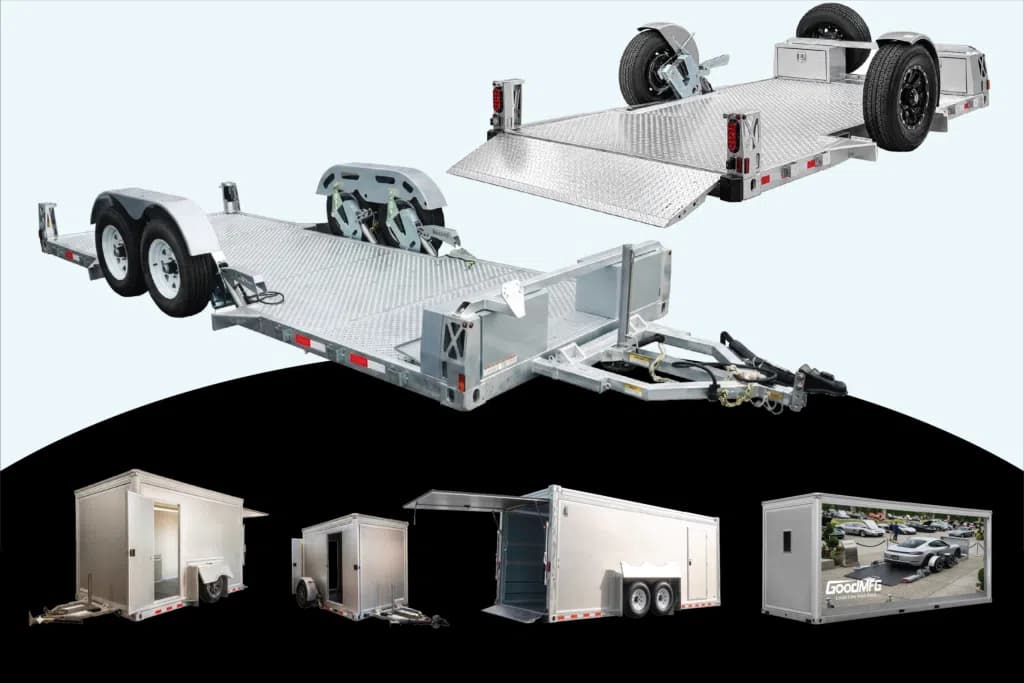
GoodMFG® hydraulic drop deck trailers eliminate steep ramps entirely by lowering the deck flat to the ground at the touch of a button. Depending on the model, the deck drops to a ground clearance of just 5.4 inches, then effortlessly lifts back up to a standard 16- to 18-inch transport height once loaded.
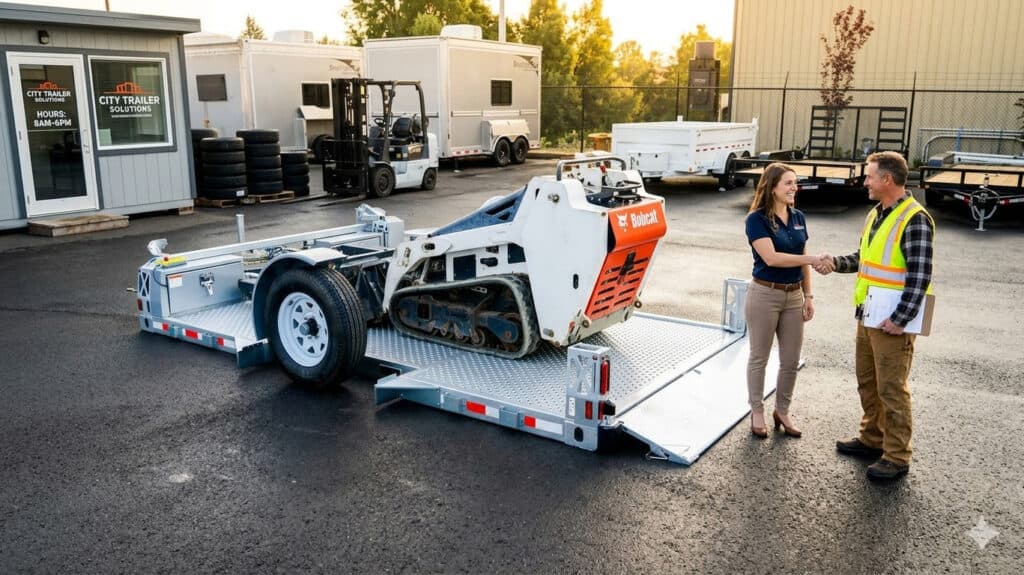
Equipped with an integrated 22-inch, 11-degree, 74″ spring-assisted fold-out ramp, operators can smoothly drive equipment straight onto the deck. It’s easy to carry everything from low-clearance scissor lifts to mini-excavators and forklifts. Moving palletized materials? Crews can load them right on board using a standard pallet jack or hand truck. They secure the load, raise the deck, and hit the road.
The entire process takes less than five minutes.
What This Means for Your Dealership’s Bottom Line
This level of utility shifts your primary customer base from low-margin hobbyists to high-intent B2B buyers. While individual consumers love the convenience, commercial fleets are the ones driving the demand.
Commercial buyers don’t “window shop” for hydraulic drop decks. They are actively hunting for solutions to:
- Slash loading times. Turning a multi-man loading job into a one-man, 5-6 minute task.
- Mitigate liability. Drastically reducing workers’ comp (L&I) claims and expensive equipment damage from ramp slip-offs.
- Boost fleet efficiency. Getting crews off the roadside and back to billable work faster.
Because these buyers are solving an expensive operational problem, they buy quickly. For your dealership, that tends to translate directly into faster lot velocity.
It’s a simple equation: GoodMFG® trailers are a premium, specialized solution, not a commodity. That means you can command healthier margins per unit, giving your business the breathing room it needs against lot rot.
The Early Adopter’s Advantage
We won’t mince words here. We’re still growing our dealer network.
But that’s actually an advantage for you.
- You’ll be first in your market, and you won’t have any other competitors selling similar trailers in your vicinity. Compare this experience to working with brands that have saturated the market, creating a situation where two dealers with two identical products sit within 15 minutes of one another.
- You get to work with an agile, responsive manufacturer that offers direct communication and a commitment to helping our dealer network establish local market dominance.
- You get extensive marketing support to help you position Good Trailers within your local market.
FAQ
What type of equipment can be loaded onto a GoodMFG® drop deck trailer?
The deck drops to just 5.4″ and has an 11°-fold-out ramp. This means these trailers can easily handle low-clearance equipment like scissor lifts, mini-excavators, and forklifts, as well as palletized cargo using standard hand trucks or pallet jacks.
How fast is the hydraulic lowering and lifting process?
The entire ground-flush lowering, loading, and lifting sequence can be executed by a single operator in under five minutes.
How do GoodMFG® trailers help dealers reduce inventory “lot rot”?
Unlike generic utility trailers that sit over 90 days accumulating floorplan interest, these specialized trailers solve immediate operational problems for B2B buyers, driving faster sales velocity and higher margins.
Key Takeaways
Still not sure whether you want to cure lot rot by becoming a GoodMFG® dealer? Consider these key takeaways.
- Commodities accelerate lot rot. Over-saturated, generic inventory forces dealers to compete solely on razor-thin margins while floorplan interest ticks away.
- Drop decks solve real world problems. Frame the sales conversation around concrete problems: steep loading hazards, breakover undercarriage damage, and excessive multi-man labor drains.
- Commercial demands drive turn rates. B2B buyers don’t haggle over small price details when a trailer saves them $18,000 a year in crew labor and eliminates expensive undercarriage damage.
- Ground flush utility sells itself. A trailer that lowers all the way to the ground, placing the deck at just 5.4″, as well as an 11° fold-out ramp, turns a tedious multi-man loading routine into a 5-minute solo task.
- Change the sales conversation. Stop defending your margins. Ask diagnostic questions that prove how a premium drop deck pays for itself over time.
- Join early. Become one of the first and only Good Trailer dealers in your local area.
Cure Lot Rot: Apply Today
When you stock standard trailers, you mostly attract one-time, price-sensitive customers who are themselves feeling the pinch of rising prices. You get residential buyers, weekend warriors, and small-scale DIYers. While these buyers can keep your lot busy, they usually don’t offer a lot of repeat business and tend to lack brand loyalty.
When you transition a portion of your inventory to premium drop deck trailers, you unlock a new, high-value target audience: B2B commercial clients who are shopping for their livelihood. Examples include:
- Commercial landscapers and hardscapers who move heavy mowers and stone pallets all day.
- Contractors who transport low-clearance scissor lifts, trenchers, and delicate floor-finishing materials safely.
- Industrial technicians and utility companies that need to transport heavy, fragile assets like $75,000 inverters or solar battery banks.
- Farmers who need to haul tractors, or who need to create mobile in-field workstations.
Commercial customers do not care about a $50 price difference. They care about downtime, safety, liability, and efficiency. If your status as a GoodMFG® dealer lets them shave 20 minutes off every loading cycle while keeping their drivers safe from loading accidents, they will happily pay a premium to do business with you. Best of all, once a commercial client trusts your equipment, they will continue to return to you as they build out their fleet and purchase maintenance services. Often, they’ll continue to do this for years.
Ready to explore the advantages of becoming a GoodMFG® dealer? Call us right now at (360) 889-9789.
See also:
The Top 4 Advantages of Trailers that Lower to the Ground
Good Trailer Buyers’ Guide: Which Good Trailer is Right for You?
This resource was compiled by the GoodMFG® Product Team, drawing on 75 years of combined experience in hydraulic systems, heavy-duty transport, trailers, and modular structures.
P.S. – We build trailers every day, but we don’t run your crews. If there’s a specific logistical headache or a “field reality” we’ve missed, we want to hear about it. Help us refine the equipment that makes your day easier! Email our Marketing Lead at devan-h @ goodrv.com and let us know what we should solve next.