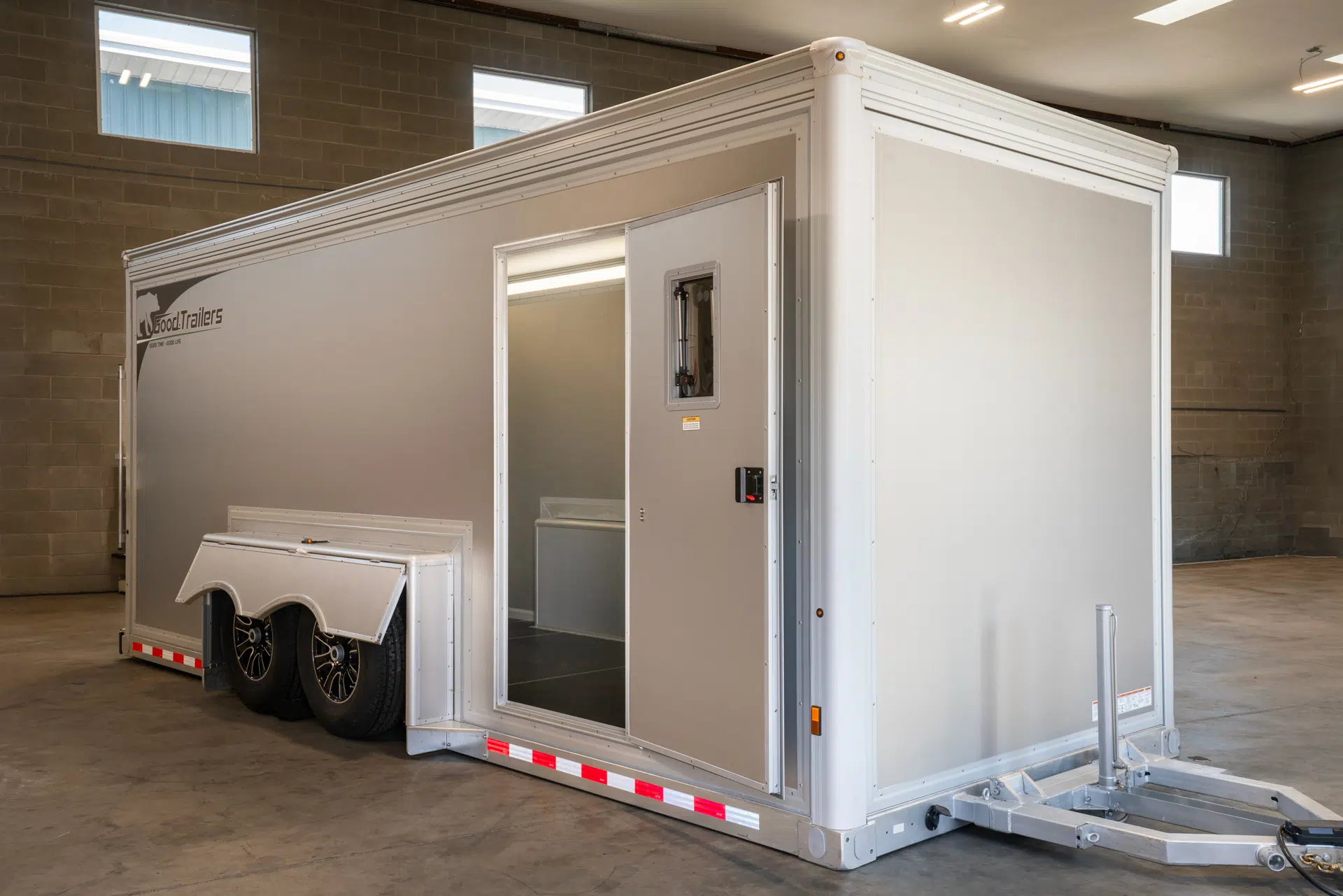
Many customers tell us they want zero degree trailers.
We get it. Ramps are awful.
But zero degree trailers are an impossibility. At least, here on Earth. Unless a trailer deck can physically merge with the asphalt, a true 0° angle violates geometry. If someone is claiming to sell you a zero degree trailer, you might want to take a pass, because they’re just not telling you the truth.
Technically, a true 0° loading experience is possible… if you happen to be hauling heavy machinery in low Earth orbit.
(As our design team points out, microgravity really takes the bite out of loading angles.)
Ramps exist because they span the height difference between the ground and the trailer deck. There is always going to be some manner of height difference. The deck has to sit above the road surface to clear tires and axles, and an angle must exist to bridge the gift.
We’d never claim we sell zero degree trailers. We can tell you what you can get instead: a ground-level loading experience that lets you feel like you’re working with a zero degree trailer. Because the real goal isn’t zero degree loading. It’s near-zero effort. Near-zero friction. And low risk.
Table of Contents
- Ground-Level Loading
- How to Choose the Right Low-Incline Trailer
- FAQ
- Zero Degree Trailers: Key Takeaways
- Say Good-bye to Standard Trailer Ramps
Ground-Level Loading
Standard equipment trailers often feature aggressive 16° to 25° ramp angles. These steep slopes create major operational hazards.
Examples:
- Scissor Lifts. Low ground clearance causes the undercarriage to high-center and scrape at the breakover point.
- Skid steers & mini excavators. High centers of gravity cause nerve-wracking tipping sensations during entry.
- Tractors. It’s easy to lose traction on steep metal ramps, especially in wet or muddy conditions.
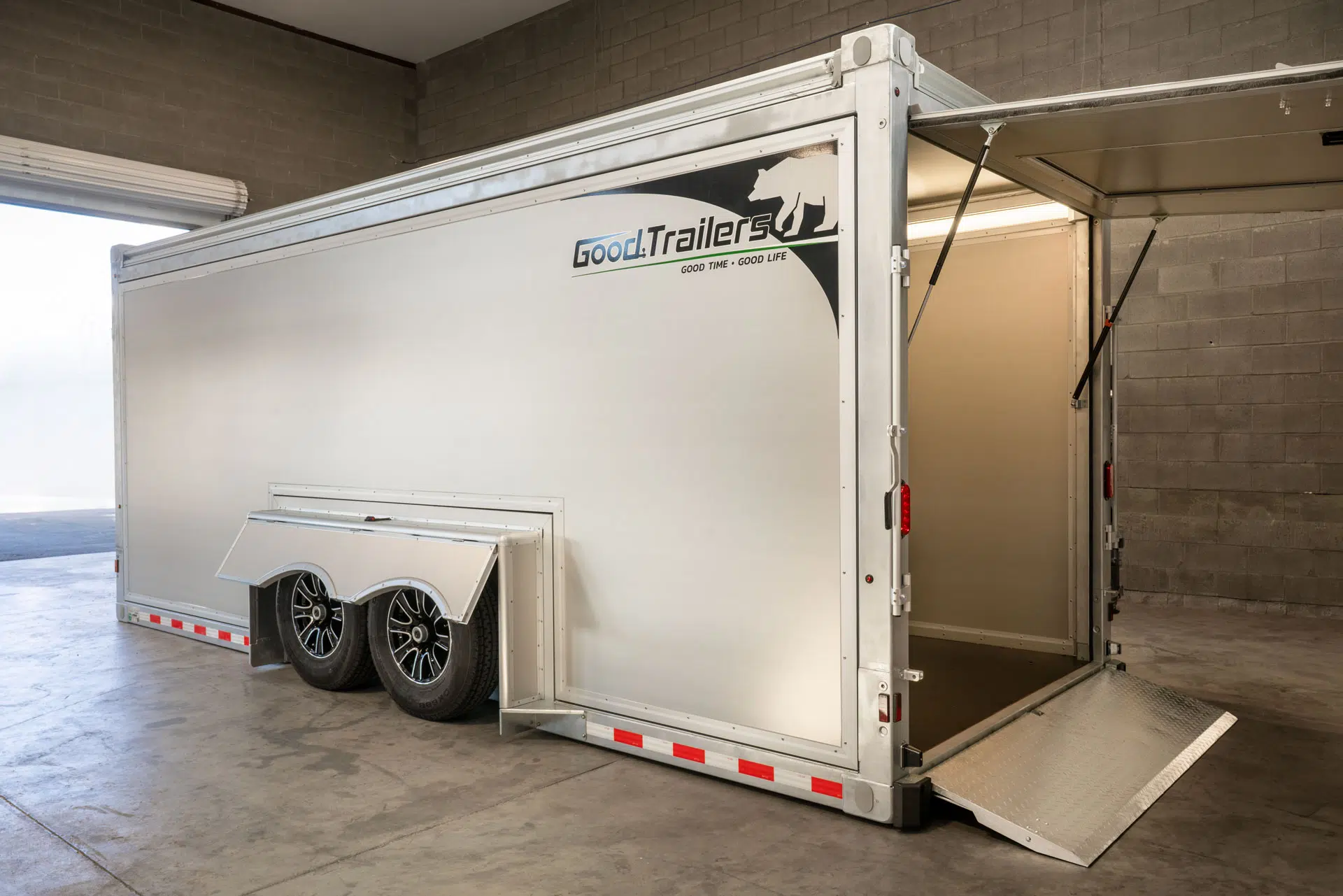
GoodMFG solves this by dropping the deck down to ground level and pairing it with a different ramp. Instead of a pair of narrow planks that sit at a steep angle, you get a 74.4” wide short ramp at 22”. It sits at a gentle 11° angle to bridge the gap between the ground and the 5.4” deck height that you achieve when you lower the trailer all the way to the ground. (You raise the trailer back to a normal transport height when the loading is done).
This angle is low enough and gentle enough to roll low-clearance scissor lifts and heavy machinery on and off the trailer without scraping, tipping, or high-speed momentum.
How to Choose the Right Low-Incline Trailer
To select the best low-incline trailer for your fleet, evaluate three core specifications.
- Lowered deck height. Look for 6” or lower when the chassis is brought flat to the ground.
- Look at ramp height and width. The ramp angle is important, but so is the ramp height and width. If you’re tired of the high-wire act, then you’ll want a ramp that spans the entire back end of the trailer. If you want a load-out experience that’s as gentle as moving from the street to a gentle driveway, then a short, gentle ramp is the way to go.
- Hauling capacity. Obviously low-angle loading doesn’t do much good if you can’t load the gear you want to load. Compare the carrying capacity of the trailer with the gear you’re trying to haul.
It’s not possible to haul all equipment with drop deck trailers. Some equipment may require heavy duty options. Always check the weight of the objects you’re trying to haul, as well as the width and length of your gear.
FAQ
What is a zero degree trailer?
It’s mostly a marketing term that people use when they mean a ground-level loading drop deck trailer. To create true zero degree trailers you’d have to have something with no loading incline. In reality, drop deck trailers are as close as you can get without violating the laws of physics, allowing you to achieve a loading surface that sits flat on the ground, but which still requires a small incline to get from the ground to the deck.
Which is closer to a zero degree loading experience, a drop deck trailer or a tilt trailer?
A tilt trailer isn’t a zero degree trailer either. Moreover, they present some risks when compared to drop decks. Hydraulic drop deck trailers eliminate the sudden shift in weight and the tipping hazards associated with steep ramps.
Key Takeaways
What’s the TL;DR on this zero degree trailer thing?
- True 0° trailers violate the laws of physics. They don’t exist. However, ground-level trailers deliver the same practical benefits.
- Steep ramp angles cause high-centering and tipping risks when moving heavy equipment.
- Good Trailers by GoodMFG° use ground-level lowering technology and 22” ramps to deliver an easy 11° entry angle. You also get a ramp that encompasses the entire back of the trailer.
- Near-zero operational stress. Lowering flat to the ground turns a hazardous, multi-person loading operation into a safe, single-operator task.
Say Good-bye to Standard Trailer Ramps
Stop fighting dangerous inclines, ruined undercarriages, and slippery ramps. GoodMFG® ground-level trailers give you the flat, low-stress loading experience your crew needs. Find your nearest dealer or contact us for options today!
See also:
Drop Deck Trailers vs. Liftgate Trucks
Drop Deck Trailer vs. Tilt Trailer: Complete Comparison Guide
Hydraulic Drop Deck Maintenance: Because Nobody Has Time for Breakdowns
This resource was compiled by the GoodMFG® Product Team, drawing on 75 years of combined experience in hydraulic systems, heavy-duty transport, trailers, and modular structures.
P.S. – We build trailers every day, but we don’t run your crews. If there’s a specific logistical headache or a “field reality” we’ve missed, we want to hear about it. Help us refine the equipment that makes your day easier! Email our Marketing Lead at devan-h @ goodrv.com and let us know what we should solve next.