Drop deck trailers vs. tilt trailers: which should you choose?
When comparing drop deck trailers vs. tilt trailers, the better choice depends less on which technology is “best” and more on what you haul, where you load it, and how often you repeat the process.
Both designs solve the same basic problem:
How do you get equipment from the ground onto a road-going trailer without relying on long removable ramps?
They just solve it differently.
A tilt trailer angles some or all of its deck toward the ground for loading.
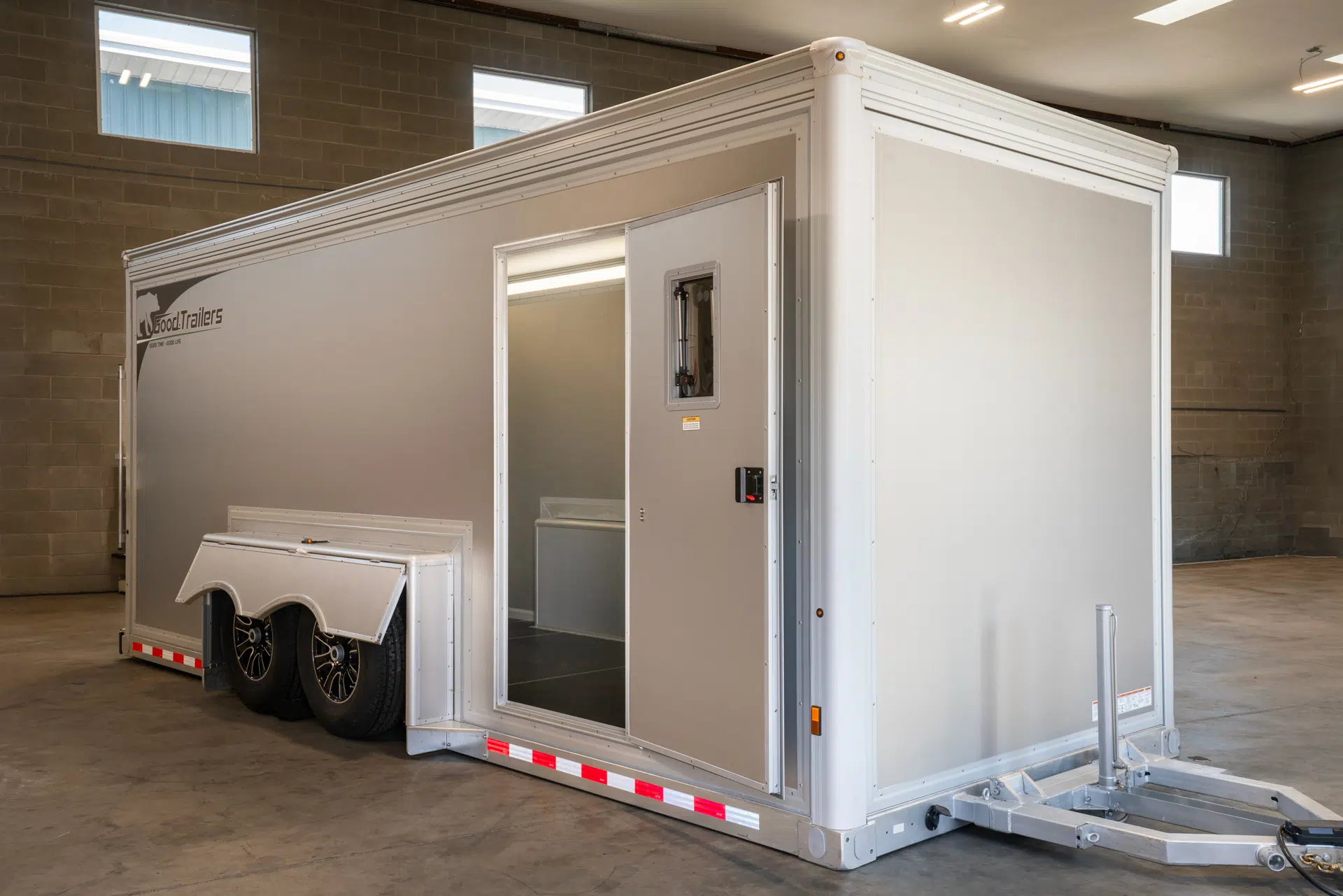
A GoodMFG® hydraulic drop deck lowers the trailer chassis to the ground while keeping the primary deck level. The deck surface sits 5.4 inches above the loading area, and a short 22-inch ramp handles the remaining transition.
For some equipment and workflows, a tilt trailer is an excellent answer.
For others, keeping the load deck level while bringing it closer to the ground can be a meaningful advantage.
Here’s how to decide.
Table of Contents
How Tilt Trailers Work
There is no single tilt-trailer design.
Common configurations include gravity tilt and powered hydraulic tilt systems, and trailers may use either a full tilting deck or a combination of stationary and tilting deck sections.
A gravity tilt trailer uses a pivoting deck and the position of the load to change the deck angle. Many current gravity-tilt designs still use a hydraulic cushion cylinder or similar system to control the rate of deck movement.
With a powered tilt, hydraulic power controls the deck position rather than relying primarily on the load moving across a pivot.
How Hydraulic Drop Deck Trailers Work
Our trailers approach the loading-height problem differently.
At towing height, the GT13FL and GT19FL decks sit approximately 18 inches above the ground.
Before operating the hydraulic drop deck, the trailer is positioned on a safe, level surface, chocked, completely uncoupled from the tow vehicle, and cleared of obstructions.
The hydraulic system then lowers the trailer until the chassis rests on the ground.
The deck itself remains 5.4 inches above the loading surface.
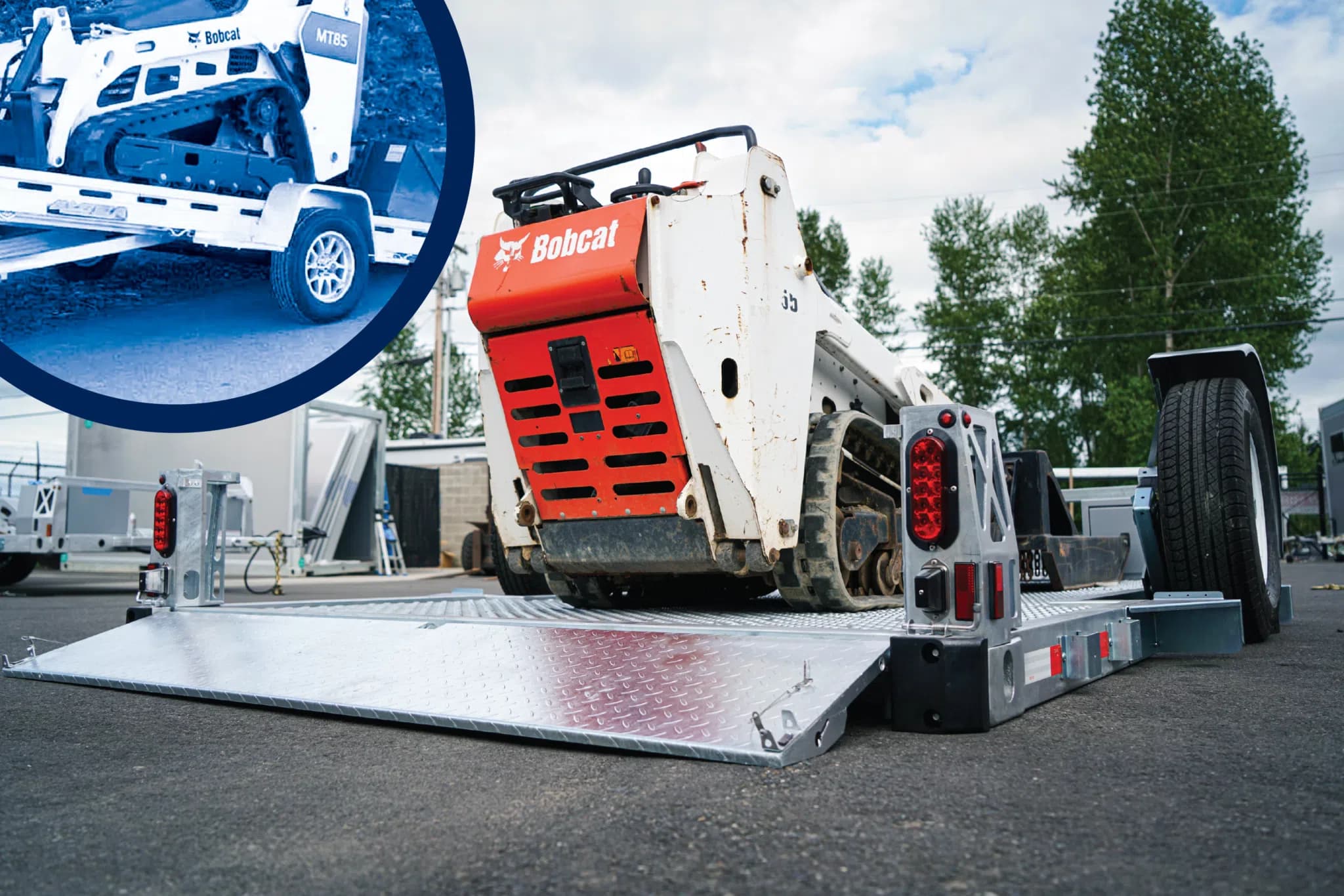
On our flatbeds, a rear ramp provides the remaining transition:
- 22 inches long
- 76.5 inches wide
- 11° approach
- Spring-assisted
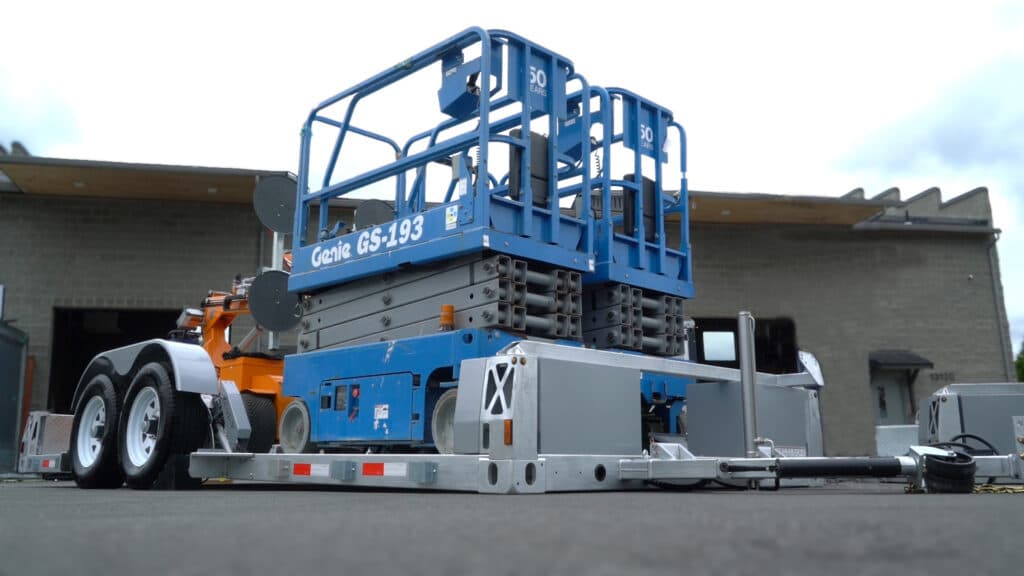
The Biggest Difference: Keeping the Deck Level
The biggest difference is what happens to the load surface during loading.
On a tilt trailer, some or all of the trailer deck becomes the incline.
On a GoodMFG® drop deck, the primary deck remains horizontal during loading. Only the short rear ramp creates an incline.
That distinction can matter when you’re moving:
- Rolling carts
- Toolboxes
- Floor-care equipment
- Scissor lifts
- Compact machinery
- Equipment with a limited allowable grade
- Other loads for which you would prefer to reach a level surface quickly.
Once lowered, the primary deck remains level. Equipment crosses a short 22-inch rear ramp with an 11° approach and then immediately reaches the flat deck, which sits 5.4 inches above the loading surface.
That changes more than the height of the trailer.
It changes how much of the loading process takes place on an incline.
For equipment that rolls, drives, or is maneuvered into position, reaching a level surface quickly can make loading and positioning more straightforward.
Why a Level Deck Matters
A loading ramp doesn’t stop mattering as soon as the front wheels reach the trailer.
With a tilted deck, the load continues traveling along an inclined surface until it reaches its final position and the deck returns to transport position.
With a GoodMFG® drop deck, the incline is limited to the short rear transition.
Once the equipment reaches the deck:
- The primary load surface is level
- The equipment is no longer climbing
- Rolling cargo is no longer being positioned on an incline
- And the operator can concentrate on final placement & securement.
This capability can be particularly useful for loads such as:
- Scissor lifts
- Compact sweepers
- Concrete grinders & floor equipment
- Commercial mowers
- Rolling toolboxes
- Carts
- Palletized materials
- And other equipment that benefits from reaching a level surface quickly.
No equipment type is universally perfect for Good Trailers. Weight, dimensions, loading instructions, and securement still determine compatibility.
A Gentler Transition for Low Clearance Equipment
Low-clearance equipment presents a different problem from simple payload.
The machine has to clear the transition between the ground, loading surface, and trailer deck.
That depends on factors such as:
- Ground clearance
- Wheelbase or Track Length
- Wheel or Track Position
- Attachments
- The manufacturer’s required transport configuration.
GoodMFG® flatbeds lower the deck to 5.4 inches and use an 11° rear approach.
That reduces the vertical climb and keeps the ramp-to-deck transition relatively gentle.
For compatible equipment, that can help reduce the chance of scraping or high-centering. The advantage is that you are solving the clearance problem by lowering the trailer rather than asking the equipment to climb farther up an inclined deck.
Drop Deck Loading Works with Enclosed Trailers Too
Ground-level loading is not limited to open equipment trailers.
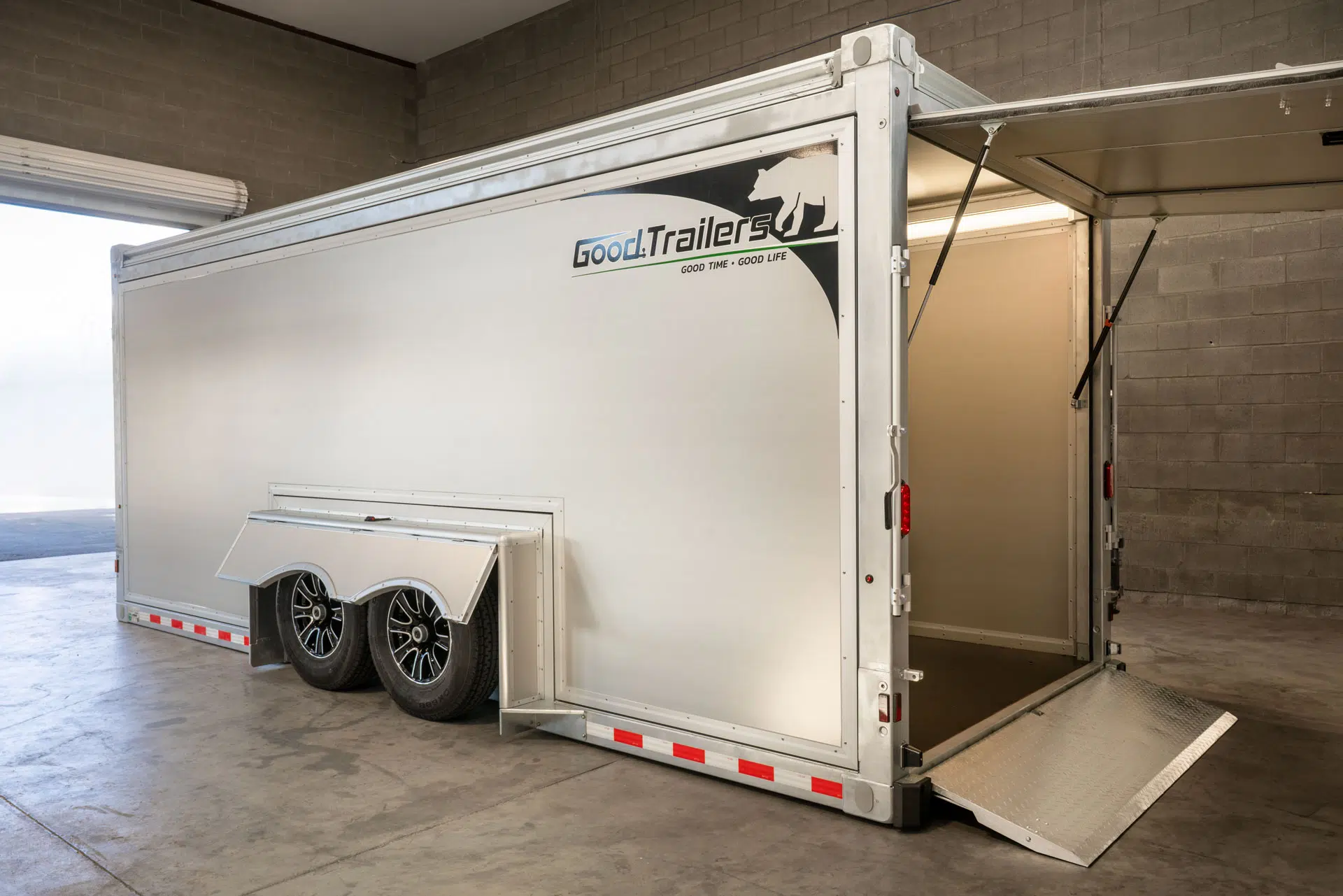
GoodMFG® also applies the hydraulic drop-deck system to enclosed trailers.
That means you can combine a low loading surface with:
- Protection from direct rain, road spray, & debris
- Lockable enclosed storage
- Interior organization
- Lighting & electrical options
- And a trailer that can serve as both transportation & workspace or storage.
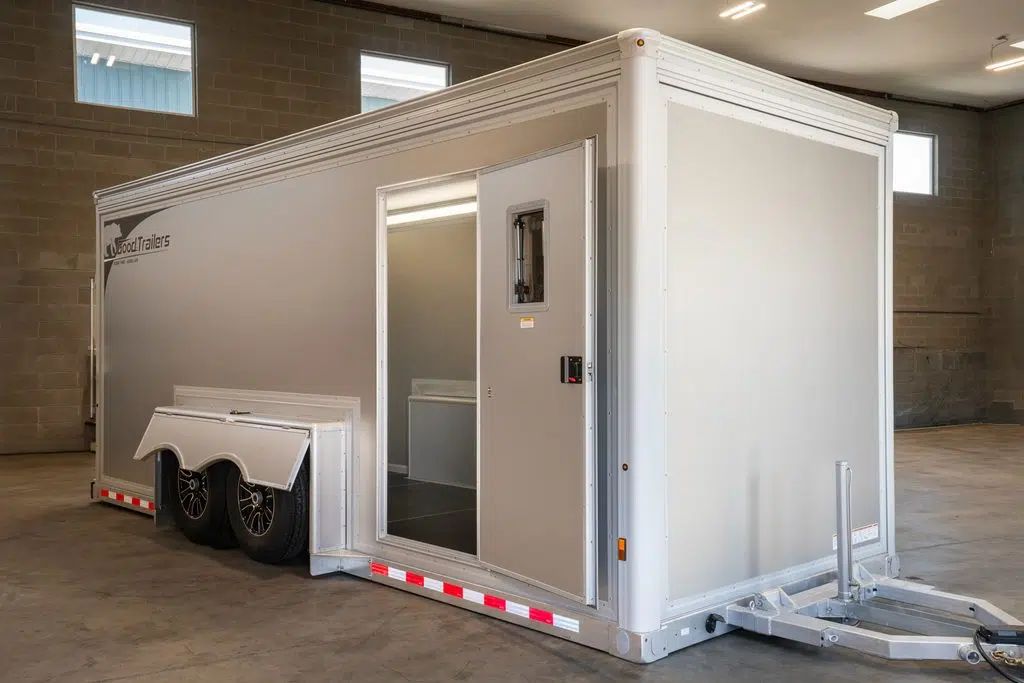
That matters if the machine itself is only part of what travels to the job.
A contractor might be moving a grinder plus dust extraction equipment and tooling.
A facilities crew might be hauling carts, tools, batteries, and repair equipment.
A municipality may need equipment plus signs, supplies, or event materials.
For those workflows, the question isn’t just “How do I get one machine onto the trailer?”
It’s “How do I move the entire equipment package?”
An enclosed hydraulic drop deck can solve both the loading-height problem and the need to keep the rest of the gear together.
No Long, Removable Ramps to Position
GoodMFG® flatbeds use an attached, spring-assisted rear ramp.
You don’t have to carry, position, align, retrieve, and stow a separate pair of long loading ramps every time you use the trailer.
That is especially useful when:
- The equipment has a narrow wheel or track spacing
- Alignment matters
- Crews load several different types of equipment
- Or the trailer is used repeatedly throughout the week.
The attached ramp gives the trailer a consistent loading path. You still need to make sure the equipment fits the 76.5-inch ramp and 82-inch deck, but you aren’t rebuilding the loading setup from separate ramp pieces each time. And once you verify the space, there won’t be any precision placement challenges to navigate.
Consistent Loading Geometry
A GoodMFG® hydraulic drop deck does not rely on the cargo itself to change the position of the deck.
The trailer is lowered before loading begins.
That means the operator knows what loading geometry to expect:
- Chassis rests on the ground
- Dec rests 5.4 inches above the surface
- 22-inch rear ramp, 76.5″ wide
- 11° approach
- Level primary deck.
That consistency can be useful when the trailer regularly carries the same machine or type of equipment.
Practical Differences
| Consideration | GoodMFG® Hydraulic Drop Deck | Tilt Trailer |
|---|---|---|
| How loading height is reduced | Entire chassis lowers | Deck tilts toward ground |
| Primary deck while loading | Level | Inclined during loading |
| Initial loading transition | Short 11° rear ramp | Tilted deck serves as loading surface |
| Rolling carts and equipment | Short incline, then level deck | Load travels along inclined deck |
| Low-clearance equipment | Low deck and short transition can help reduce scraping/high-centering | Depends on exact tilt geometry |
| Enclosed configurations | Available | Depends on trailer design |
| Long removable ramps | Not required | Generally not required |
| Loading geometry during equipment movement | Main deck remains level | Deck position changes or remains tilted depending on design |
| Unhitch before operating | Yes | Depends on design |
| Best fit | Buyers prioritizing low loading height, level-deck loading, rolling equipment, or enclosed ground-level access | Depends on application |
Who Benefits Most from a Hydraulic Drop Deck
A GoodMFG® drop deck is particularly worth considering when:
- You regularly move low-clearance equipment;
- Your equipment benefits from reaching a level deck quickly;
- You move heavy rolling carts, toolboxes, or material-handling equipment;
- You want an enclosed trailer without giving up low loading height;
- You dislike managing long removable ramps;
- Your equipment package includes several pieces that need to be staged on a level deck;
- Or you routinely load in places where a suitable level setup area is available.
Those are the workflows where lowering the entire trailer can make more sense than tilting the load surface.
FAQ
Are drop deck trailers better than tilt trailers for low clearance equipment?
They can offer an important advantage because the main deck remains level and sits just 5.4 inches above the loading surface.
The equipment only needs to negotiate the short 11° rear transition before reaching the flat deck.
That can help reduce scraping or high-centering for compatible equipment, although exact ground clearance, wheelbase, attachments, and manufacturer loading instructions still matter.
Why does a level deck matter for rolling loads?
Once a cart, toolbox, palletized load, or other rolling equipment reaches the deck, it no longer has to be moved along an incline.
That can make positioning and staging more straightforward than continuing to move the load along a sloped loading surface.
Material-handling equipment still needs to be used within its manufacturer’s slope and capacity limits.
Is a tilt trailer ever the better choice?
Possibly. Every operation has different priorities. And some tilt trailers can handle loads that Good Trailers just aren’t equipped to handle. What do you haul? Start there.
Key Takeaways
Need the TL;DR before you make your final decision?
- A tilt trailer brings the deck to the ground by angling it.
- A GoodMFG® drop deck brings the chassis to the ground while keeping the primary deck level.
- GoodMFG® flatbeds provide an 11° rear transition to a deck only 5.4 inches above the loading surface.
- Once the load crosses the rear ramp, it reaches a level deck instead of continuing along an inclined loading surface.
- GoodMFG® also offers enclosed hydraulic drop deck trailers, combining low loading height with protected cargo space.The attached rear ramp eliminates the need to position and retrieve separate long loading ramps.
- The strongest reason to choose a drop deck is simple: you get the loading surface close to the ground without turning the primary deck itself into the ramp.
How to Buy Drop Deck Trailers
It’s easy to buy drop deck trailers by reaching out to a dealer near you, or contact us if you can’t find a dealer in your local area. Get in touch now!
See also:
Does GoodMFG® Make Durable Trailers?
The Top 4 Advantages of Trailers that Lower to the Ground
This resource was compiled by the GoodMFG® Product Team, drawing on 75 years of combined experience in hydraulic systems, heavy-duty transport, trailers, and modular structures.
P.S. – We build trailers every day, but we don’t run your crews. If there’s a specific logistical headache or a “field reality” we’ve missed, we want to hear about it. Help us refine the equipment that makes your day easier! Email our Marketing Lead at devan-h @ goodrv.com and let us know what we should solve next.