Durable trailers are a must.
When you buy a trailer, you want something that’s going to last and keep doing the job you bought it for.
Trailer durability comes from more than one material or component. Chassis construction, corrosion protection, enclosure materials, hydraulic serviceability, maintenance, loading, and the conditions where the trailer works all contribute.
Here’s how we build Good Trailers with long-term service in mind—and what those construction choices can and cannot tell you about lifespan.
Table of Contents
Galvanized Steel Frames
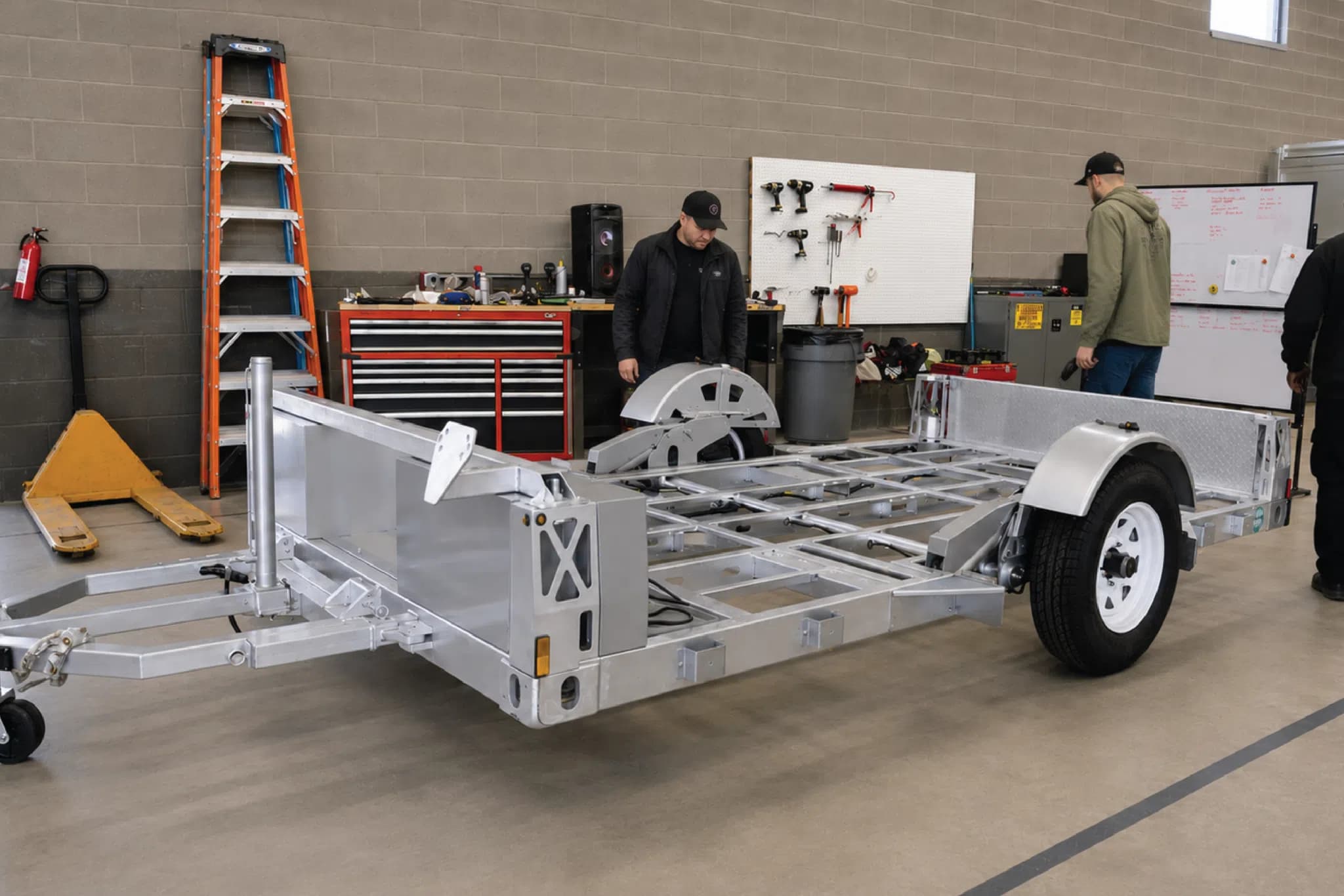
Every Good Trailer starts with a galvanized steel chassis.
Hot-dip galvanizing protects steel by applying a zinc coating that acts both as a barrier and as sacrificial corrosion protection. That makes it particularly useful for equipment that spends its working life exposed to rain, road spray, humidity, and other outdoor conditions.
Galvanized steel has an excellent long-term corrosion record. The American Galvanizers Association reports that properly specified hot-dip galvanized structural steel can provide decades of corrosion protection before its first maintenance is required, although actual performance depends on coating thickness and environmental exposure.
That does not give us an honest way to promise that a complete Good Trailer will last 25, 30, or 70 years.
A trailer is a system. Tires, brakes, bearings, hydraulics, electrical components, welds, road exposure, load history, collisions, maintenance, and storage conditions all affect its eventual service life.
What galvanizing gives us is simpler and still important: strong corrosion protection for one of the trailer’s most important structural components.
Modular Hydraulics
Adding hydraulics naturally raises another durability question:
What happens when part of the hydraulic system eventually needs service?
The hydraulic drop-deck system is made up of individual pumps, hoses, valves, fittings, cylinders, and related components that can be inspected, serviced, or replaced when necessary.
Hydraulic repairs and maintenance should be performed by a qualified technician and warns against altering components, system pressure, or flow rate. The components in the system need to remain compatible with the trailer’s design.
Routine maintenance matters too. Annual hydraulic filter replacement (or more frequently under heavy use) is a must. Using the right hydraulic fluid (AW32 or equivalent) also matters.
Your hydraulic pump user manual is available here on our site. Use 3T for 9′ and 13′ trailers and 5T for 19′ trailers.
Composite Aluminum Panels
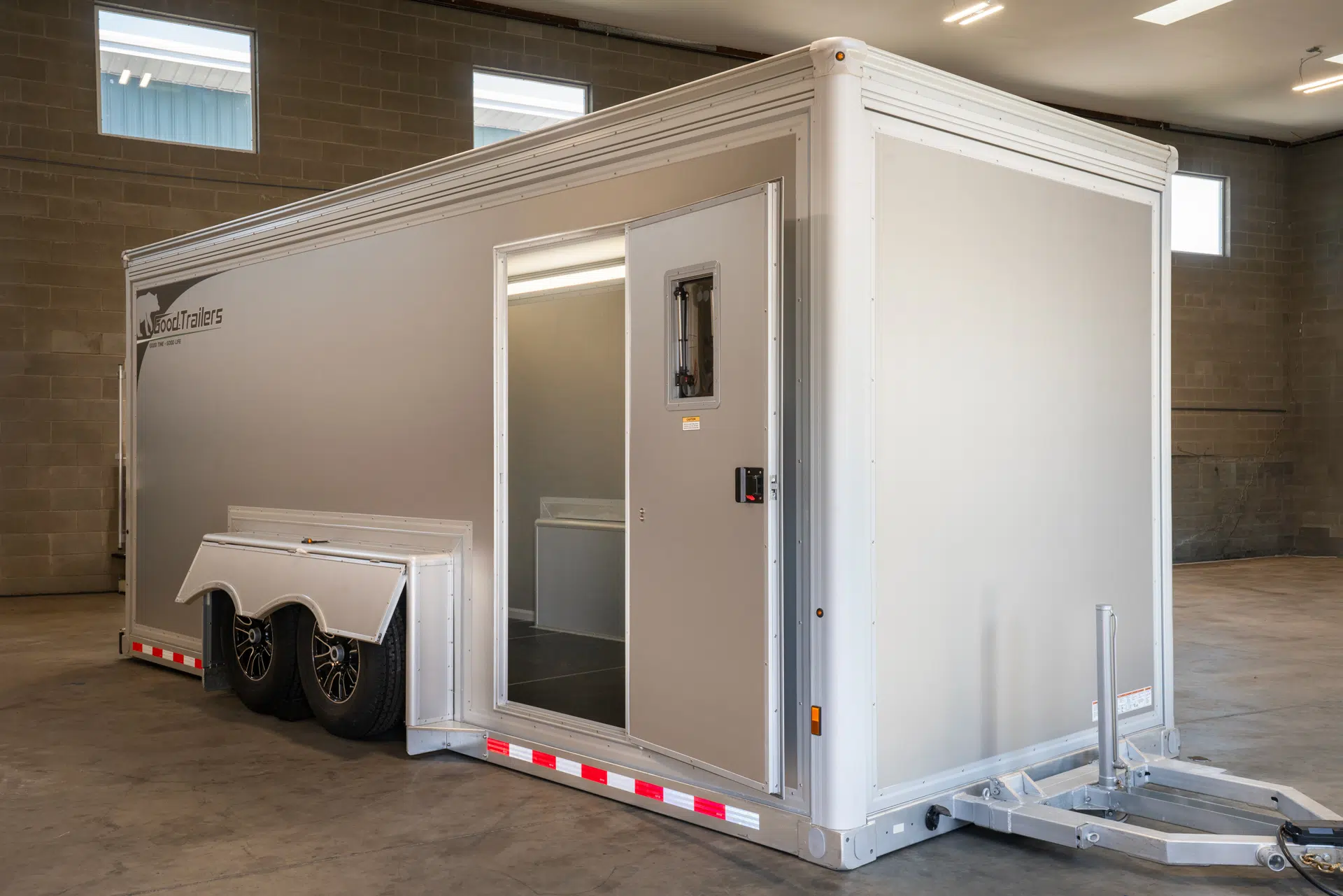
Our enclosed trailers use composite panel construction rather than conventional sheet metal over wood framing.
The wall and roof assemblies use #5052 aluminum skins around a polystyrene foam core.
That construction gives the enclosure several useful characteristics.
The aluminum skins provide corrosion resistance without adding the weight of an all-steel enclosure. The foam core adds insulation, slowing heat transfer through the walls and roof. And the composite construction creates a rigid enclosure without requiring conventional interior wood wall construction.
Likewise, we can’t assign the complete trailer a projected lifespan simply from the expected durability of aluminum. Aluminum’s corrosion resistance is one reason we use it, but trailer longevity depends on the complete assembly and how the trailer is used and maintained.
That said, we know these little panels can take some punishment, which is why we chose them when we set out to build durable trailers our customers would be proud to own.
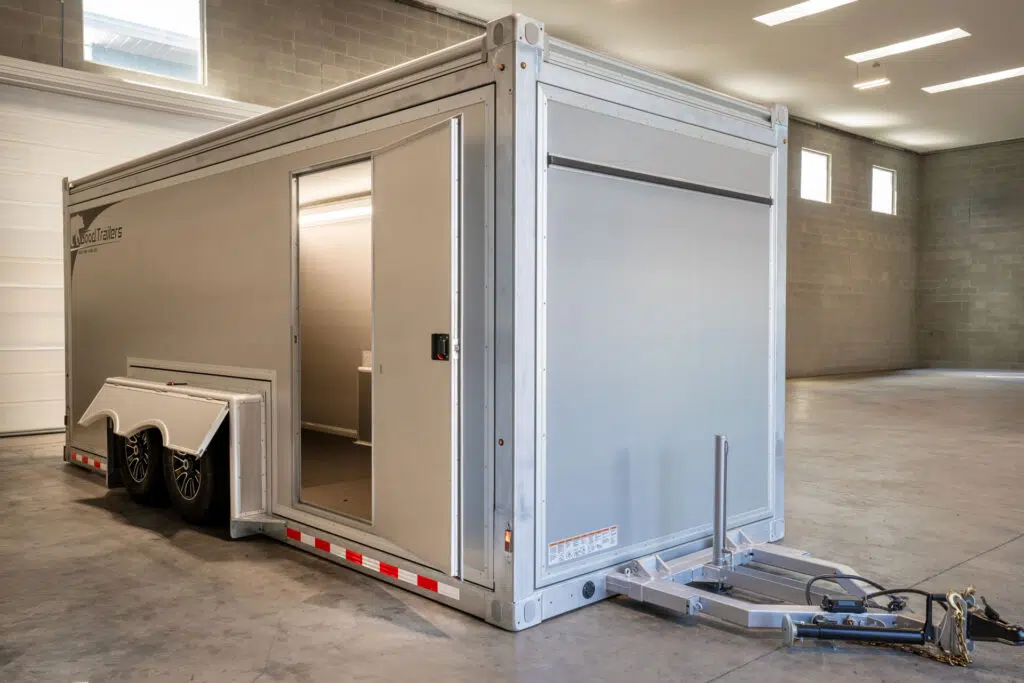
Heavy Duty Durable Trailer Options
Not every trailer spends its life traveling between paved lots.
For users who regularly encounter gravel roads, rough access routes, industrial sites, or other demanding environments, we also offer HD and HDX enclosed models.
GoodMFG® HD (Heavy-Duty) and HDX (High-Cube Heavy-Duty) models replace standard aluminum wall posts with heavy-gauge steel vertical posts welded directly to the galvanized chassis.
That does not make an HD or HDX trailer indestructible, and rough-road operation still requires appropriate speed, inspection, maintenance, and loading.
But if your normal work regularly includes rough access roads or demanding sites, the additional steel framing is one reason to consider the HD/HDX series.
NATM Compliance Verification
You don’t need to navigate complex federal regulatory codes to verify if a trailer is built safely. Third-party industry authorities perform this validation on every unit built.
GoodMFG® is a National Association of Trailer Manufacturers (NATM) and has successfully completed NATM’s Compliance Verification Program.
The program is mandatory for NATM member trailer manufacturers. Every two years, an NATM compliance professional conducts a consultation reviewing manufacturing processes against a checklist drawn from applicable Federal Motor Vehicle Safety Standards, regulations, and industry best practices.
A little independent oversight can go a long way towards helping us build good, durable trailers!
FAQ
How long should a Good Trailer last?
There isn’t one honest number we can give for every trailer.
Good Trailers use galvanized steel chassis construction, corrosion-resistant aluminum in enclosed models, serviceable hydraulic systems, and components designed for trailer service.
But actual lifespan depends on how the trailer is loaded, road and environmental conditions, mileage, storage, maintenance, impacts, corrosion exposure, and replacement of normal wear components.
What does NATM Compliance Verification actually mean?
NATM’s Compliance Verification Program reviews whether member manufacturers have the processes in place to build trailers in accordance with applicable federal safety regulations and recommended industry practices.
The consultation occurs every two years and is conducted by an NATM compliance professional. Manufacturers that successfully complete the process are eligible to use NATM compliance decals on their trailers.
It is a manufacturing-compliance program—not a claim that NATM independently tests and certifies every individual trailer.
Which Good Trailer is the most durable trailer?
For enclosed applications that regularly involve rough roads or demanding jobsite conditions, our HD and HDX models add galvanized steel vertical framing and are the models we specifically position for heavier-duty service.
A medium-duty model may still be the better choice when lower empty weight or a different configuration matters more.
Key Takeaways
Here’s your TL;DR if you’re looking for durable trailers with drop-deck power.
- Galvanized steel chassis construction helps protect Good Trailers against corrosion. Hot-dip galvanizing has a well-established record of long-term corrosion protection, although coating life is not the same thing as complete trailer lifespan.
- Enclosed Good Trailers use composite aluminum-panel construction. Aluminum provides corrosion resistance while the foam core adds insulation by slowing heat transfer.
- GoodMFG® hydraulic systems are maintainable, but repairs should use the correct compatible components and be performed by qualified technicians in accordance with our Owner’s Manual.
- HD and HDX models add galvanized steel vertical framing for customers whose normal work includes more demanding road and jobsite conditions.
- No responsible manufacturer can promise one universal trailer lifespan. Load history, mileage, environment, maintenance, storage, impacts, and wear components all matter.
Durable Trailers: Built for the Long Haul
We know that when you invest in trailers you want durable trailers that will be with you for the long haul. That’s why our team here in Marysville, WA takes all of our work very seriously, building every trailer around the construction standards and quality-control processes we’ve established.
Ready to find yours? Find your nearest dealership or contact us for options today.
See also:
The Ultimate Drop Deck Trailer Buyers Guide
Hydraulic Drop Deck Trailer Maintenance, Because Nobody Has Time for Breakdowns
The Top 4 Advantages of Trailers that Lower to the Ground
This resource was compiled by the GoodMFG® Product Team, drawing on 75 years of combined experience in hydraulic systems, heavy-duty transport, trailers, and modular structures.
P.S. – We build trailers every day, but we don’t run your crews. If there’s a specific logistical headache or a “field reality” we’ve missed, we want to hear about it. Help us refine the equipment that makes your day easier! Email our Marketing Lead at devan-h @ goodrv.com and let us know what we should solve next.