Before you choose an insulated enclosed trailer, it helps to understand what the insulation does and doesn’t do.
Insulation can slow heat transfer through the walls and roof of your trailer. It can help moderate rapid temperature changes and reduce the conditions that contribute to condensation on interior surfaces. If you spend a lot of time inside your trailer or carry materials that benefit from a more protected environment, those advantages can matter.
So, do you need it?
Let’s look at what insulated enclosed trailers actually do, where they make the most sense, and which other features you should consider before choosing one.
Table of Contents
- What Does Insulation Actually Do in an Enclosed Trailer?
- Can Insulated Enclosed Trailers Help with Condensation?
- Insulated Enclosed Trailers vs. Climate Controlled Trailers
- Best Uses for an Insulated Enclosed Trailer
- What Makes GoodMFG® Enclosed Trailers Different
- FAQ
- Key Takeaways
- Next Steps if an Insulated Enclosed Trailer is Right for You
What Does Insulation Actually Do in an Enclosed Trailer
The basic job of insulation is simple:
It slows heat transfer.
If the outside of your trailer is sitting in cold winter air, insulation slows the movement of heat from the warmer interior toward the colder exterior.
If the trailer is sitting in summer sun, insulation slows the movement of outside heat through the trailer envelope.
That does not mean the inside remains at one temperature indefinitely. Leave an insulated trailer parked in hot weather with no active cooling and, eventually, the interior will still get hot.
The difference is in how readily the interior responds to conditions outside.
That can be worthwhile for two reasons.
First, cargo and people inside the trailer are less directly exposed to rapid temperature changes through the metal shell.
Second, insulation changes the temperature of the trailer’s interior-facing surfaces, which can become important when condensation is a concern.
Can Insulated Trailers Help with Condensation?
Yes, insulation can help reduce the risk of surface condensation, but it cannot guarantee that condensation will never occur.
Here’s why.
Air contains water vapor. When humid air comes into contact with a surface that is cold enough—below the air’s dew point—the water vapor can condense into liquid water.
That is why you sometimes see water appear on a cold drink, window, metal wall, or ceiling even though nothing is leaking.
EPA moisture-control guidance explains that managing surface temperature is an important part of condensation control. Insulation can help by limiting heat flow and helping interior-facing surfaces remain above the dew point under appropriate conditions.
That is particularly relevant in a metal enclosure.
GoodMFG® uses composite aluminum panels rather than an uninsulated sheet-metal wall. The panels incorporate rigid polystyrene foam between #5052 aluminum skins, creating insulation as part of the panel itself.
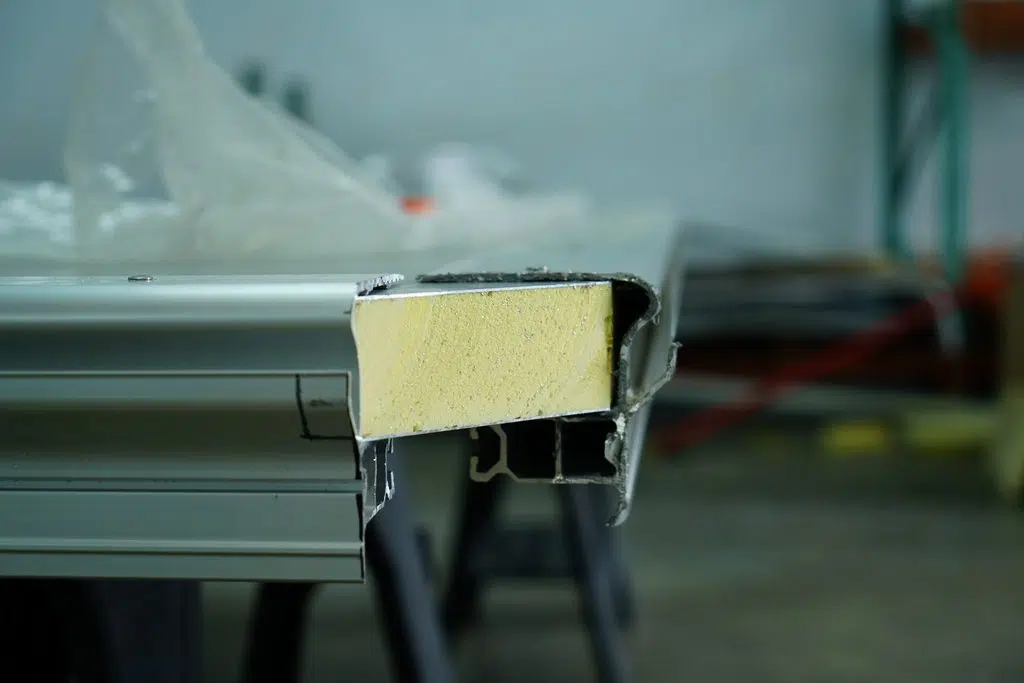
That construction can reduce the conditions that contribute to condensation on interior wall and ceiling surfaces. In other words, you still get a better hedge against condensation than you’d get if you had no insulation at all. Composite aluminum panel construction helps you control the surface temperature, contributing to condensation control.
Insulated vs. Climate-Controlled Trailers
hese terms are easy to blur together, but they describe different things.
Insulated
An insulated trailer has material in its walls, ceiling, or other surfaces that resists heat transfer.
It does not necessarily have heating or cooling equipment.
Heated or Cooled
A trailer equipped with a heater or air conditioner can actively add or remove heat.
Whether it can maintain a particular temperature depends on the equipment, trailer construction, outside conditions, doors opening and closing, and other factors.
Climate Controlled
“Climate controlled” usually implies some ability to actively manage the interior environment rather than simply slow heat transfer.
Depending on the application, that may involve heating, cooling, ventilation, humidity control, or some combination.
That distinction matters if your cargo comes with strict storage requirements.
If a manufacturer says a material needs to stay within a specific temperature or relative-humidity range, insulation by itself should not be treated as proof that those conditions will be maintained.
Start with the cargo requirements. Then determine whether an insulated enclosure is enough or whether you need active environmental controls as well.
Best Uses for an Insulated Enclosed Trailer
There is no single cargo category that makes insulation mandatory.
Instead, ask: would slowing the effects of outside conditions solve a real problem?
For several types of users, the answer may be, “yes.” The list below is not exhaustive.
Woodworking, Cabinetry, and Millwork
Wood is hygroscopic, meaning it exchanges moisture with its surrounding environment. Temperature, relative humidity, and the wood’s existing moisture content influence that process. Changes in moisture content can affect the material’s dimensions and performance.
The Architectural Woodwork Institute recommends protecting architectural woodwork during storage from excessive heat, cold, moisture, direct sunlight, and inappropriate relative-humidity variations.
An insulated enclosed trailer can therefore make sense for:
- Custom cabinetry
- Doors & trim
- Millwork
- Finished wood components
- Installation materials
- Woodworking tools & equipment
It gives those products an enclosed environment that is buffered from outside temperature changes.
But there is an important limit.
An insulated trailer does not replace proper acclimation.
For work covered by AWI 200, the product must acclimate to the actual installation environment at least 72 hours before installation. Time spent riding around in an insulated trailer doesn’t count.
Use the insulated enclosed trailer for protected transport. Follow the appropriate product or project requirements when the material reaches its destination.
Contractors & Mobile Work Crews
Not everything inside an enclosed trailer is particularly temperature-sensitive.
Sometimes you are.
If crews regularly enter the trailer to retrieve tools, organize materials, work at a bench, or prepare for the next stage of a job, an insulated shell reduces direct heat transfer through the trailer walls and roof.
That does not make an unconditioned trailer comfortable in every temperature.
It does give you a better starting point than treating the trailer as a bare metal box.
Contractors should still consider the complete workspace. Fortunately, on a GT19AL or any other insulated enclosed trailer we put out, you get 360° interior lighting automatically. To improve tool access, you can also add shelving, cabinets, E-track, securement points, and more. Speak to your local dealer or call us directly to learn more about these options.
Concession & Mobile Services Trailers
An insulated shell can also be valuable when people spend substantial portions of the day inside the trailer.
People and equipment both generate heat, and outside weather still has an effect. Insulation slows heat transfer through the enclosure, giving operators a better starting point for managing the interior environment.
This isn’t a guarantee your trailer will stay comfortable no matter what. A 103° day is likely to be miserable no matter how insulated your concession trailer is, and your food warming or other equipment can still raise interior temperatures.
Seasonal & Multipurpose Fleets
Insulation may be particularly worthwhile when a trailer needs to serve several purposes or operate throughout the year.
A trailer used only occasionally for dry cargo in mild weather may not receive as much practical benefit from insulation as a trailer that travels between jobs throughout summer heat, winter cold, wet conditions, and changing seasons.
So don’t ask: “Is insulation good?” Ask: “Is insulation useful for the way we will actually use this trailer?”
The answer, if insulation doesn’t matter to you at all, is that the hydraulic drop deck features on each of our insulated enclosed trailers may still be a gamechanger for you or your business. But that’s an independent evaluation.
What Makes GoodMFG® Insulated Enclosed Trailers Different?
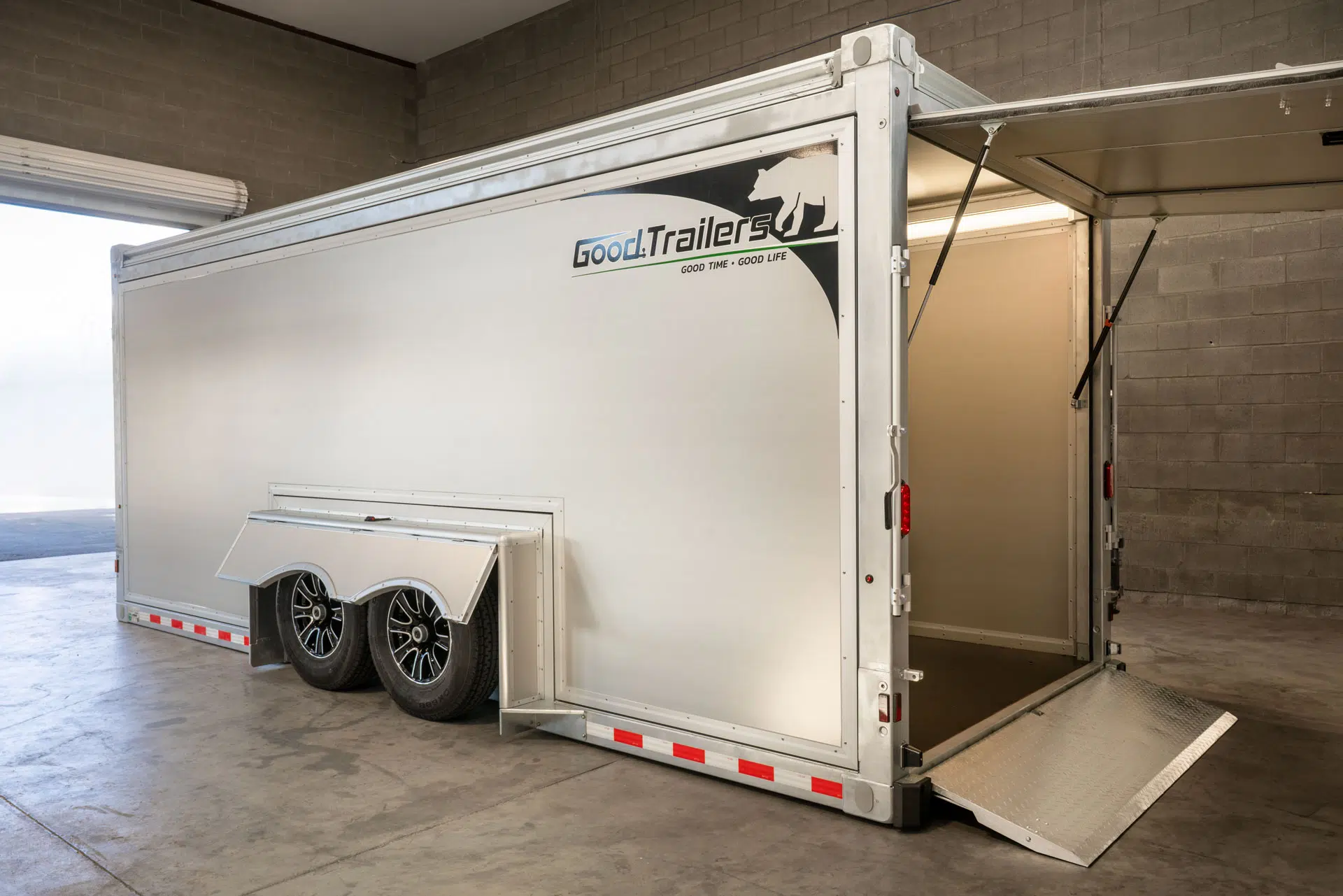
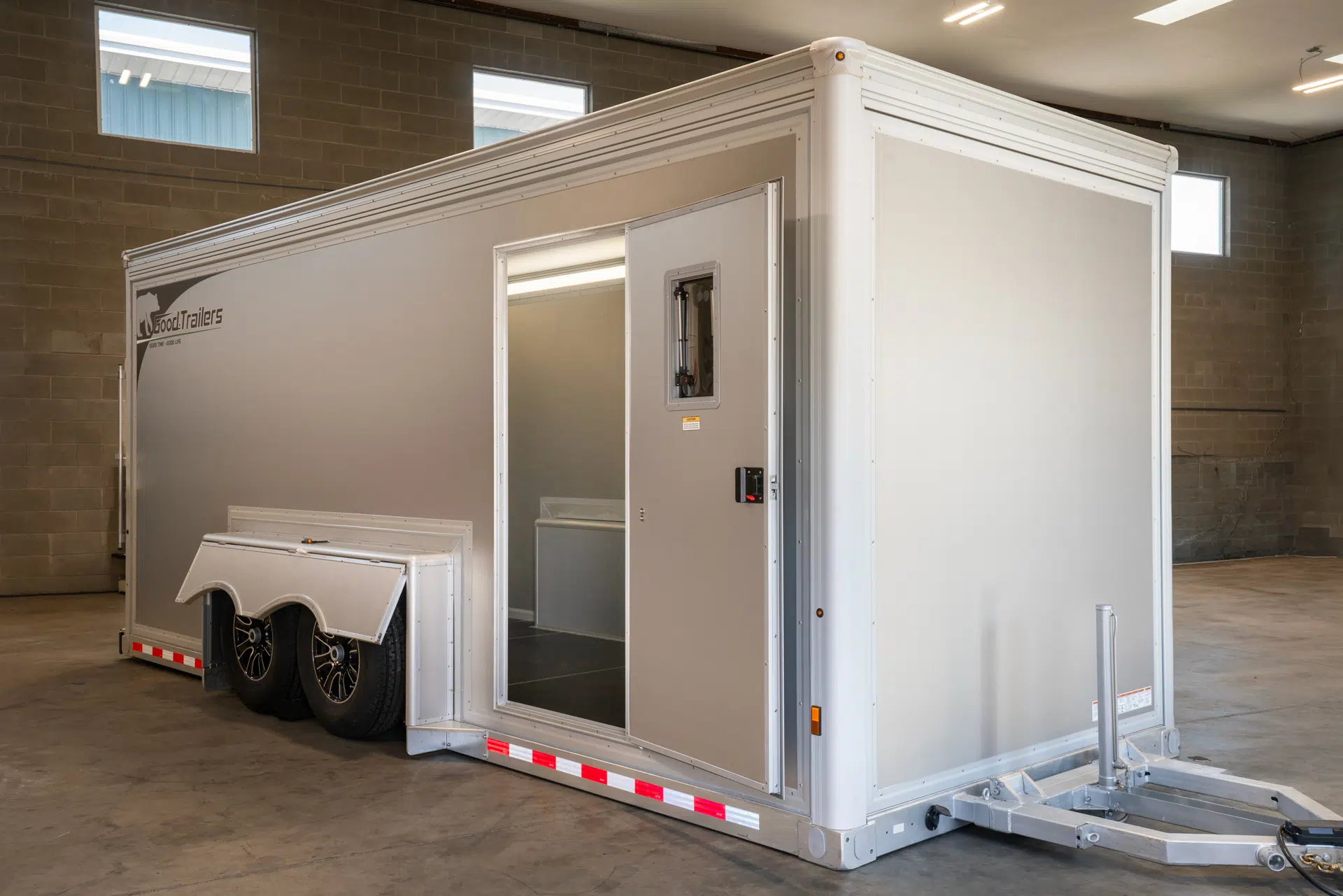
Our enclosed drop deck trailers combine insulated construction with ground-level loading.
The trailer walls use our patent-pending composite panel construction, with rigid polystyrene foam sandwiched between #5052 aluminum skins. The insulation is incorporated into the panel rather than simply being an interior afterthought.
But insulation is only one part of the design.
GoodMFG®’s GT13AL and GT19AL also lower hydraulically until the deck sits 5.4 inches above the ground. A short 22-inch 76.5″ ramp with an 11° approach bridges the remaining transition.
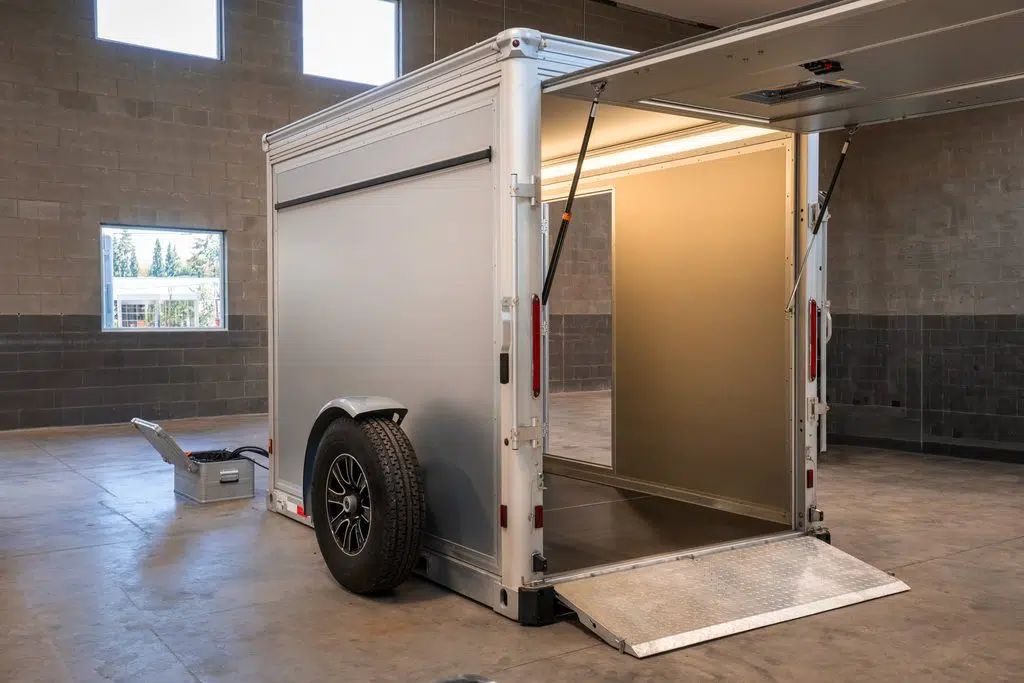
That combination can matter when you are transporting carts, rolling workstations, cabinetry, tools, equipment, or other cargo that benefits from both an enclosed environment and easier loading.
Instead of choosing between environmental protection and loading access, you can plan around both.
FAQ
Will an insulated enclosed trailer stay cool in the summer?
It will certainly be cooler than an uninsulated trailer.
Lots of factors influence what the interior temperature will actually be. Sun exposure, outdoor temperature, equipment, ventilation, and how frequently the doors open all affect the interior.
If you need to maintain a specific temperature, insulation may need to be paired with appropriately designed cooling equipment.
Should an insulated enclosed trailer still be ventilated?
That depends on how it is being used.
Insulation does not remove moisture, fumes, heat, dust, or other contaminants inside the trailer. If your cargo or work produces any of these, appropriate ventilation may still be necessary.
What should I compare besides insulation when choosing an enclosed trailer?
Before choosing an insulated enclosed trailer consider carrying capacity, interior dimensions, door-opening dimensions, deck height, ramp angle, cargo securement, interior lighting, storage & organization options, and towing requirements. Always take the time to verify the cargo you need to haul can safely fit, load, or travel within the trailer’s ratings.
Key Takeaways
Here’s the TL;DR of what you should be thinking about as you shop for an insulated enclosed trailer.
- Insulated construction can help reduce surface-condensation risk. It does not eliminate condensation under every combination of temperature and humidity.
- Insulation slows heat transfer; it does not actively control temperature. An insulated enclosed trailer can moderate how quickly the interior responds to outside conditions, but it is not automatically climate-controlled.
- Insulation can be useful for wood products, contractor equipment, mobile workspaces, wet-weather operations, and other applications where environmental buffering has practical value. The exact benefit depends on how the trailer is used.
- Cargo-specific requirements still apply. Materials requiring precise temperature, humidity, ventilation, or acclimation conditions may need more than an insulated enclosure.
- GoodMFG® combines insulated composite panels with hydraulic drop deck loading. Get insulation and an easier loading configuration in the same smart investment.
Next Steps if an Insulated Enclosed Trailer is Right For You
Have you decided to upgrade to one of our insulated enclosed drop deck trailers? Click here to find your nearest dealer or contact us for options if there’s no dealer near you. You can use the form below or call us directly!
Loading form…
See also:
Easy Loading Enclosed Trailer: Evaluating Options
Does GoodMFG® Make Durable Trailers?
This resource was compiled by the GoodMFG® Product Team, drawing on 75 years of combined experience in hydraulic systems, heavy-duty transport, trailers, and modular structures.
P.S. – We build trailers every day, but we don’t run your crews. If there’s a specific logistical headache or a “field reality” we’ve missed, we want to hear about it. Help us refine the equipment that makes your day easier! Email our Marketing Lead at devan-h @ goodrv.com and let us know what we should solve next.