A landscaping trailer can have enough room for your equipment and still be awkward to work from. The important questions show up when you arrive at a job: How will you get the mower off? Can wheeled equipment be rolled aboard instead of lifted? Can you reach the tools you need without unloading everything else?
Ground-level loading is worth considering when getting equipment onto and off the trailer is part of the challenge. But the right choice depends on what you haul, how often you stop, and whether you need an open deck or protected storage.
Here is how to decide whether it makes sense for your landscaping business.
Table of Contents
- Loading Requirements
- Roll, Don’t Lift
- Choosing Landscaping Trailers: Flatbed or Enclosed?
- Consider the Whole Stop
- Check Equipment Fit
- FAQ
- Key Takeaways
- Load Low, Haul Good
Loading Requirements
Before choosing a landscaping trailer, check the loading instructions for the equipment that will ride on it. A mower’s requirements can tell you more about the loading arrangement you need than its cutting width or weight alone.
For example, Toro’s operator’s manual for the Z Master® Commercial 3000 Series mower, model 74958, warns about tip-over during loading. It specifies a single full-width ramp rather than separate wheel ramps and says the angle between the ramp and the ground—or the ramp and the trailer—must not exceed 15 degrees. Those instructions apply to that machine, not every zero-turn mower.
The takeaway is not that every ramp below 15 degrees is automatically suitable. It is that loading geometry belongs on your trailer-shopping checklist.
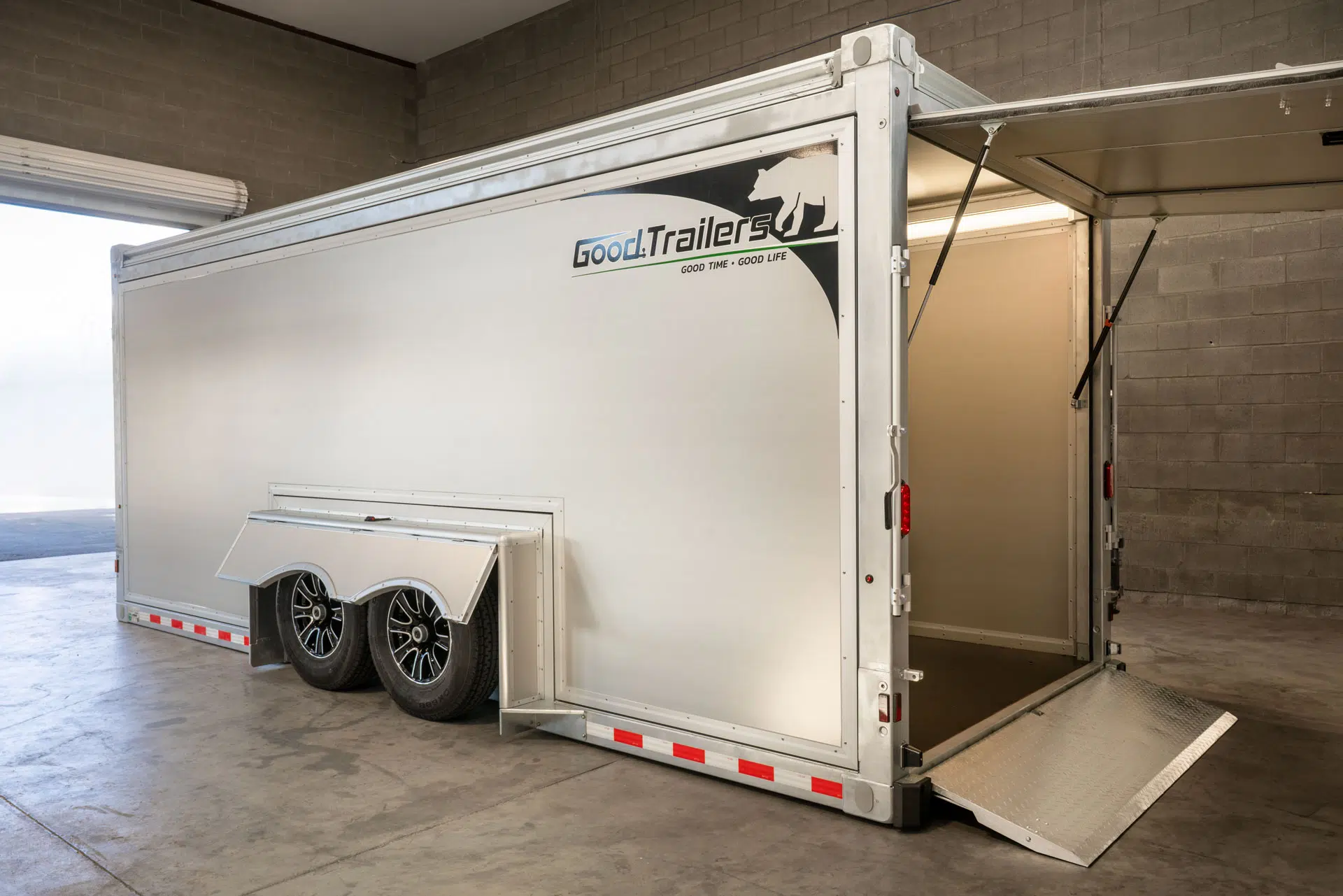
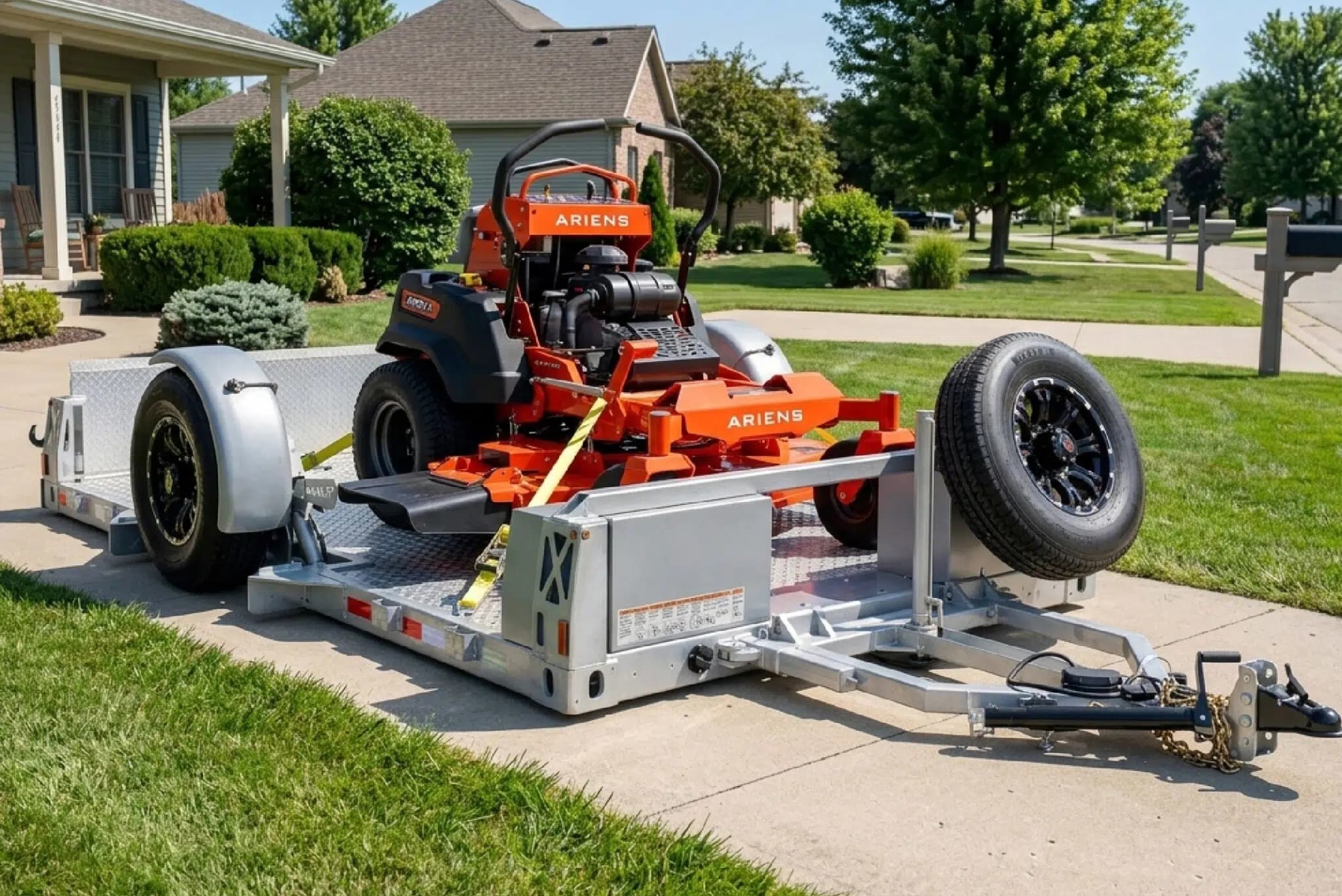
The hydraulic drop deck system on a Good Trailer by GoodMFG® lowers the trailer for loading, bringing the chassis all the way to the ground. The deck sits at 5.4”.
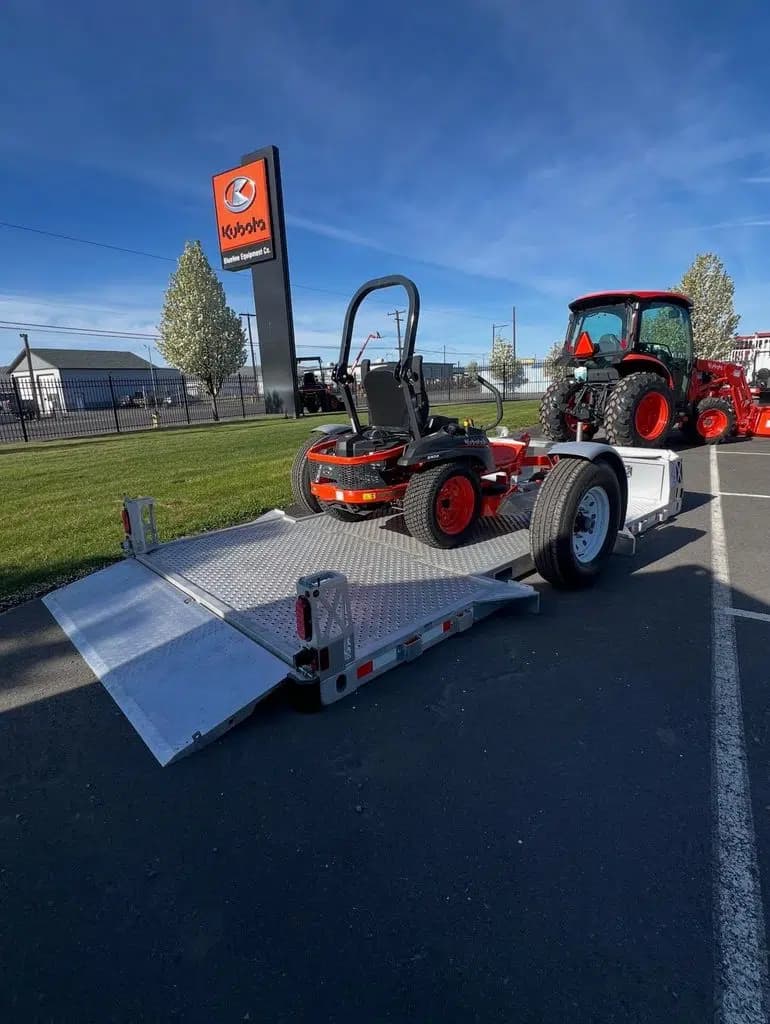
Our loading ramp is 22 inches long and 74.4 inches wide, with an 11-degree approach angle. Think of a short driveway-style transition rather than a long climb onto a raised deck. There is still a ramp, but it serves a different purpose: bridging the short transition to the lowered trailer. It’s also short, wide, and gentle.
Compare that arrangement with your equipment’s requirements, including ramp width, weight capacity, ground clearance, and the complete loading procedure. An approach angle alone does not establish compatibility.
Roll, Don’t Lift
Your largest mower is not the only item worth considering. Think about the walk-behind equipment, carts, and other wheeled tools your crew brings to a job.
Are workers lifting something onto the trailer that could otherwise roll? Does getting a tool aboard require an awkward reach or an extra pair of hands?
OSHA identifies lifting, awkward postures, and ergonomic hazards among the concerns in landscaping work. That makes equipment handling a practical consideration—not just a matter of convenience.
A lowered deck may provide an opportunity to replace some lifting with roll-on loading. For example, a suitable equipment cart or wheeled machine may be easier to move across a short loading transition than to lift onto a raised deck.
The important word is suitable. Check the load, wheel size, traction, and the operator’s ability to control it. Ground-level loading does not make every heavy item safe to push by hand. The useful question is more specific: “Which handling task could this trailer change for your crew?”
Choosing Landscaping Trailers: Flatbed or Enclosed?
Both deserve consideration. Start with the work the trailer needs to do, then decide whether an enclosure adds something your crew will use.
A flatbed keeps the focus on equipment transport
A flatbed is a sensible starting point when your main need is moving landscaping equipment and protected tool storage is already handled elsewhere.
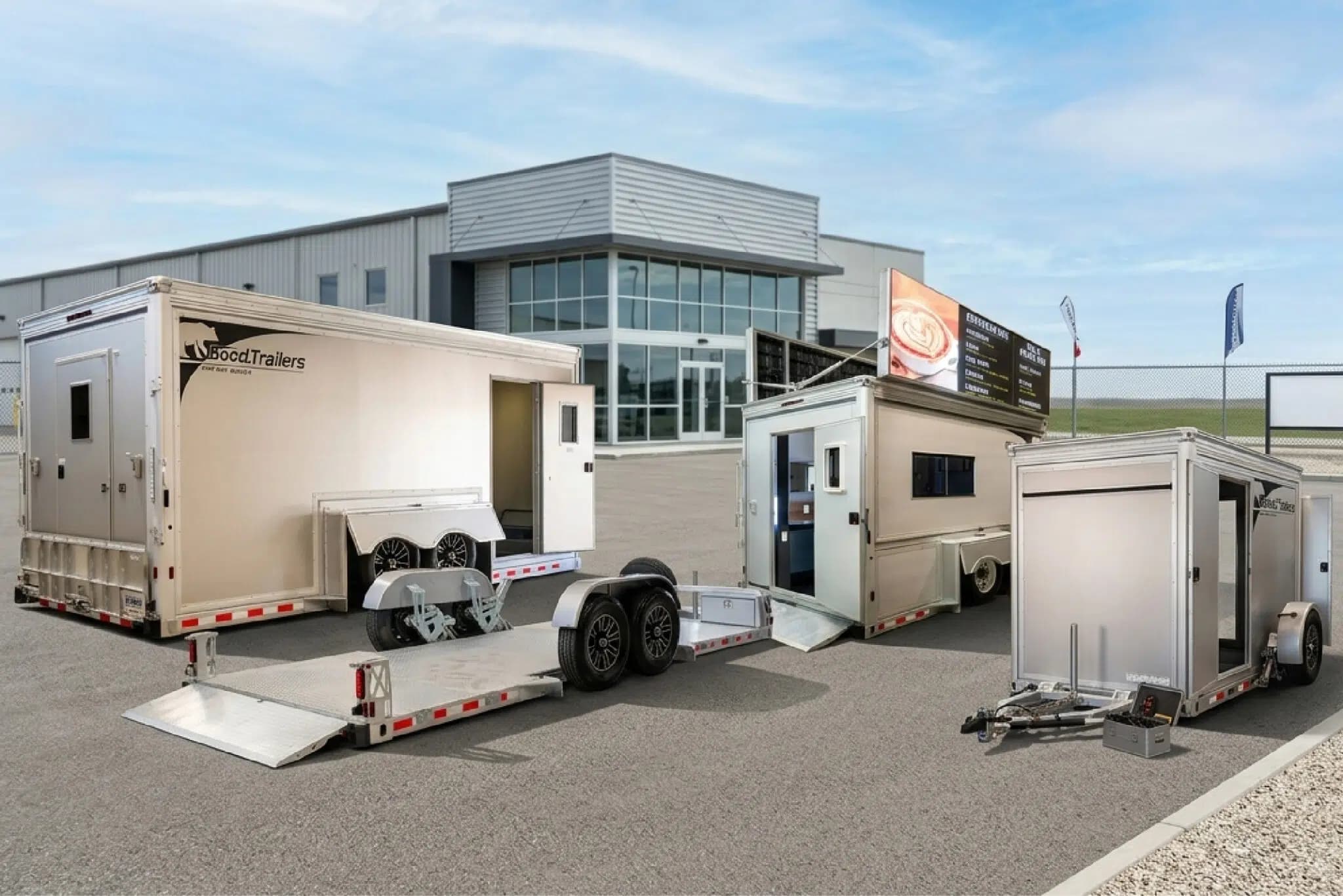
Without an enclosure, there is no rear doorway or roof opening to account for. However, you still need to check the ramp, usable deck dimensions, equipment placement, and access to tie-down points. The GT13FL drop deck flatbed trailer, for example, has separately published deck dimensions and ramp measurements—those are more useful for checking fit than the trailer’s model name alone.
For a landscape-installation crew, a flatbed may provide the loading arrangement it needs without adding an enclosed space it does not need.
An enclosed trailer adds protected, organized storage
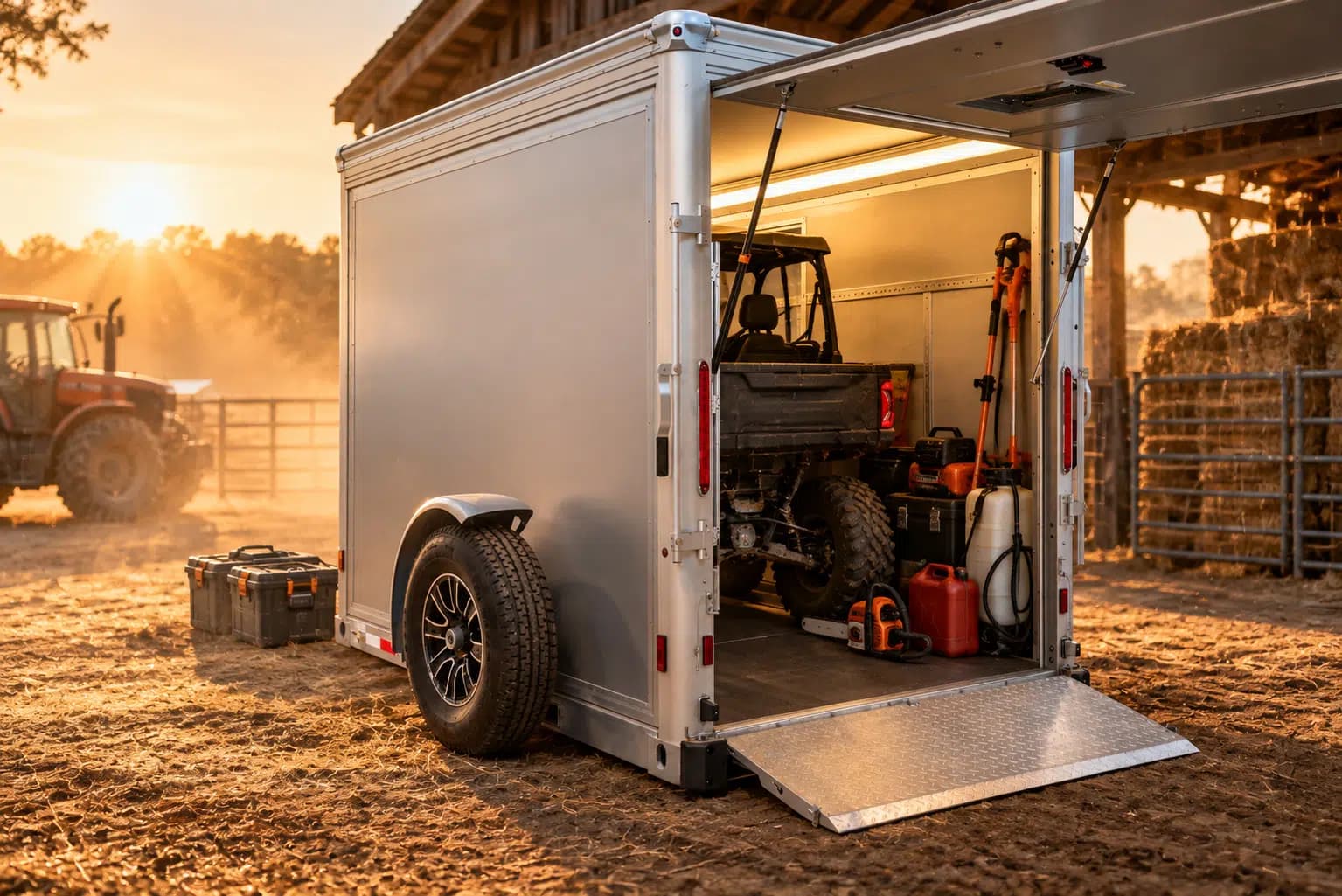
An enclosed landscaping trailer deserves a closer look when you want equipment sheltered during transport and smaller tools organized inside the trailer.
GoodMFG® can add shelves and cabinets to an enclosed trailer, with E-track or floor-mounted D-rings available to support an appropriate cargo-securement arrangement. Plan those features around the equipment—not as an afterthought once the floor is full. Ask your dealer about these add-ons, or call us directly.
Consider which tools need to remain accessible while the mower is aboard. A cabinet is less useful if you have to unload a machine before you can open it.
Weather protection is particularly relevant when planning transport for battery-powered tools. The National Association of Landscape Professionals identifies transportation, security, and inclement weather as key considerations when comparing open and enclosed trailers for battery-powered fleets. An open trailer can still work, but it requires appropriate protection and storage.
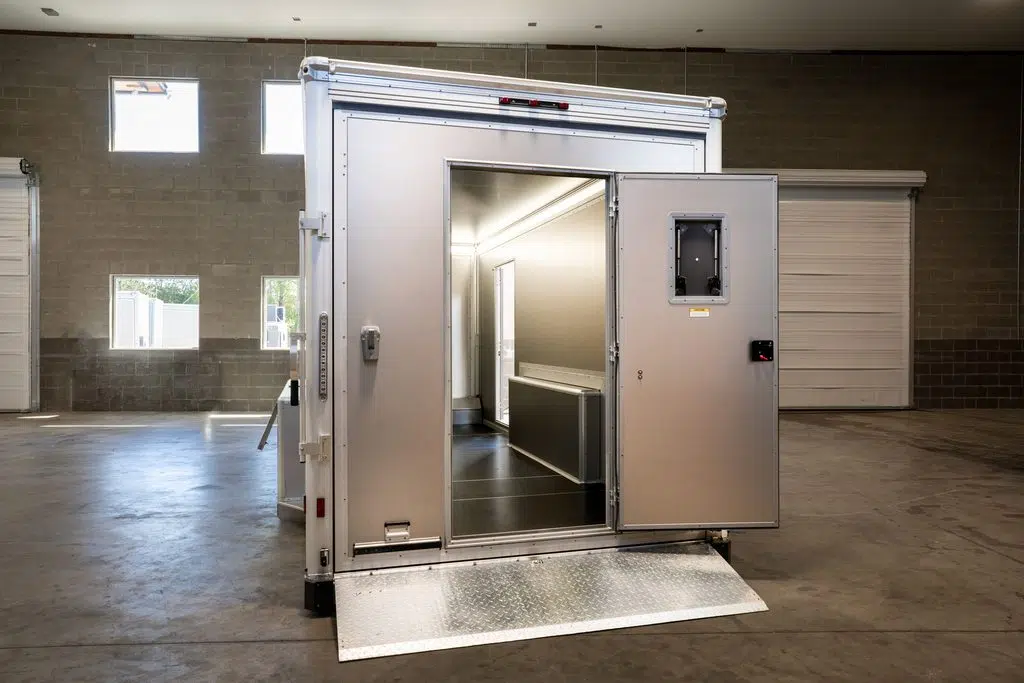
Note that every enclosed drop deck trailer, such as our GT19AL, is built using our patent-pending composite aluminum panels. We sandwich 1.5” of polystyrene between sheets of #5052 aluminum. This insulates the trailer such that the interior temperature is typically 10 to 15-degrees lower than you’d find in a similar aluminum trailer. We also water-test every trailer to make sure that they’re weather-tight.
Consider the Whole Stop
Loading convenience matters, but so does the complete process of arriving at a property and getting ready to leave.
Good Trailers by GoodMFG® must be uncoupled from the tow vehicle before operating the hydraulic drop-deck system. Our operating instructions also call for a safe, level surface, wheel chocks, and clearance around and underneath the trailer. Follow the full instructions for your model rather than treating lowering the deck as an isolated step.
That requirement belongs in the buying decision.
For a crew working at one installation project for several hours, setting up a lowered trailer may fit naturally into the job. For a mowing crew making many short stops, disconnecting and reconnecting deserves closer consideration.
However, even with hitching and unhitching, you’ll typically find the loading process takes perhaps 5 or 6 minutes. Steep, narrow, high-angle ramps on traditional trailers can increase those loading times to 15 to 20 minutes. Hitching and unhitching usually feels, at first, like a bigger problem than it actually is.
Check Equipment Fit
Before comparing models, make an equipment list and work through three practical checks.
Measure the complete machine. Cutting width is not overall width. The 60-inch Toro mower discussed above is listed at 76 inches wide with its discharge deflector down.
A tight fit in our 6’10” GT19AL, but doable!
Check your own machine’s dimensions in its manufacturer-approved transport configuration, including attachments, and compare them with the trailer’s narrowest loading point. For an enclosed trailer, check doorway height and interior clearance as well.
Plan for everything you’ll need to bring with you though:
- All machines
- All attachments
- All tools
- All supplies
We would never say our trailers are right for every landscaping crew. We will say our trailers might well be right for many of them.
FAQ
Can a ground-level loading trailer replace a dump trailer?
Not when your main need is unloading loose materials. A hydraulic drop deck system lowers the trailer for equipment access. A dump trailer raises and tips its bed to discharge materials such as mulch, soil, or gravel. Both use hydraulics, but they fulfill different functions. You may need both types of trailers.
Does the load need to be rearranged after dropping off equipment?
It may. Removing a heavy machine changes both the trailer’s total weight and its weight distribution. Staying below the carrying-capacity limit is not enough: equipment placement also affects tongue weight—the downward load on the hitch—and towing stability.
For example, suppose you deliver one mower to a crew but leave another machine aboard. Before towing away, reassess the remaining load rather than assuming the original arrangement still works. Follow your trailer’s loading guidance, verify appropriate weight distribution, and secure everything again. Plan for the loads you will tow between stops, not just the full load leaving the shop.
Is an enclosed landscaping trailer enough to protect tools from theft?
It can help, but an enclosure is not a complete security plan. Equipment can be stolen from a trailer, and the trailer itself can also be taken. The National Association of Landscape Professionals recommends layered protection, including consistent locking practices, key control, secure storage, and tracking where appropriate.
Create an end-of-day routine that covers both the trailer and its contents. Keep an up-to-date inventory of equipment makes, models, and serial numbers, and establish who checks that tools are accounted for and secured. Those records can also help with reporting and identifying stolen equipment.
Can crews warm up mowers or test gas-powered tools inside an enclosed trailer?
No. Do not use the enclosure as a place to idle engines, test gas-powered tools, or operate a portable generator. Gasoline engines produce carbon monoxide, which can accumulate dangerously in enclosed or partially enclosed spaces—even spaces that appear well ventilated. Opening the trailer doors is not a reliable safeguard.
An enclosed trailer can provide equipment storage, but it should not be treated as an engine-running workspace. Perform those tasks outdoors in an appropriate location, following the equipment manufacturer’s instructions.
Key Takeaways
Consider the following as you think about whether drop deck trailers are the right landscaping trailers for your business.
- Match the loading arrangement to your equipment. Good Trailers’ 22-inch-long, 11-degree ramp provides a short approach to the lowered deck. Still, check each machine’s loading instructions, actual transport dimensions, and ground clearance. A gentle angle alone does not establish compatibility.
- Choose a flatbed or enclosure based on the rest of the job. Start with a flatbed when equipment transport is the priority. Consider an enclosed trailer when protected storage and organization matter too, with optional shelves, cabinets, E-track, or floor-mounted D-rings planned around your equipment.
- Evaluate the complete stop, not just the hydraulic movement. Good Trailers must be uncoupled before lowering. Include positioning, unhitching, loading, securement, and reconnecting when deciding whether the system fits your workday.
- Plan beyond the first load. A useful landscaping trailer setup accounts for equipment access, carrying capacity, weight distribution, maintenance, and security—including what changes as equipment comes off and goes back aboard.
Load Low, Haul Good
Ready to make a hydraulic drop deck trailer your next landscaping trailer?
Click here to locate your nearest dealer, or contact us for options!
See also:
How to Choose the Right Ground Level Loading Trailer
Who Sells Zero Degree Trailers? The Ground-Level Loading Truth
Drop Deck Trailers for Daily Equipment Moves
This resource was compiled by the GoodMFG® Product Team, drawing on 75 years of combined experience in hydraulic systems, heavy-duty transport, trailers, and modular structures.
P.S. – We build trailers every day, but we don’t run your crews. If there’s a specific logistical headache or a “field reality” we’ve missed, we want to hear about it. Help us refine the equipment that makes your day easier! Email our Marketing Lead at devan-h @ goodrv.com and let us know what we should solve next.