Comparing drop deck trailers vs. liftgate trucks? Both drop deck trailers and liftgate trucks serve the goal of moving heavy cargo from ground level to transport heights. However, each solution tackles the problem in fundamentally different ways.
Which solution is right for you? Here’s our no-fluff take on when you should invest in drop deck trailers and when liftgates might genuinely be the better solution.
Table of Contents
How Each Solution Works
A liftgate uses a powered platform mounted at the rear or side of a truck body to move cargo between ground level and the height of the truck bed.
A hydraulic drop deck solves the same height problem in the opposite direction.
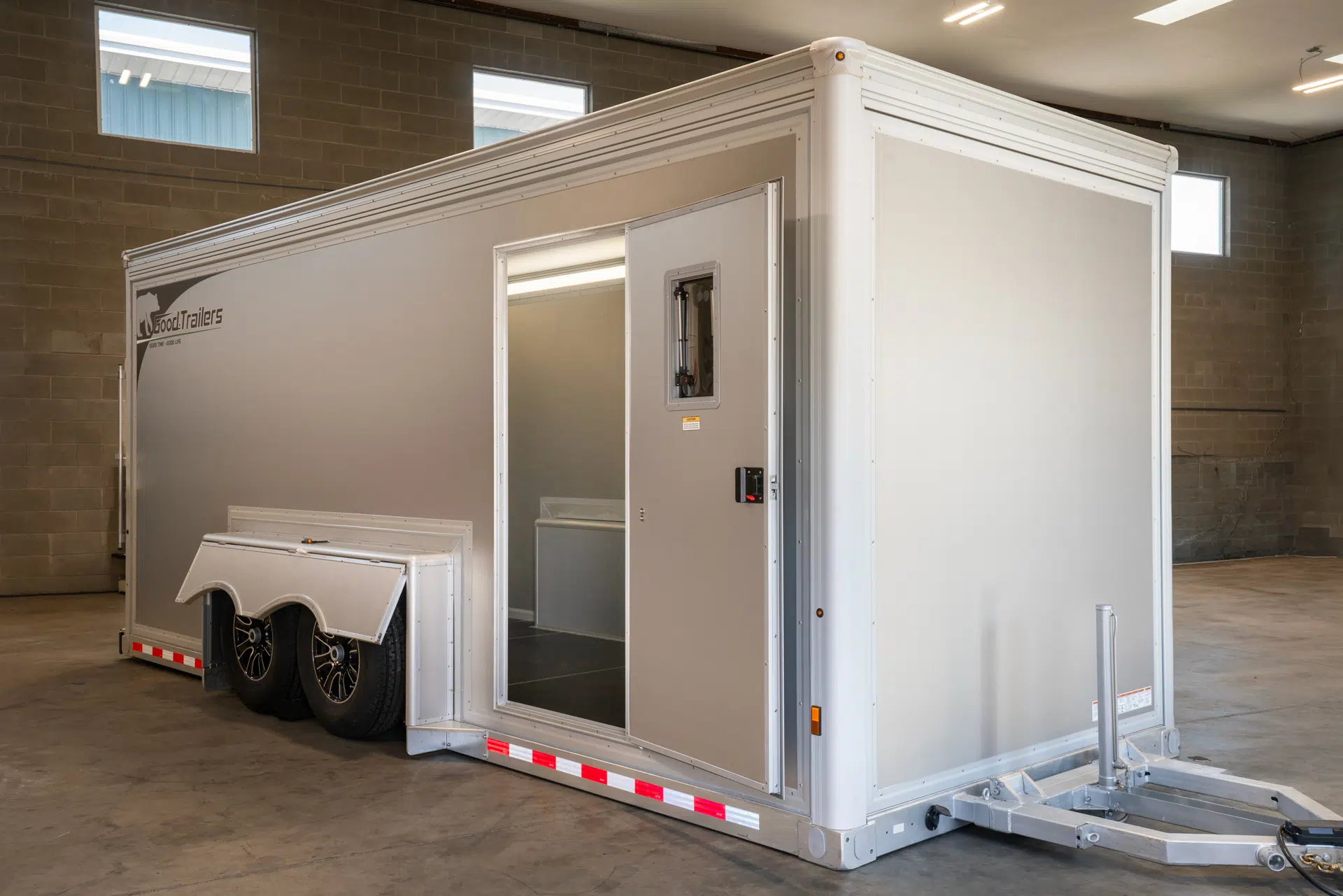
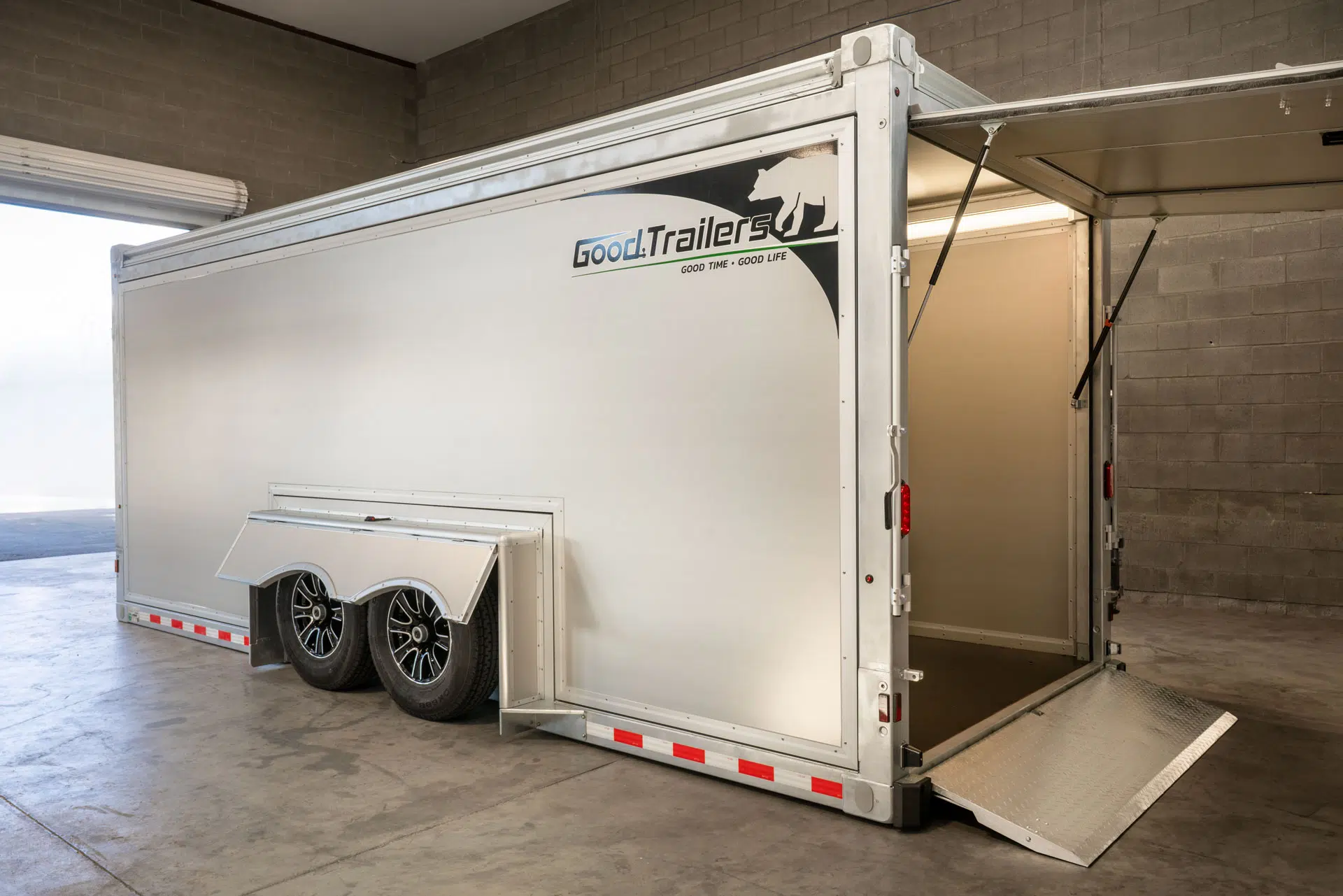
GoodMFG® trailers lower the chassis to the ground, bringing the deck to just 5.4 inches above the loading surface. On our flatbeds, a short 22-inch, 76.5-inch-wide rear ramp provides the remaining 11° transition.
Instead of raising each load several feet to meet the cargo floor, you bring the trailer down close to the load.
Once the cargo is aboard and properly secured, the trailer is raised back into towing position and reconnected to the tow vehicle.
That difference becomes especially useful when the cargo is large, heavy, wheeled, low-clearance, or awkward to fit onto a lifting platform.
Handling Larger Loads & Equipment
A liftgate has two important limits: the rated capacity of the lifting system and the usable size of the platform.
That works very well for cargo designed around the platform.
But once the load becomes larger, longer, or more awkward, platform size can become just as important as weight.
A GoodMFG® drop deck gives you the trailer deck itself as the loading surface.
For example:
The GT19FL provides a 17′9″ × 6′10″ usable deck and an estimated carrying capacity of 8,000 pounds.
The GT13FL provides an 11′8″ × 6′10″ usable deck and an estimated carrying capacity of 5,055 pounds.
That can make a drop deck a strong option for compatible compact machinery, scissor lifts, landscaping equipment, floor-care equipment, carts, and other loads that benefit from a broad loading surface rather than a lifting platform.
Of course, you should always check the complete load weight, usable dimensions, loading path width, ground clearance, weight distribution, and equipment-manufacturer instructions before choosing the trailer.
Drop Deck Trailers vs. Liftgate Trucks: Loading the Whole Equipment Package
A liftgate moves cargo between two heights one platform load at a time.
A drop deck can approach the job differently.
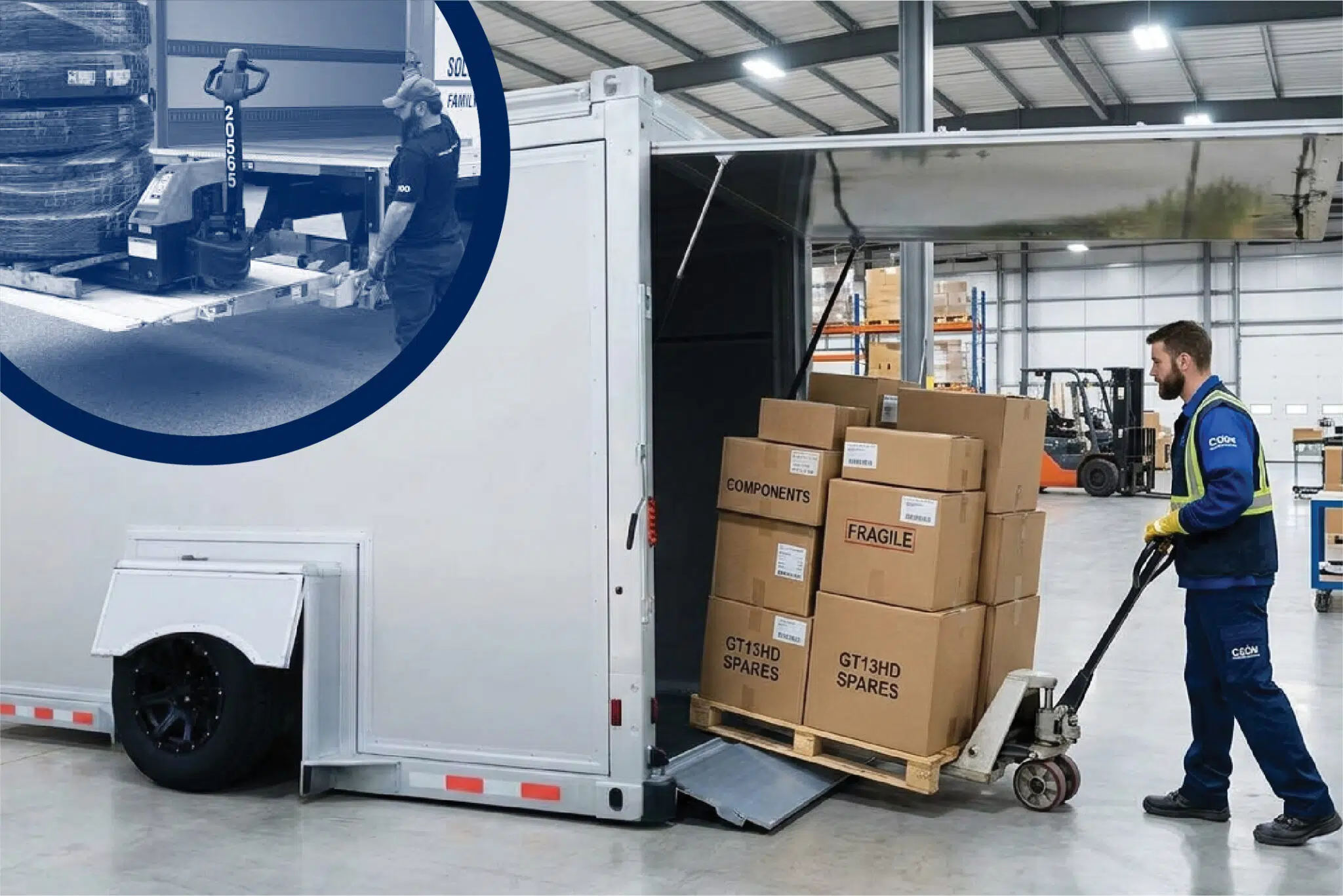
Once a GoodMFG® trailer is lowered, the entire deck becomes accessible at the lower loading height. That can be useful when a crew needs to load several compatible pieces of equipment, carts, tools, or supplies as one equipment package.
Instead of raising the loading platform separately for each item, the trailer remains lowered while the load is arranged and secured.
Good Trailers do require their own setup process. Our current Owner’s Manual requires the trailer to be completely uncoupled from the tow vehicle before operating the hydraulic drop deck.
So we would not promise that a drop deck is always faster.
If you make dozens of quick curbside deliveries throughout the day, repeatedly unhitching a trailer would get old fast.
But if you arrive at a jobsite, yard, facility, event, or project and unload an entire equipment package, bringing one large deck down to the load can be a very practical way to work.
Drop Deck Trailers vs. Liftgate Trucks: Footprint & Fleet Flexibility
A truck with an integrated cargo body can have an advantage in tight delivery environments because it is one vehicle rather than a tow vehicle and trailer combination.
That matters if your normal day involves curbside deliveries, loading zones, parking structures, or congested retail locations.
A trailer offers a different kind of flexibility.
The tow vehicle and cargo trailer remain separate assets.
That means an appropriately rated tow vehicle can be used for other work when the trailer is not needed, and the trailer can be left at a jobsite or facility when that fits the operation.
If a tow vehicle is unavailable, another properly rated and compatible tow vehicle may also be able to move the trailer.
For fleets that already operate suitable pickups or other tow vehicles, that separation can be one of the practical advantages of a trailer-based system.
Drop Deck Trailers vs. Liftgate Trucks: Weather Protection
If you need enclosed cargo space, a liftgate truck is not the only option.
GoodMFG® offers enclosed hydraulic drop deck trailers in several configurations, including high-cube models with additional interior height.
That lets you combine low loading height with protection from direct rain, road spray, and debris, along with a lockable enclosed cargo area.
If the work calls for open access instead, our flatbed models provide the same hydraulic drop-deck concept without the enclosure.
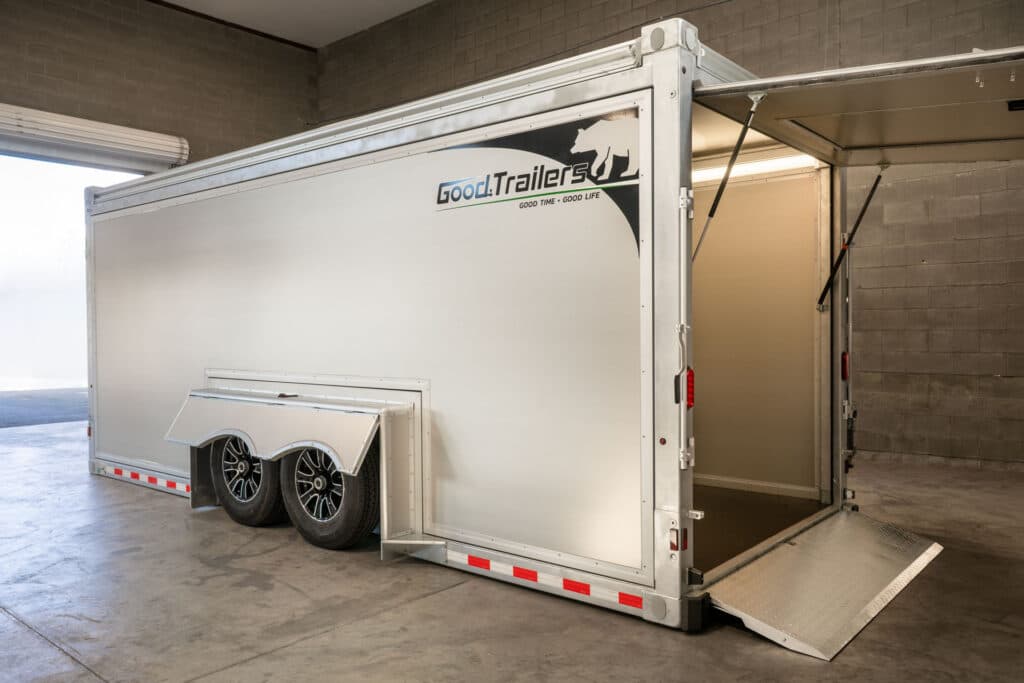
Drop Deck Trailers vs. Liftgate Trucks: Loading Geometry
One of the biggest differences between these systems is where the load is while the height changes.
A liftgate raises cargo on a platform until it reaches the height of the truck floor.
A GoodMFG® drop deck brings the trailer floor close to the cargo instead.
That keeps the initial loading transition close to ground level.
For compatible wheeled or low-clearance equipment, the load crosses a short 11° rear ramp and then reaches the level deck 5.4 inches above the loading surface.
That geometry can reduce the amount of climbing required and may make positioning large or awkward equipment more straightforward.
It does not eliminate loading hazards.
Cargo still needs to fit the trailer, remain within weight ratings, be loaded on an appropriate surface, and be properly positioned and secured.
FAQ
What happens if the drop deck hydraulic system needs repair?
Hydraulic systems require inspection and maintenance like other mechanical systems.
If the hydraulic system is damaged, leaking, or operating abnormally, stop using it and have the problem properly diagnosed.
Hydraulic repair and maintenance should be performed by a qualified technician using components compatible with the system.
How do drop deck trailers compare to liftgate trucks for docks & route delivery?
If your normal operation involves loading at warehouse docks, frequent curbside deliveries, or repeated stops at retail locations where there is little practical room to uncouple and lower a trailer, a truck-based loading system may be the more practical choice.
That is especially true for delivery routes involving relatively small quantities of cargo at many stops.
GoodMFG® drop decks are strongest when the problem you need to solve is different: getting machinery, rolling equipment, carts, tools, or an entire equipment package onto a broad, low loading surface.
Key Takeaways
When should you choose each vehicle?
Look, we’d never tell you drop decks are always the right solution for every situation. Here’s how you make the comparison when you need to decide on drop deck trailers vs. liftgate trucks.
Buy a liftgate truck if:
- Your work consists primarily of frequent curbside deliveries at many locations.
- You regularly work from standard warehouse loading docks.
- Your daily route leaves little practical space or time to uncouple a trailer.
- Your cargo comfortably fits the lifting platform and the truck’s intended workflow.
Buy a drop deck trailer if:
- You haul compatible machinery or equipment that benefits from a broad loading surface.
- Low-clearance or wheeled equipment benefits from reaching a level deck after a short 11° transition.
- You want to load several compatible pieces of equipment or supplies onto one lowered deck.
- You need ground-level loading in either a flatbed or enclosed trailer.
- You already operate appropriately rated tow vehicles and value being able to separate the cargo trailer from the powered vehicle.
- You need up to 5,055 pounds of estimated carrying capacity on the GT13FL or 8,000 pounds on the GT19FL.
- You want the loading surface to come down close to the cargo rather than lifting the cargo several feet to the transport floor.
Haul Yourself the Right Solution
Match the equipment to the payload, dimensions, loading site, and daily workflow.
If what you really need is a broad loading surface that comes down to the load, that’s exactly what GoodMFG® hydraulic drop deck trailers were designed to provide.
Explore our flatbed and enclosed models, find your nearest dealer, or contact our team to compare your equipment with the right trailer.
See also:
Best Trailers for Hauling Stone Pavers
Drop Deck vs. Tilt Trailers: A Complete Comparison Guide
This resource was compiled by the GoodMFG® Product Team, drawing on 75 years of experience in hydraulic systems, heavy-duty transport, trailers, and modular structures.
P.S. – We build trailers every day, but we don’t run your crews. If there’s a specific logistical headache or a “field reality” we’ve missed, we want to hear about it. Help us refine the equipment that makes your day easier! Email our Marketing Lead at devan-h @goodrv.com and let us know what we should solve next!