A mini skid steer trailer has to carry more than the machine you see on the spec sheet. The loader may be compact, but the bucket, trencher, forks, auger, rake, fuel, and securement gear that make it useful still have to travel with you.
That is why choosing a trailer for a stand-on compact loader starts with the complete working load. The best mini skid steer trailer is the one that fits the machine you actually use, not a stripped-down brochure version. Machine weight matters, but so do attachment weight, deck space, loading geometry, securement access, and the tow vehicle pulling the whole setup.
At GoodMFG®, our GT13FL and GT19FL hydraulic drop deck flatbeds are designed around low, drive-on loading and a level open deck. For many compatible mini skid steers, that combination makes a practical equipment-hauling setup. The right model depends on what your crew actually takes to work.
Table of Contents
A Mini Skid Steer Trailer Needs to Carry the Whole Work Setup
Manufacturers use several names for this equipment category: mini skid steer, mini track loader, compact utility loader, and stand-on skid steer are all common. For this guide, “mini skid steer” means the compact stand-on loaders that share the same basic transport questions.
The first question is not simply, “What does the loader weigh?”
Ask instead:
- What does the machine weigh in the configuration you normally transport?
- Which attachment stays mounted?
- Which additional attachments ride separately?
- What tools, chains, straps, fuel, or other jobsite gear travel on the trailer?
- How much deck space must remain available for positioning and securement?
A mini skid steer trailer that works well for the loader and one bucket may feel very different once a trencher, forks, or power rake joins the load.
For example, Toro lists the TX 1000 Turbo at 2,911 pounds and 104 inches long with its bucket. Ditch Witch lists the SK1050 at 3,435 pounds without an attachment and 105 inches long with a standard bucket. Those are compact machines, but neither is weightless—and the attachment package can add hundreds of pounds more.
The loader may be compact. Its attachment collection did not get the memo.
Start With the Complete Transport Weight
Before choosing a mini skid steer trailer, total the weight that will actually ride on it.
Use the machine manufacturer’s current specifications, then add the attachments and cargo you expect to carry. Bobcat’s transport guidance makes the same basic point: the transport or towing vehicle needs adequate capacity for the machine and attachments being transported. Separate attachments also need to be properly secured when they are not mounted to the loader.
Attachment weight can add up quickly. Ditch Witch lists, among the attachments available for the SK1050, a 375-pound trencher, 428-pound powered forks, a 487-pound power rake, and a 493-pound rototiller. Your equipment may be entirely different, but the lesson is the same: a trailer selected around the bare loader can run out of useful capacity once the working package is aboard.
GoodMFG® gives you two open flatbed choices to work from:
| Model | Usable Deck | Estimated Carrying Capacity |
|---|---|---|
| GT13FL | 11’8″ L × 6’10” W | 5,055 lb |
| GT19FL | 17’9″ L × 6’10” W | 8,000 lb |
Treat the numbers as selection limits, not targets to squeeze every load against. A mini skid steer trailer should leave you with a workable transport setup, not a math exercise that only works when nothing else comes along.
Check the complete cargo, load placement, tow vehicle, hitch, and applicable ratings before transport.
Attachment Space Can Matter as Much as Payload
A mini skid steer trailer can have enough weight capacity and still be the wrong size for the way you work.
That happens because mini skid steers are attachment platforms. Deck planning is where a mini skid steer trailer often proves either useful or frustrating. A bucket mounted to the machine occupies one kind of space. A trencher, forks, auger, rake, or tiller carried separately creates another problem: it needs its own footprint, securement, and access.
Think about what happens at the first job of the day. If the attachment you need is buried behind another tool, or removing the loader is the only way to reach it, the trailer may technically hold everything without supporting the workflow very well.
A larger mini skid steer trailer is not automatically better. If your normal setup fits comfortably on the smaller model, there is no prize for towing unused deck space.
The useful question is whether your ordinary work package fits with enough room to position and secure it properly.
Loading Geometry Matters for Tracked Stand-On Equipment
A mini skid steer trailer also has to provide a loading path that works with the machine.
Tracked stand-on loaders have a wheelbase or track length, ground clearance, attachment geometry, and operator platform that all affect the transition onto a trailer. For a mini skid steer trailer, the loading transition deserves the same attention as payload.
A machine can have plenty of room once it reaches the deck and still be a poor match for the route it has to take to get there.
GoodMFG® flatbeds address that transition by bringing the trailer down toward the equipment.
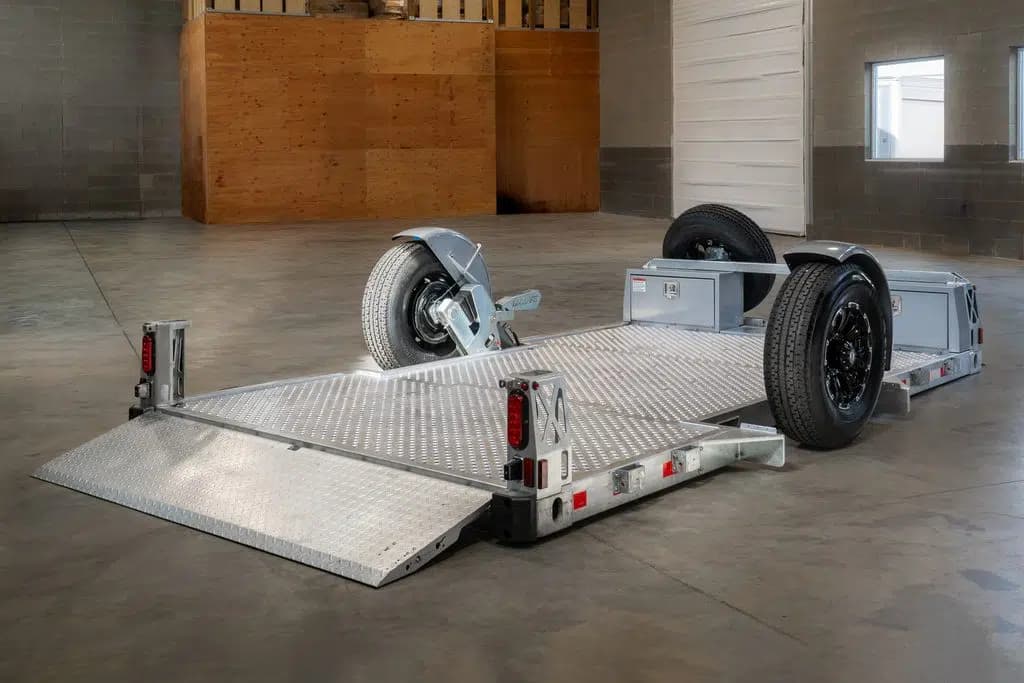
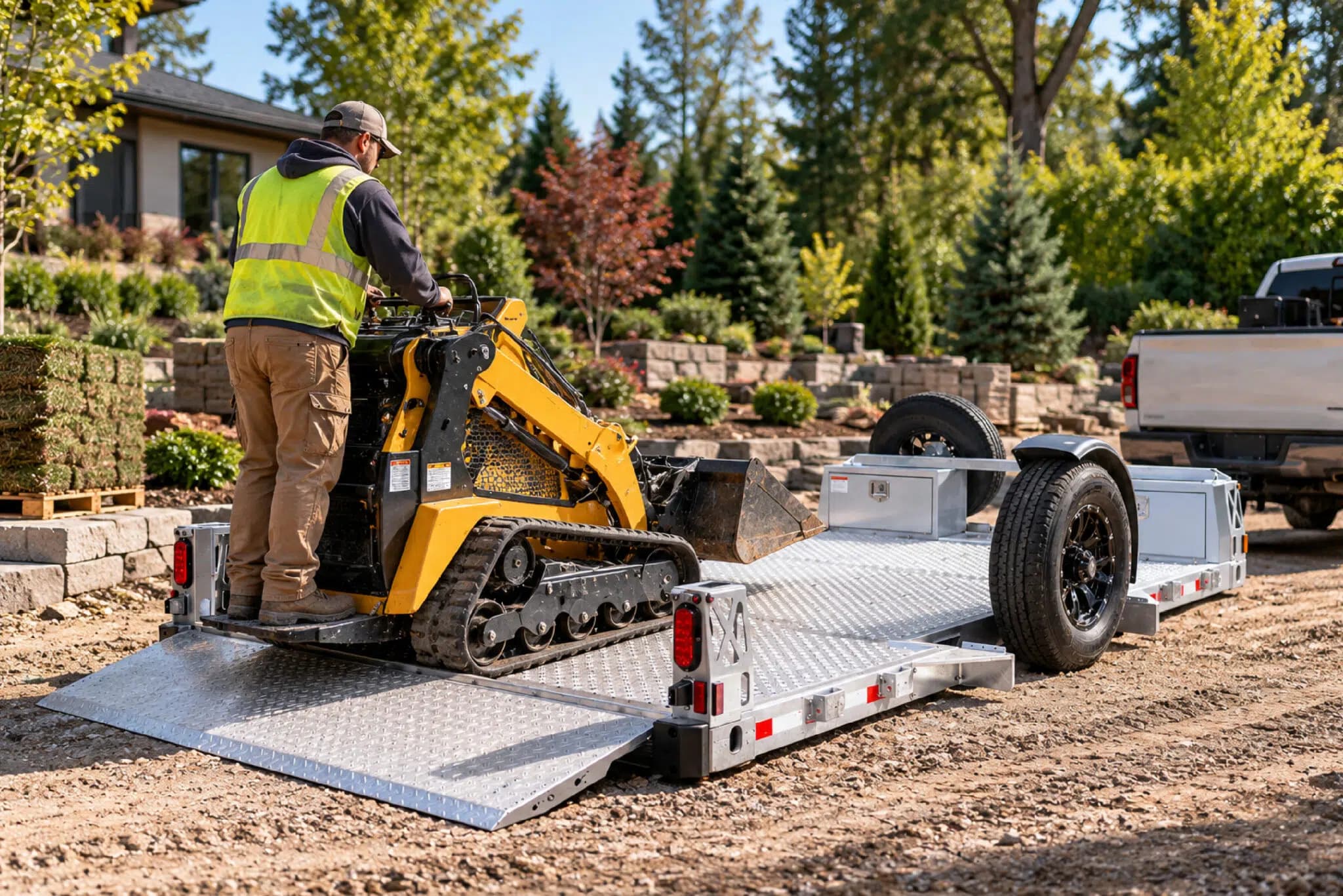
The GT13FL and GT19FL lower until the chassis rests on the loading surface. The main deck sits 5.4 inches above that surface, and a 22-inch rear ramp bridges the remaining height at an 11-degree approach. The ramp is 76.5 inches wide, so a compatible machine crosses a short transition and reaches a level main deck.
That does not guarantee clearance for every mini skid steer. Compare the actual machine in its transport configuration with the trailer dimensions and the equipment manufacturer’s loading instructions.
The practical benefit is straightforward: instead of asking the loader to climb to the trailer’s normal 18-inch towing height, the mini skid steer trailer lowers for loading.
A Level Main Deck Gives You Room to Position the Machine
Once the machine is aboard, a mini skid steer trailer still has to let you position and secure it correctly.
The GoodMFG® hydraulic system lowers the trailer without turning the main deck itself into the loading incline. After the loader crosses the short rear ramp, it reaches a level platform.
That distinction can matter when you are positioning a tracked machine and separate attachments. You can move the loader into its transport position on a flat surface, then arrange the rest of the load around the available deck space.
An open flatbed also keeps the machine accessible from the sides. That can help when you need to reach the machine’s designated securement points and arrange separate cargo around it.
Always follow the loader manufacturer’s transport instructions rather than treating every compact loader alike. Bobcat, for example, directs operators to use the designated front and rear tie-down points identified in the machine’s manual and to properly secure separate attachments to the transport device.
Your equipment manufacturer’s instructions control for your machine.
GT13FL or GT19FL? Start With the Work Package
The most useful way to compare GoodMFG® options is not “small machine equals small trailer.”
Start with the complete package that needs to travel.
Start With the GT13FL When the Load is Compact
The GT13FL is worth a close look when the loader and its normal attachments fit comfortably within the 5,055-pound estimated carrying capacity and 11’8″ × 6’10” usable deck.
Consider the Toro TX 1000 Turbo as an illustration. Toro lists the machine at 2,911 pounds and 104 inches long with its bucket. The GT13FL has a 140-inch usable deck length.
On paper, that leaves meaningful payload and deck length available.
That does not automatically certify the combination. A different attachment, different machine configuration, additional cargo, load placement, or manufacturer requirement can change the answer.
But it does illustrate why the GT13FL can be a sensible mini skid steer trailer for crews with a relatively compact transport setup.
Start with the GT19FL When Attachments are Part of the Everyday Load
The GT19FL makes a stronger case when the loader is only one part of the setup.
Its 17’9″ usable deck provides substantially more length than the GT13FL, and its estimated carrying capacity increases to 8,000 pounds. That gives you more room to account for separate attachments, tooling, and future additions without immediately crowding the machine.
Take the Ditch Witch SK1050 as an example. Ditch Witch lists the loader at 3,435 pounds without an attachment. Add one of its listed 550-pound trencher attachments and the combination is already around 3,985 pounds before you count any other cargo.
That could still fall within the GT13FL’s published capacity, depending on the actual configuration. But weight alone does not tell you whether the remaining deck space supports the way your crew works.
If multiple attachments travel regularly, the longer GT19FL may be the more practical mini skid steer trailer even when the smaller trailer has enough payload on paper.
Do Not Forget the Tow Vehicle & Load Distribution
Choosing a mini skid steer trailer does not stop at trailer payload.
The tow vehicle, hitch, trailer ratings, cargo placement, and tongue weight all have to work together. A mini skid steer trailer only works as part of a suitable towing combination.
Do not assume that because a mini skid steer physically fits on the deck, the complete towing setup is automatically appropriate.
Confirm the tow vehicle’s ratings, the trailer’s GVWR, the hitch and coupler requirements, and the actual loaded configuration.
Load placement matters, too. An attachment that looks easy to tuck into an empty spot can change how weight is distributed across the trailer. Plan where the loader and attachments belong before treating every remaining square foot as cargo space.
If you are comparing several types of equipment or need a broader walkthrough of trailer selection, our ground-level loading trailer guide covers the dimensions, payload, loading-path, and towing questions that apply across the lineup.
FAQ
Does a drop deck eliminate the need to check ground clearance?
No. A mini skid steer trailer can reduce the climb without guaranteeing that every machine clears every transition.
GoodMFG® flatbeds lower the deck to 5.4 inches above the loading surface and use an 11-degree rear ramp. Compare that geometry with your machine and follow its loading instructions.
Should attachments stay connected to the loader during transport?
Follow the equipment manufacturer’s transport instructions.
Some attachments may remain mounted; others may ride separately. Any separate attachment needs to be properly positioned and secured for transport. Bobcat, for example, specifically addresses securing attachments that are carried separately.
Key Takeaways
- Choose a mini skid steer trailer around the complete working load, not the bare machine.
- Attachments affect both payload and usable deck space.
- The GT13FL can be a practical match for compact loader-and-attachment setups within its limits.
- The GT19FL provides more payload and substantially more deck length when multiple attachments travel with the loader.
- GoodMFG® flatbeds lower to a 5.4-inch deck height with a short 11-degree loading transition, then provide a level main deck.
- Verify the machine manufacturer’s loading and securement instructions and confirm the complete towing setup before transport.
Trailers for the Work You Do
- Choose a mini skid steer trailer around the complete working load, not the bare machine.
- Attachments affect both payload and usable deck space.
- The GT13FL can be a practical match for compact loader-and-attachment setups within its limits.
- The GT19FL provides more payload and substantially more deck length when multiple attachments travel with the loader.
- GoodMFG® flatbeds lower to a 5.4-inch deck height with a short 11-degree loading transition, then provide a level main deck.
- Verify the machine manufacturer’s loading and securement instructions and confirm the complete towing setup before transport.
Build the Trailer Around the Work You Actually Do
The right mini skid steer trailer should make sense on Monday morning with the bucket aboard and on Thursday afternoon when the trencher, forks, and the rest of the week’s gear have joined the trip.
If that’s a drop deck trailer from GoodMFG®, find your nearest dealer or contact us for options!
This resource was compiled by the GoodMFG® Product Team, drawing on 75 years of combined experience in hydraulic systems, heavy-duty transport, trailers, and modular structures.
P.S. – We build trailers every day, but we don’t run your crews. If there’s a specific logistical headache or a “field reality” we’ve missed, we want to hear about it. Help us refine the equipment that makes your day easier! Email our Marketing Lead at devan-h @ goodrv.com and let us know what we should solve next.