Comparing trailer types for equipment hauling starts with two questions: how will your load get aboard, and what does it need while it travels?
Shopping gets confusing because the names describe different things. An equipment trailer might also be a flatbed, a tilt trailer, or a hydraulic drop deck. An enclosed trailer can lower for loading, too.
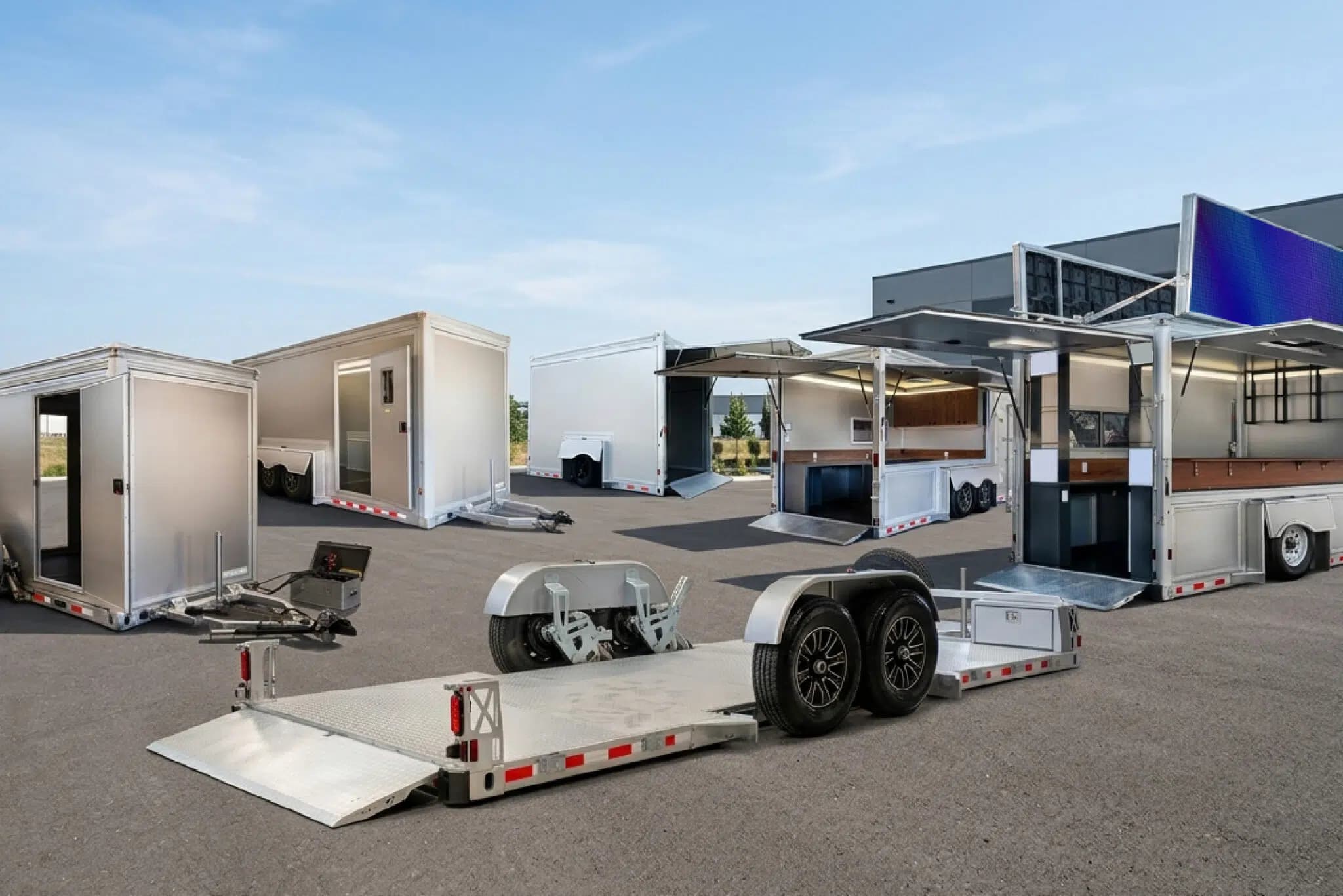
At GoodMFG®, we build hydraulic drop deck trailers that bring the loading surface closer to the ground while keeping the main deck level. We offer both open and enclosed configurations, giving equipment owners a way to combine easier loading with the cargo space their work requires.
Here is how to compare the trailer types you are likely to encounter and identify the options worth a closer look.
Table of Contents
Understanding Trailer Types Before You Compare Models
Most trailer listings describe a combination of three characteristics:
- Body style: An open deck or an enclosed cargo area.
- Loading method: Ramps leading to a fixed deck, a deck that tilts, or a hydraulic system that lowers the trailer.
- Hitch arrangement: How the trailer connects to the tow vehicle, such as a rear-mounted hitch for a bumper-pull trailer or an in-bed hitch for a gooseneck.
Those labels can overlap. A trailer can be both enclosed and a hydraulic drop deck. “Flatbed” describes an open cargo platform; it does not tell you whether that platform stays at towing height, tilts, or lowers for loading.
To compare trailer types, separate the cargo space you need from the loading method you prefer.
Choose the Body Style that Matches Your Cargo
Open Utility & Equipment Trailers
Open utility trailers commonly have a deck with low sides or rails. Equipment trailers are built around machinery transport, with the deck, loading arrangement, and rated capacity varying by model. The names alone do not establish what either trailer can carry.
When comparing these trailer types, look at how you will reach the load. An open flatbed gives you access around equipment for positioning and securement, without an enclosure defining the available overhead space.
That can be useful when your primary load is a mower, compact machine, or other equipment you unload at the jobsite. You can see the load and approach its attachment points from outside the trailer.
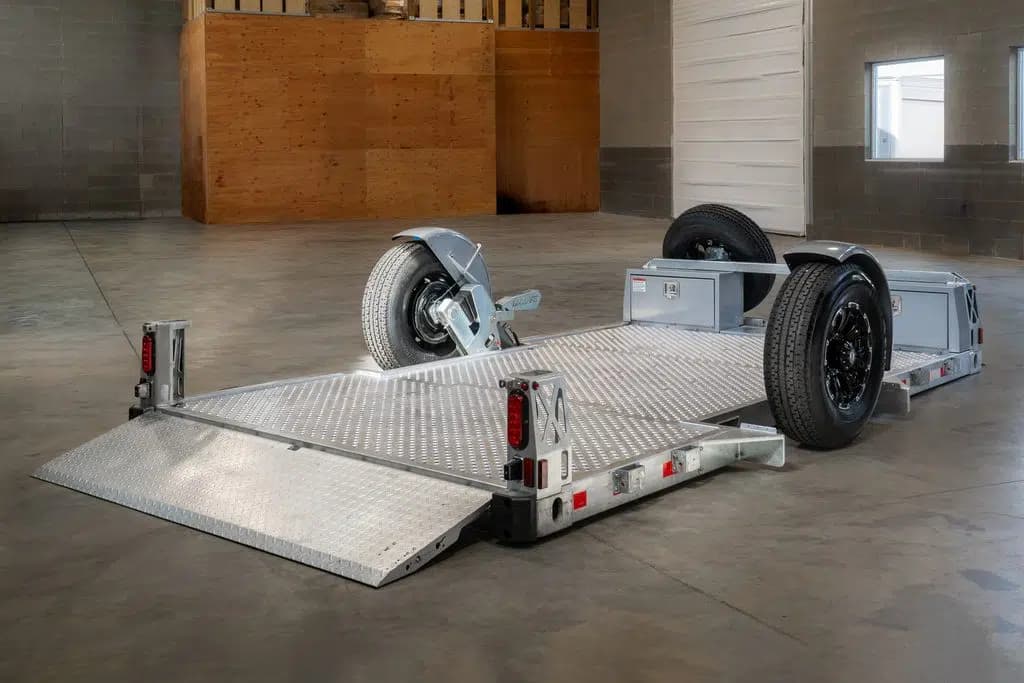
GoodMFG® flatbed drop deck trailers combine that open access with hydraulic lowering. Choosing an open trailer does not mean you have to accept a conventional loading height.
Enclosed Cargo Trailers
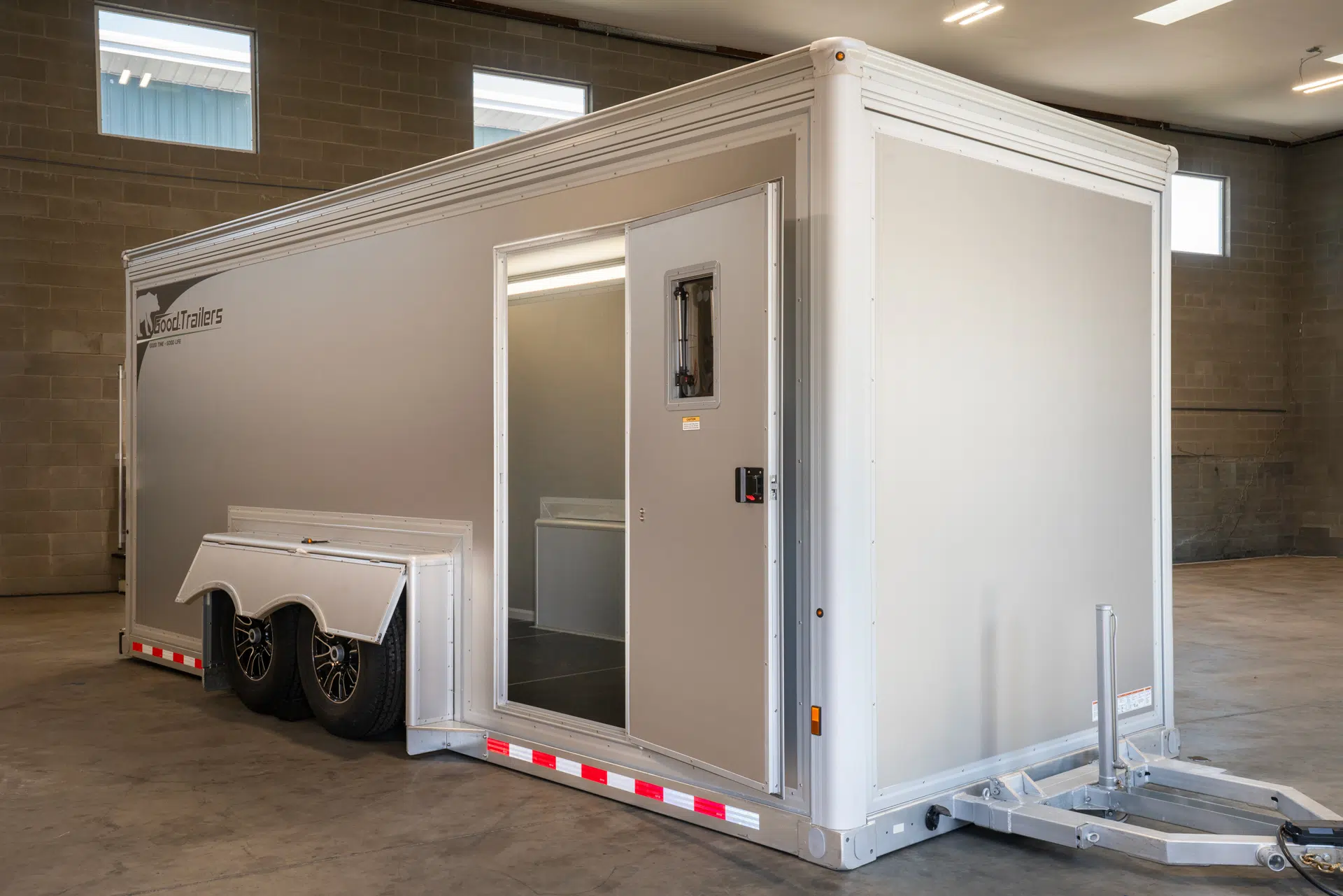
Enclosed trailers add walls, a roof, and a cargo area you can close and lock. They provide protection from direct rain, road spray, and debris, while giving tools and supplies a place to stay together between jobs.
The decision between open and enclosed trailer types becomes more interesting when the machine is only part of the load.
A contractor might also carry toolboxes, replacement parts, cords, and materials. An enclosure creates room to organize that equipment, including shelving or cabinets where the configuration allows. Think about whether you want to unload everything after each trip or keep a working setup aboard.
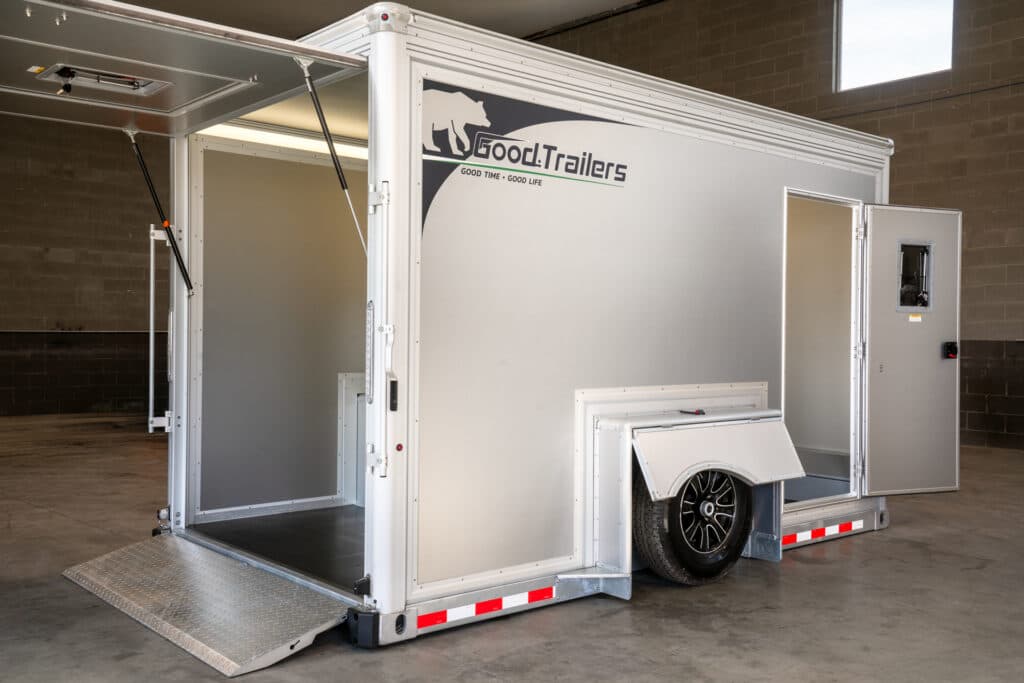
Our enclosed drop deck trailers bring hydraulic lowering to that protected cargo space. You can choose an enclosure and still bring the loading surface down toward your equipment.
Compare Trailer Types by How They Load
Once you have an idea of the body style, compare the loading approaches. This is where differences between trailer types can change the work you do at every pickup and delivery.
| Loading approach | What moves | Route onto the trailer |
| Fixed deck with ramps | The ramps are positioned or unfolded | The load climbs the ramps to a deck at transport height |
| Tilt deck | Some or all of the load deck angles toward the ground | The load travels along the inclined deck during loading |
| Hydraulic drop deck | The trailer lowers while the main deck stays level | On GoodMFG® flatbeds, a short rear ramp leads onto the lowered deck |
Each approach can be offered in different sizes and capacities. Compare the actual design, rather than assuming every trailer carrying the same label works identically. [4]
Fixed Decks with Loading Ramps
On a conventional fixed-deck trailer, ramps bridge the distance between the ground and the cargo platform. Depending on the model, they may fold, stand upright, or slide into storage. Some are attached; others are removable.
For these trailer types, the ramp arrangement deserves as much attention as the deck. Consider the loading angle, ramp width, equipment wheel or track spacing, and the transition at the top.
If that transition is the difficult part of your current routine, a trailer that lowers gives you another way to address it. You can reduce the height your equipment has to climb by bringing the trailer down.
Tilt Trailers
A tilt trailer pivots some or all of its deck toward the ground. Gravity-tilt designs use the balance of the deck and load to control movement, often with hydraulic damping. Powered versions use hydraulics to control the tilt.
These trailer types use the deck itself as the loading incline, reducing the need to position a separate pair of ramps.
Pay attention to what happens after the front wheels reach the trailer. The equipment continues along an angled surface until it reaches the appropriate position and the deck returns to transport position. Some designs combine stationary and tilting sections.
For equipment you want to maneuver or stage on a level surface, that distinction is worth understanding.
Hydraulic Drop Deck Trailers
Hydraulic drop deck trailers lower the trailer chassis while keeping the main cargo deck level. The load reaches a low platform without the whole deck becoming an incline.
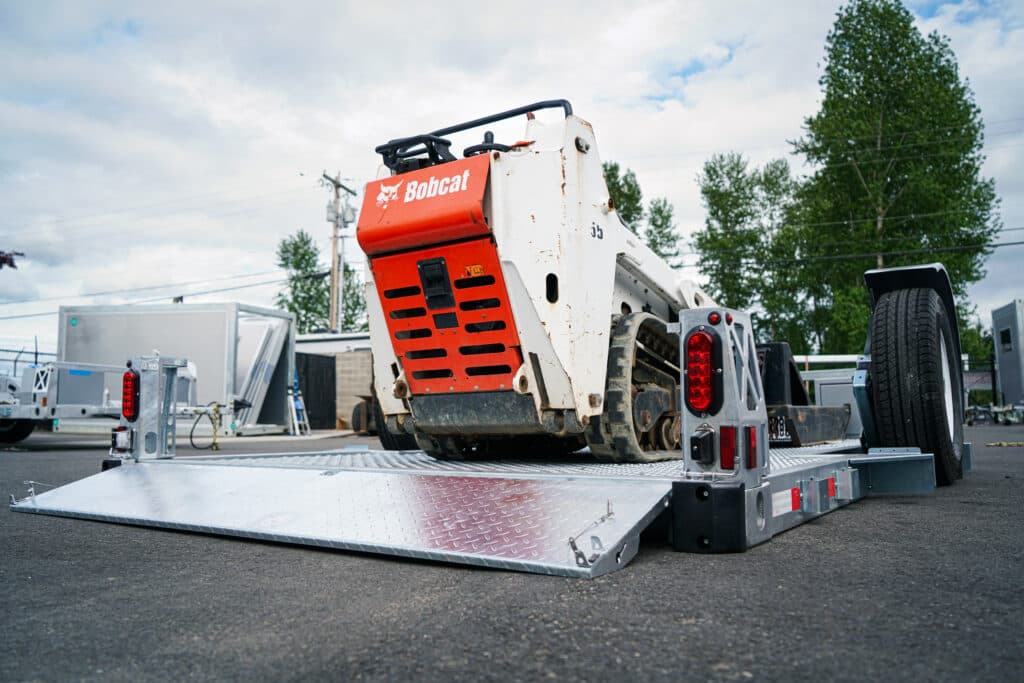
On the GoodMFG® GT13FL and GT19FL, the lowered deck sits 5.4 inches above the loading surface. A 22-inch rear folding ramp with an 11° approach bridges the remaining height. The equipment crosses that short transition and reaches the level main deck.
For buyers comparing trailer types for rolling equipment, the benefit is a short loading incline followed by a level main deck. Once a compatible cart or machine is aboard, you have a flat surface for positioning and securing it.
The attached ramp also stays with the trailer. On the GT19FL it is spring assisted, helping with the work of folding it into position.
GoodMFG® brings those features together for wheeled equipment, rolling workstations, and other loads that benefit from a short transition onto a level deck. Our enclosed models extend the same loading approach to tools and equipment that need covered transport.
Plan for a suitable, level loading area and uncouple the tow vehicle before operating the hydraulic drop deck system. Follow the preparation and operating instructions for your model.
For a closer comparison, see Drop Deck Trailers vs. Tilt Trailers.
Recognize Trailer Types for Special Requirements
Some jobs call for a feature or capacity outside the options above.
A dump trailer uses a lifting bed to discharge loose material. If unloading gravel, soil, or debris is central to the job, that dumping function is a reason to choose one.
A gooseneck connects to a hitch in the pickup bed. It describes the connection, rather than a particular loading method. If your complete equipment load exceeds the capacity or dimensions available in our range, a suitably rated larger equipment trailer, potentially a gooseneck, may be appropriate. Check the actual trailer and tow-vehicle ratings.
These trailer types address specific jobs. When your work is primarily moving equipment that fits a GoodMFG® model, compare our open and enclosed configurations for the loading access and cargo space you need.
Match Trailer Types to the Way You Work
Consider how the choice might look in a few everyday hauling situations.
Moving a Machine Between Jobs
Your primary load is a compact machine and its attachments. It comes off the trailer when you reach the site, and you want access around it for tie-downs.
Start with an open equipment platform. A GoodMFG® flatbed brings the deck down to the equipment, so the machine crosses a short ramp before reaching a level platform.
Taking a Complete Tool Setup to the Job
You carry a floor grinder, dust extraction equipment, tooling, and supplies. The machine needs to get aboard, but the rest of the kit needs an organized home, too.
An enclosed hydraulic drop deck lets you address both needs together. You get covered transport, room to plan storage, and a level main deck for arranging the load after it crosses the rear ramp.
Moving Carts & Facilities Equipment
A facilities crew transports rolling cabinets, maintenance supplies, and equipment between work areas. Some items come out at each stop; others stay aboard.
When comparing trailer types for this routine, consider both the loading transition and access after loading. GoodMFG® offers the low deck, with open or enclosed configurations to suit the rest of the job. An enclosed layout can keep supplies together; an open layout keeps equipment accessible from outside.
In each case, the full load and the places you work determine the final model. These examples give you a starting point for a useful dealer conversation.
Check Fit Before Choosing Between Trailer Types
Before moving from a shortlist to a purchase, confirm three things:
- The complete loaded weight. Count the machine, attachments, tools, supplies, and anything else traveling aboard. Payload is the weight of cargo the trailer can carry. GVWR is the maximum rated weight of the trailer and its load together.
- The usable space and loading route. Compare actual deck or interior dimensions, ramp width, and any doorway or wheel-box restrictions. Leave access for securing and handling the load.
- The towing and loading setup. Match the trailer to the vehicle and hitch ratings, and consider where you will position and prepare it at your usual stops.
For example, the GT19FL has a published estimated carrying capacity of 8,000 pounds. That figure applies to that model; it is not a blanket rating for every GoodMFG® trailer. Confirm the available capacity of the configuration you are buying.
Once you have those basics, comparing trailer types becomes a much more concrete task. You can ask which configuration gives you the loading access and working space you want within the requirements of your load.
Our ground level loading trailer guide helps you take that next step. If you are leaning toward an enclosure, Easy Loading Enclosed Trailers: Evaluating Options explains what to check along the loading route.
FAQ
Can a trailer be both an enclosed trailer and a drop deck?
Yes. Enclosed describes the cargo area; hydraulic drop deck describes how the trailer lowers for loading. GoodMFG® combines both features, so you can have covered, lockable cargo space with a lowered loading surface.
Which trailer types should I consider for low-clearance equipment?
A hydraulic drop deck belongs on your shortlist because it reduces the height the equipment must climb. Compare the actual approach and transition with the machine’s ground clearance, wheelbase, attachments, and manufacturer loading instructions. Those details determine compatibility.
Does ground-level loading mean there’s no ramp?
On GoodMFG® flatbeds, the chassis lowers to the ground, and the deck sits 5.4 inches above it. The attached 22-inch ramp provides the remaining transition. You get a short approach onto a level deck, with no separate pair of long ramps to position.
Key Takeaways
- Trailer types describe different features. Body style, loading method, and hitch arrangement can overlap.
- Choose open access or an enclosure around the equipment and supplies you carry.
- A hydraulic drop deck brings the main deck down while keeping it level, giving equipment a short transition onto the loading surface.
- GoodMFG® offers that loading approach in both flatbed and enclosed configurations.
- Match the specific model to your complete load, available space, and towing setup.
Find a Good Trailer for Your Equipment
Comparing trailer types should leave you with a clearer idea of how you want to work. GoodMFG® combines a low, level loading deck with your choice of open or enclosed cargo space.
Explore our flatbed and enclosed trailers, then find your nearest dealer. Bring your equipment list and tell us what makes loading difficult. We can help you compare models and available options around the job you need the trailer to do.
No dealer nearby? Contact GoodMFG® for options.
Loading form…
This resource was compiled by the GoodMFG® Product Team, drawing on 75 years of combined experience in hydraulic systems, heavy-duty transport, trailers, and modular structures.
P.S. – We build trailers every day, but we don’t run your crews. If there’s a specific logistical headache or a “field reality” we’ve missed, we want to hear about it. Help us refine the equipment that makes your day easier! Email our Marketing Lead at devan-h @ goodrv.com and let us know what we should solve next.