When you’re shopping for a scissor lift trailer, you must account for scissor lift specs: weight and stowed dimensions for your specific machine. From there, you can compare carrying capacity, deck space, and the loading approach that works with your equipment.
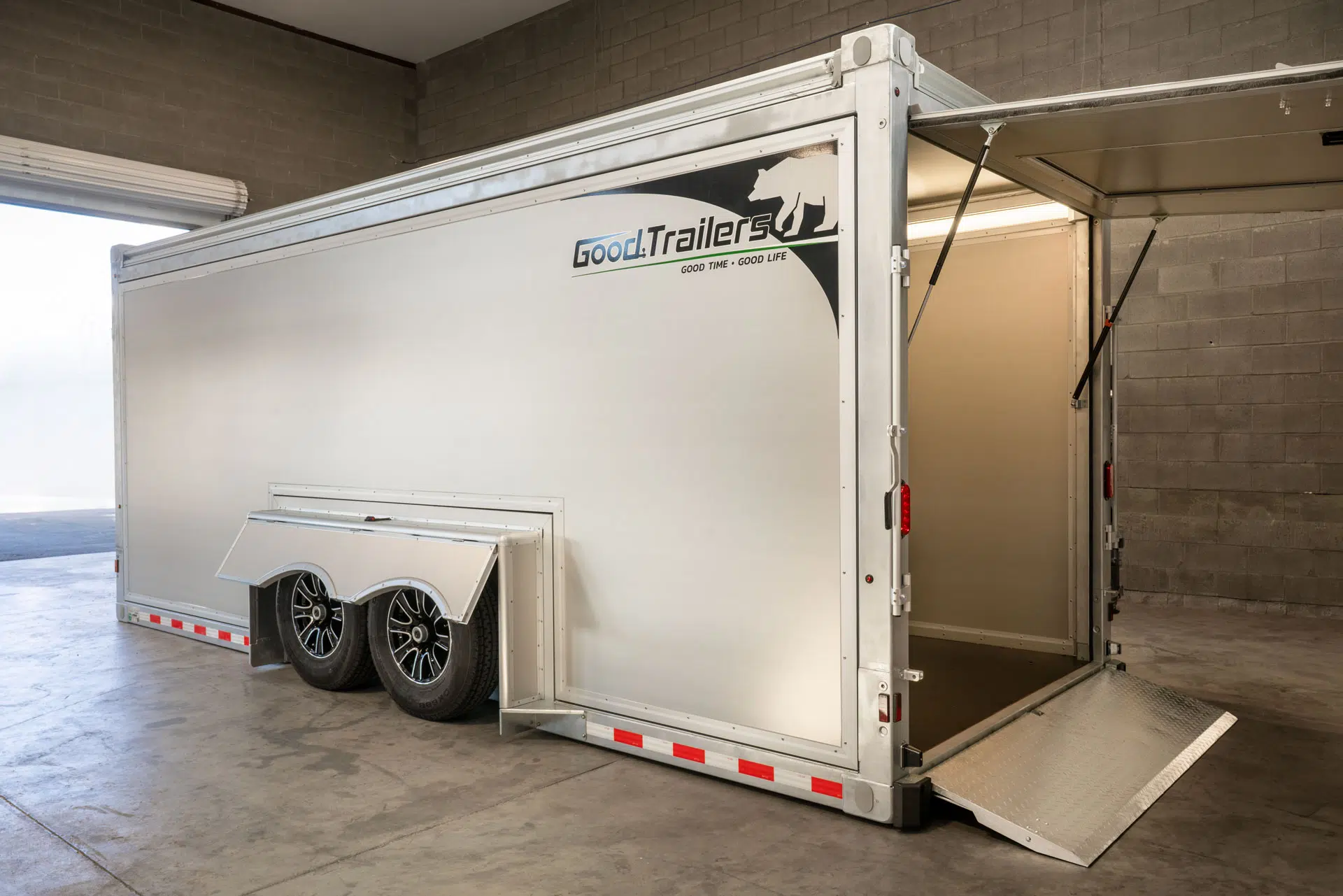
GoodMFG®’s hydraulic drop deck flatbeds give you two options to consider: the GT13FL and the larger GT19FL.
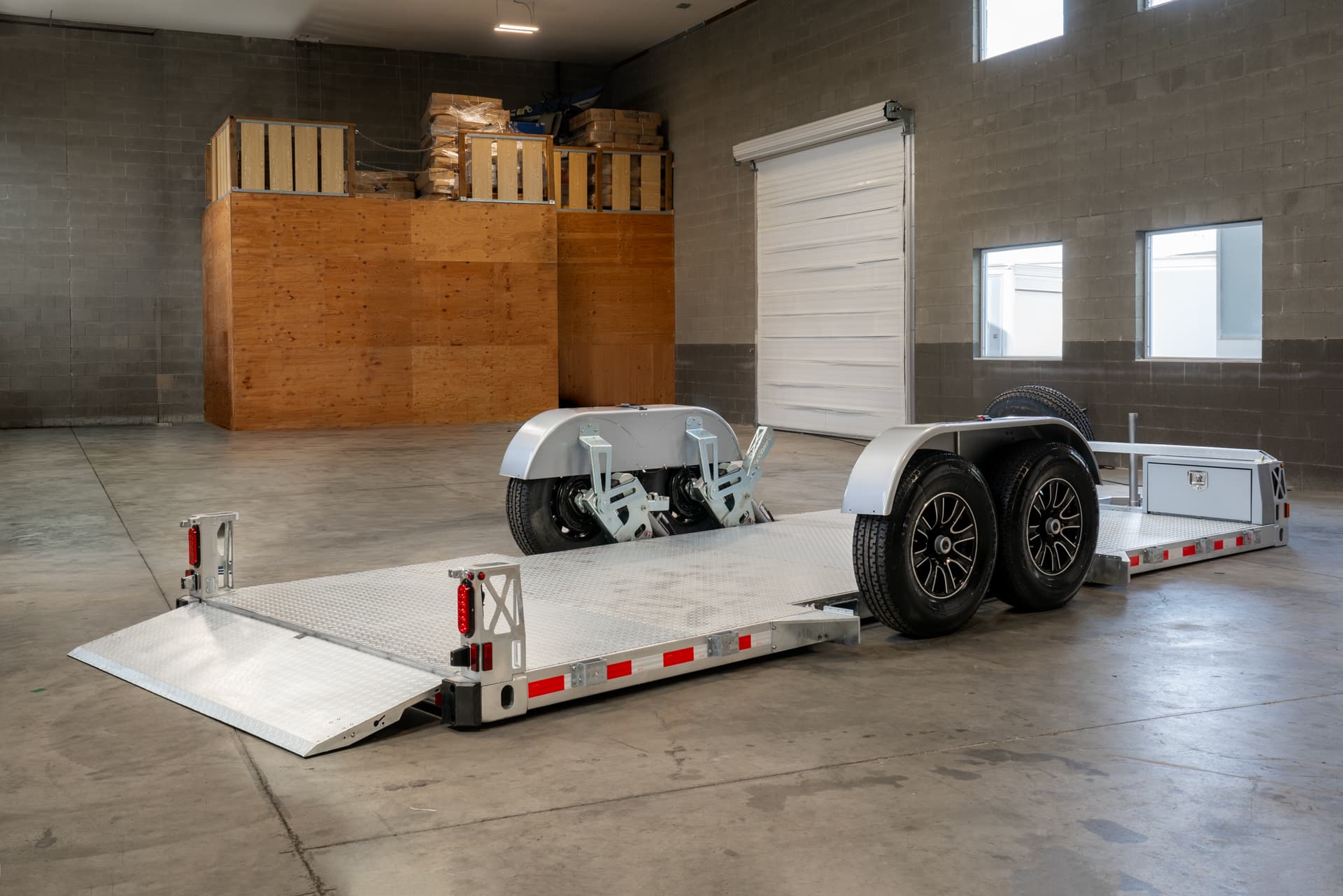
Both models bring the trailer down to the ground for loading instead of requiring your lift to climb to its normal transport height.
Table of Contents
- Choosing the Right Size & Payload
- Scissor Lift Weights, Lengths, and Widths
- Moving Scissor Lifts: Good Solutions
- FAQ
- Key Takeaways
- Transform Transport
Choosing the Right Size & Payload
Start with three questions: How much does the complete load weigh? How much deck space does it need? How will you load and secure it?
Understand carrying capacity—not just GVWR
A trailer’s gross vehicle weight rating, or GVWR, covers the maximum permitted weight of the loaded trailer. It includes the trailer itself.
To calculate available carrying capacity, subtract the trailer’s empty weight from its GVWR. Added trailer equipment and everything you carry must be accounted for in the final loaded weight.
Here’s how our two flatbed models compare.
| Specification | GT13FL | GT19FL |
|---|---|---|
| GVWR | 7,000 lbs. | 11,800 lbs. |
| Estimated curb weight | 1,945 lbs. | 3,800 lbs. |
| Estimated carrying capacity | 5,055 lbs. | 8,000 lbs. |
| Usable deck length | 11′8″ | 17′9″ |
| Deck width | 82″ | 82″ |
The scissor lift is only part of that weight allowance. Don’t forget to include your securement equipment, additional tools, and anything else that might be traveling on board your scissor lift trailer.
Use the identification plate and the manufacturer’s documentation for your scissor lift to get the actual machine weight. Options and configuration changes can affect weight, so note that knowing the model’s name isn’t always enough to get the most accurate weight.
Compare Stowed Dimensions with Usable Deck Space
For transport planning, use the lift’s dimensions with its platform lowered and extension deck retracted—not its working height or extended platform length. Manufacturer specification sheets distinguish these measurements.
Compare the machine’s length and width with the usable deck, then account for the loading route, equipment placement, and access to tie-down points.
Check both carrying capacity and usable deck space. Your trailer needs to accommodate the lift’s weight and footprint, along with any additional cargo. Plan the machine’s position so you can achieve appropriate weight distribution and reach its designated tie-down points.
Scissor Lift Weights, Lengths, and Widths
The examples below help you narrow your scissor lift trailer choices using manufacturer-published specifications.
They are weight-and-dimension comparisons, not blanket approval of every machine-to-trailer pairing. Final selection must also account for the actual machine configuration, ramp rating, load placement, and securement requirements.
GT13FL: Single-Lift Loads to Compare
These published machine weights and footprints fall within the GT13FL’s estimated carrying capacity and deck dimensions.
| Scissor Lift Model | Published machine weight | Stowed/overall length | Published Machine Width |
|---|---|---|---|
| Skyjack SJ3213 micro | 1,897 lbs. | 60″ | 32″ |
| JLG ES1530M | 1,940 lbs. | 56.2″ | 30″ |
| Genie GS-1432m E-Drive | 1,984 lbs. | 55″ | 32″ |
| Genie GS-1932m E-Drive | 2,600 lbs. | 55″ | 32″ |
| Skyjack SJ3219 micro | 2,675 lbs. | 60″ | 32″ |
| Skyjack SJ3226 E | 4,200 lbs. | 91.6″ | 32″ |
| JLG ES2632* | 4,400 lbs. | Approximately 94.3″ | 32″ |
| Genie GS-2632 E-Drive | 4,729 lbs. | 96″ | 32.2″ |
The remaining carrying capacity matters as you move down this list.
For example, subtracting the GS-2632’s published 4,729-pound weight from the GT13FL’s estimated carrying capacity leaves 326 pounds before accounting for other cargo and any trailer additions not included in its estimated curb weight. That is a useful comparison when deciding between a dedicated single-lift setup and a larger scissor lift trailer with more flexibility.
GT19FL: More Carrying Capacity for Heavier Machines
These examples exceed the GT13FL’s estimated carrying capacity but fall within the GT19FL’s published weight and deck-size limits before other cargo is added.
| Scissor lift model | Published machine weight | Stowed/overall length | Published machine width |
|---|---|---|---|
| Genie GS-3246 E-Drive | 5,218 lbs. | 96″ | 46″ |
| Genie GS-3232 E-Drive | 5,367 lbs. | 96″ | 32.2″ |
| Skyjack SJ4732 E | 5,478 lbs. | 91.6″ | 47″ |
The larger scissor lift trailer is also worth considering when you haul a lighter lift alongside additional equipment, or when your fleet includes machines with different transport requirements. Plan around the complete loads you expect to carry. Don’t plan around the lightest machine you know.
Moving Scissor Lifts: Good Solutions
The right scissor lift trailer should do more than carry the weight. It should make getting your equipment aboard easier, too.
GoodMFG®’s GT13FL and GT19FL hydraulic drop deck trailers bring the deck down to your equipment, replacing the climb to a raised trailer bed with a short, wide loading approach. Here is what that means for your crew.
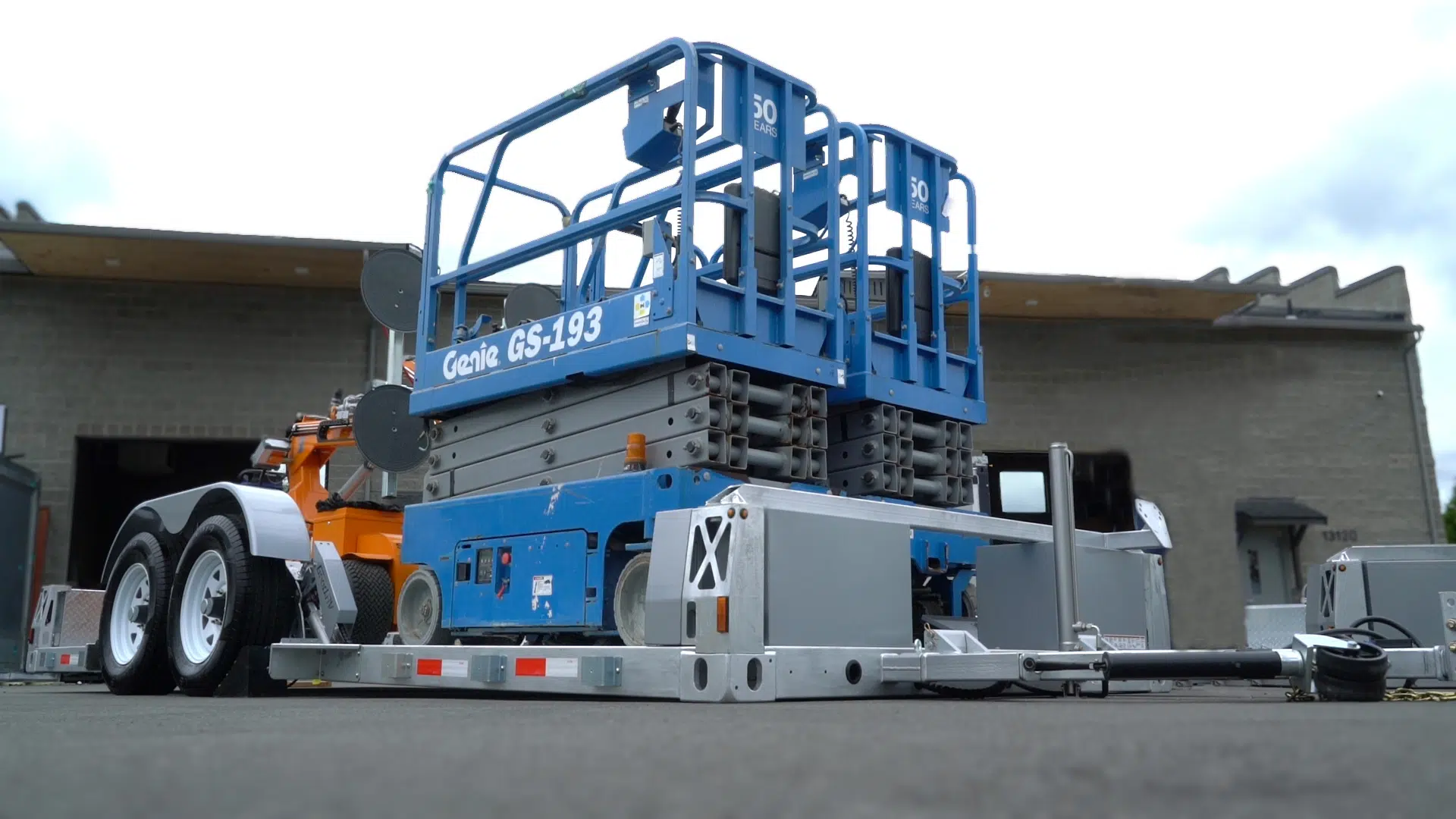
Check out this video to see why our flatbeds make such great scissor lift trailers.
Make the climb easier. Both models lower the deck to 5.4 inches above the ground, with a 22-inch-long ramp at an 11-degree angle bridging the remaining transition. Your lift has less height to climb and a gentler incline to negotiate than it would on a steeper ramp leading to a raised deck.
Help protect low-clearance equipment. A gentler ramp-to-deck transition helps reduce the risk of bottoming out compared with a sharper change in angle. That gives the low-clearance components beneath your scissor lift a less abrupt loading path. The gentler approach helps to reduce damage. A good thing when you depend on your scissor lift to get the job done!
Make alignment more straightforward. The 76.5-inch-wide ramp provides one continuous loading surface. Instead of positioning separate wheel ramps and aligning each side of the lift with its own narrow track, your operator has one wide approach onto the deck.
Take loose-ramp handling out of the job. The folding rear ramp stays with the trailer, so there are no separate ramps to carry, position, or find storage space for. Prepare and lower the trailer, then unfold the ramp for loading. The GT19FL also includes spring assistance to make handling its ramp easier.
The result is a more manageable loading routine: a lower climb, a wider approach, and less ramp handling at each stop. Choose the model that fits your lift’s size and payload and put those loading advantages to work.
Once your scissor lift is secured, you can raise the deck on your scissor lift trailer, hitch it up to the tow vehicle, and roll out.
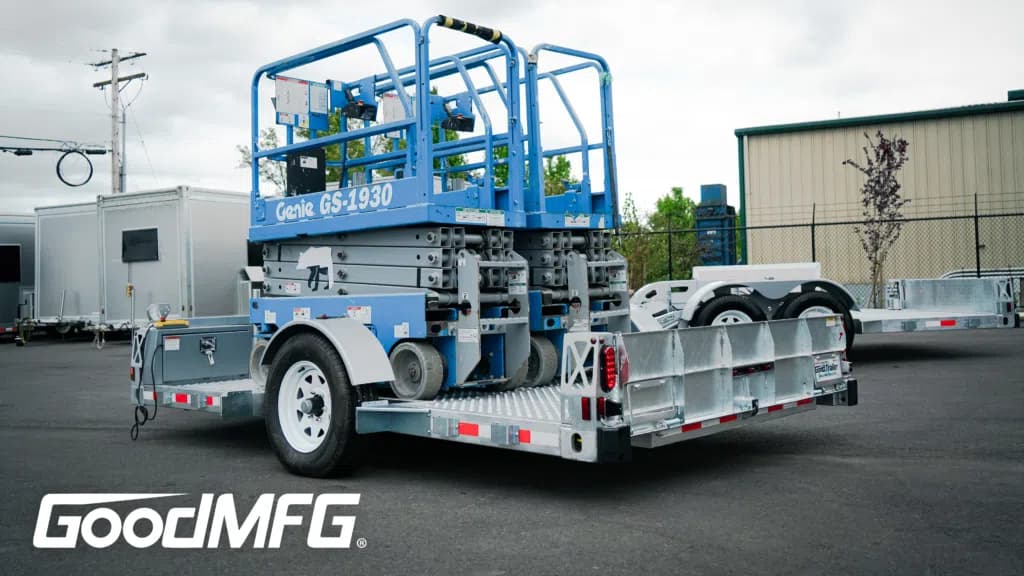
Be sure to follow manufacturer’s instructions for loading and transport. For example, JLG specifies its machines must be transported in the stowed position and then secured to the truck or trailer at designated tie-down points. Securement equipment must be adequately rated and suitable for the task, and loose items must be removed before tie-down.
FAQ
Can I carry two scissor lifts on one trailer?
Potentially, but calculate the combined weight before arranging the machines.
Two Genie GS-1932m E-Drive lifts at their published 2,600-pound weight total 5,200 pounds. That exceeds the GT13FL’s estimated carrying capacity, while leaving 2,800 pounds within the GT19FL’s estimate before other cargo and trailer additions are counted.
Next, think about the actual loading arrangement. Each machine must fit, the load must produce appropriate tongue and axle weights, and the required securement points must remain usable. A combined weight that’s below the limit is the starting point, not the entire loading plan.
Do all rough-terrain scissor lifts require a larger, specialized trailer?
No. “Rough terrain” describes a type of machine, not a single transport weight.
For example, Genie publishes the GS-2669 RT at 7,149 pounds, 10 feet, 3 inches long, and 5 feet 9 inches wide in its standard configuration. Those figures put it within the GT19FL’s published payload and deck dimensions for further evaluation. However, Genie lists the same model with outriggers at 7,942 pounds and a longer overall length.
That configuration difference matters: 7,942 pounds leave only 58 pounds with an 8000-pound payload allowance before other items are added.
Choose by the actual configuration and loading requirements. It’s not a universal rule that all rough-terrain lifts need the same trailer.
Do you need a CDL to haul a scissor lift?
It depends on the GVWR of your hauling vehicle and your trailer. You can haul mini and medium scissor lifts without a CDL as long as your trailer and towing vehicle are light enough.
A standard F-250 truck hauling a GT19FL is usually just under the 26,000-pound limit that a CDL requires. Be careful, because some F-350 models weigh a little too much and will push you over that limit. Always check the GVWR of your towing vehicle though…don’t make generalizations.
A major advantage of Good Trailers drop deck trailers is your ability to haul them without resorting to a CDL, so long as the transport vehicle hits that sweet spot between a vehicle that’s tough enough to tow and a vehicle that’s light enough to keep you off the 26,000-pound threshold. Go over by even one pound, and you must use a CDL.
Key Takeaways
- Start with the specific machine. Use its actual weight and stowed dimensions.
- Choose for the complete load. The GT13FL and GT19FL offer different payload and deck-length options. Account for everything that will travel aboard.
- Evaluate loading as well as carrying. Ramp capacity, loading geometry, machine instructions, and securement all belong in the selection process.
- Plan the whole combination. Match the trailer to a properly rated tow vehicle and verify load placement and licensing requirements.
Transform Transport
The right scissor lift trailer gives you an easy way to move equipment between the jobs that need it.
Ready to lower the deck and raise the bar? Reach out to your nearest authorized dealer or contact us for options!
See also:
Hauling Heavy Equipment at Highway Speeds
Hauling Skid Steers Safely: A Guide to Weight, Straps, & Trailers
Hauling Mini-Excavators with Good Trailers
This resource was compiled by the GoodMFG® Product Team, drawing on 75 years of experience in hydraulic systems, heavy-duty transport, trailers, and modular structures.
P.S. – We build trailers every day, but we don’t run your crews. If there’s a specific logistical headache or a “field reality” we’ve missed, we want to hear about it. Help us refine the equipment that makes your day easier! Email our Marketing Lead at devan-h @ goodrv.com and let us know what we should solve next.