Looking for the right skid steer trailers?
Hauling skid steers can come with a host of headaches and challenges. Yet you need them on nearly every site. They’re too versatile to leave behind: capable of hauling bricks and concrete; capable of grading and leveling soil; capable of destroying driveways; capable of drilling. Swap out the attachments and you have one machine doing the work of dozens. Skid steers are like the Swiss Army Knives of heavy machinery.
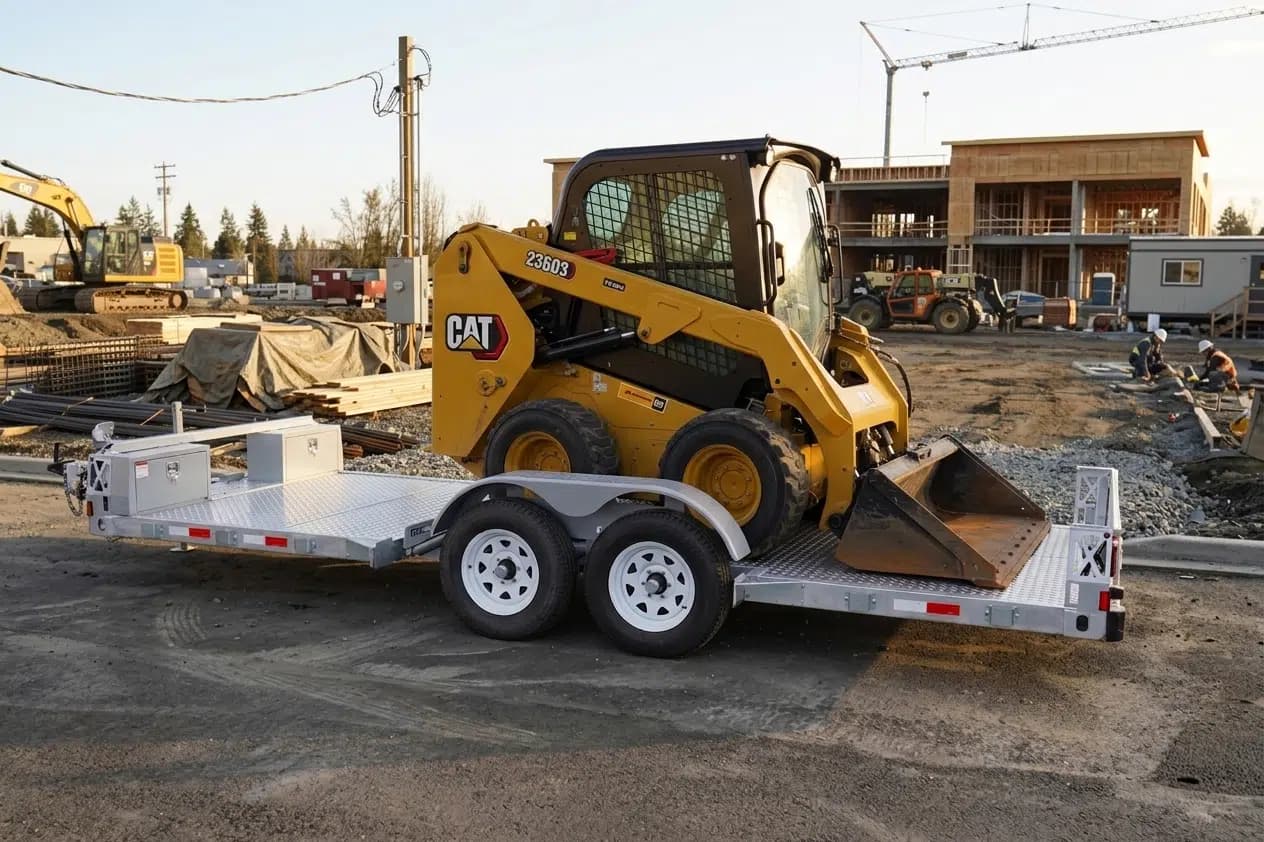
But traditional loading comes with some dangers when you’re hauling skid steers. Fortunately, Good Trailers by GoodMFG® provide excellent solutions for hauling small frame skid steers like the Bobcat S70, or medium frame skid steers like the CAT 236D3.
Pictured above: CAT236D3. Other models also discussed.
Table of Contents
- Weighing in on Weight
- The Dangers of Hauling Skid Steers
- Loading Attachments
- Choosing the Right Skid Steer Trailers
- FAQ
- Key Takeaways
- The Trailer that Makes the Grade
Weighing in on Weight
Skid steers can be beasts when it comes to estimating weight.
Sure, you can have the manufacturer’s specs, but those don’t cover the 400 extra lbs. of mud weight that can get packed into the chassis, wheels, or tracks. You don’t always have time to clean skid steers from job site to job site.
Then, there’s all the attachments. You usually need 3-4, all of which need to fit onto your trailer alongside your machine without exceeding weight limits. Any given attachment can weigh between 150 and 2100 pounds, so pay close attention to what you’re dealing with.
Then there’s the tie downs.
Many operators prefer 2-inch or 4-inch polyester ratchet straps because they are lightweight (roughly 4 pounds per strap). But they’re also susceptible to edge cuts from the sharp metal around a skid steer’s tie-down points.
Ratchet straps often have a working load limit of 3,333 lbs. To legally secure a machine, you need enough straps that the combined WLL equals at least 50% of the load weight. Many state regulations and best practices for 4-point securement require the combined WLL to exceed the full weight of the machine for safety.
In many cases the law will require you to switch to Grade 70 transport chains instead, and that’s a lot more weight for your load. A single 20-foot 3/8″ chain with hooks weighs approximately 32 lbs., and a matching ratchet binder adds another 10-13 lbs. Carrying a full set of four chains and binders adds nearly 170-180 lbs. to your trailer’s total GVWR.
Keep all of this in mind when choosing skid steer trailers, and pay close attention to your trailer’s carrying capacity and dimensions as you make your choices. We recommend leaving a little wriggle room: typically at least 1500 pounds between the weight of the skid steer and the weight of what your trailer can handle. That covers the mud and, with careful weighing and measurement, usually will cover some attachments as well.
The Dangers of Hauling Skid Steers
Skid steers present unique hauling challenges.
- Bucking. Skid steers are notorious for popping wheelies if you accelerate too fast while attempting to drive them up high trailer ramps. That can make loading and unloading them one of the most stressful parts of the day.
- Blind spot exits. Most skid steers are front entry. To get out of the machine after loading it onto a trailer, the operator often has to climb over the bucket. If the operator hasn’t properly lowered the arms or engaged the safety bar, they end up in the “kill zone” between the frame and the lift arms.
- Reverse loading. For safety, skid steers usually need to be backed onto a trailer. Because the engine is in the back, driving forward up a steep ramp can cause the machine to flip over backwards.
While no skid steer trailer can solve skid steer design, the GT19FL is a solid drop deck for skid steer loading and unloading. Instead of a long 18° ramp you get a short, gentle ramp that sits at roughly 11°. Instead of a ramp that covers 1/3 of the deck, you get a 74.4″ wide ramp that covers the whole thing. And instead of a 5-foot deck height, you get a 5.4-inch deck height: true ground level loading.
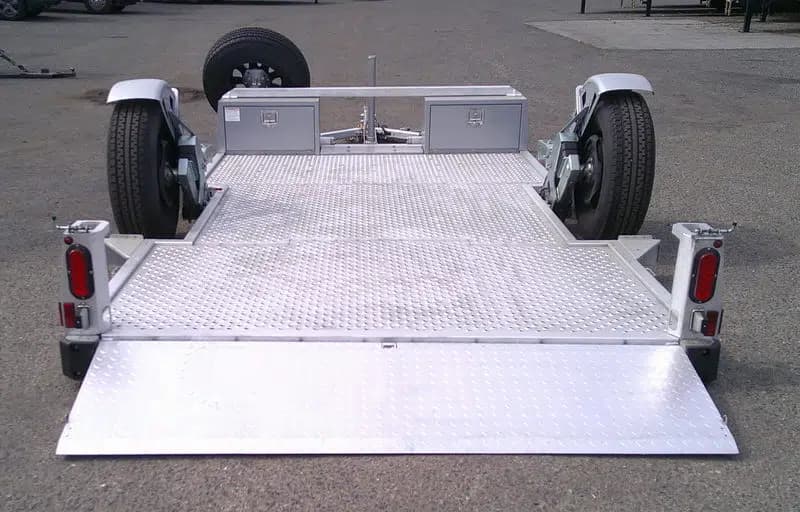
Fewer wheelies, reduced traction issues, and a much safer surface for reverse loading. And because you can drive right on, the GT19FL is basically one of the fastest loading trailers for skid steers out on the market today.
Choosing the Right Skid Steer Trailers
Below are some weight, length, and height dimensions for the most popular skid steer brands, as well as information on which skid steer trailer will be the right choice for each of these brands.
Note the GT13FL has an estimated carrying capacity of 5,055 lbs., but in many cases, we’ve recommended the larger trailer because we are, again, making room for you to place attachments on your skid steer trailer. It’s not a useful trailer to you if it doesn’t support your total haul, and we’re doing our best to stay aware of that. However, we can’t know the specific weight of the specific attachments you use, so we have to make some educated guesses.
GT13FL:
- Bobcat S70: ~2,892 lbs., length with no bucket: 6’4″, 2’12” width over tires
GT19FL:
- Bobcat S450: ~ 5,019 lbs., 8’2″ length with no bucket, 4’11” width over tires
- Cat 226D3: ~5,849 lbs., 8’3″ length with no bucket, 4’11” width over tires
- JD 316GR: ~6,180 lbs., 7’11” length with no bucket, 5’3″ width over tires
- Bobcat S510: ~6,213 lbs., 8’7″ length with no bucket, 5’8″ width over tires
- Bobcat S530: ~6,480 lbs., 8’7″ length with no bucket, 5’8″ width over tires
- Bobcat S570: ~6,500 lbs., 8’7″ length with no bucket, 5’8″ width over tires
Remember to always check the specific weights and dimensions with your manufacturer before loading it on any trailer. Compare the specs to trailer dimensions and carrying capacities to make sure that the trailer can handle your gear.
If you notice the list is short, it’s because many skid steers weigh a lot more, which means many skid steer trailers will need to have a far higher GVWR than anything GoodMFG® currently has to offer. Which is ok! We want you to find the skid steer trailer that’s right for you and your business. If it’s one of ours, we’re very happy. If it’s not, we’re glad you’re getting what you need. We want to be as realistic as possible about what our trailers can and can’t do.
FAQ
How much extra weight capacity buffer should I leave when choosing a skid steer trailer?
Always leave at least 1,500 lbs. between the weight of your skid steer and the carrying capacity of the trailer. This is because you need to account for hidden and packed mud or debris (up to 400 lbs.), fuel, heavy attachments (ranging from 150-2,100 lbs. each) and transport chains or binders (approximately 170 to 180 lbs).
Can I use polyester ratchet straps instead of chains to secure my skid steer trailer?
While straps are lighter, sharp edges on a skid steer frame frequently cut polyester webbing. Due to safety standards and local transport regulations requiring 4-point securement to meet or exceed 100% of the load’s weight, Grade 70 transport chains and ratchet binders are usually legally required for heavy equipment.
Why is reverse loading recommended when driving a skid steer onto a trailer?
Because a skid steer’s center of gravity is in the rear where the engine is located. This means driving forward up steep, traditional ramps can cause the machine to flip backward (“bucking”). Backing onto the trailer keeps the heavy engine lower and forward, preventing tip-overs.
Which Good Trailers model is best for small vs. medium frame skid steers?
The GT13FL (carrying capacity ~5,055 lbs.) is ideal for small-frame models like the Bobcat S70. For medium-frame skid steers (e.g., CAT 236D3, JD 320G, Kubota SSV65) and extra attachments, the GT19FL (carrying capacity ~8,000 lbs.) is recommended.
Key Takeaways
Here’s the TL;DR that will help you make good decisions about buying skid steer trailers.
- Remember the mud! Unless a skid steer is squeaky clean, you should always account for ~400 lbs. of hidden mud weight. Hidden mud can push you over your legal limit or push you over the trailer’s safe carrying capacity.
- Angle matters. The GT19FL’s 11° ramp angle is gentler, and since the trailer lowers all the way to the ground the ramp itself is shorter and wider than the ones, you’ll find on standard trailers. Your chances of “bucking” the skid steer are significantly lower, and loading front-heavy attachments becomes much safer.
- Know your limits. With a 17’9″ deck, you have the length for a medium-frame skid steer and 4 attachments but watch your GVWR closely.
The Trailer that Makes the Grade
Don’t let your transport logistics fail the test. We’re making the world a flatter place one ground-level load at a time.
Ready to lower the deck and raise the bar? Upgrade to the GT19FL and finally get a trailer that makes the grade.
Run a rental equipment business and want to provide your customers with a transport solution that minimizes damage? We’re looking for partners in California and Oregon right now. Call us!
See also:
The Ultimate Mini Excavator Trailer Guide
Scissor Lift Trailer Guide
Ground-Level Loading for Forklift Transport
This resource was compiled by the GoodMFG® Product Team, drawing on 75 years of combined experience in hydraulic systems, heavy-duty transport, trailers, and modular structures.
P.S. – We build trailers every day, but we don’t run your crews. If there’s a specific logistical headache or a “field reality” we’ve missed, we want to hear about it. Help us refine the equipment that makes your day easier! Email our Marketing Lead at devan-h @ goodrv.com and let us know what we should solve next.