Why write a mini excavator trailer guide? Isn’t hauling mini excavators fairly straightforward?
Hauling mini excavators may seem like a relatively small, simple task compared to hauling cranes or other major rigs, but for construction project managers these little machines are often a source of major logistical headaches.
They may move between jobs several times in a week, and the trailer has to accommodate more than the machine’s advertised operating weight. Transport length, attachments, securement, load position, tow-vehicle ratings, and sometimes CDL requirements all enter the picture.
The loading setup matters too. A machine that fits comfortably on the deck may still be awkward to move up a long, steep ramp.
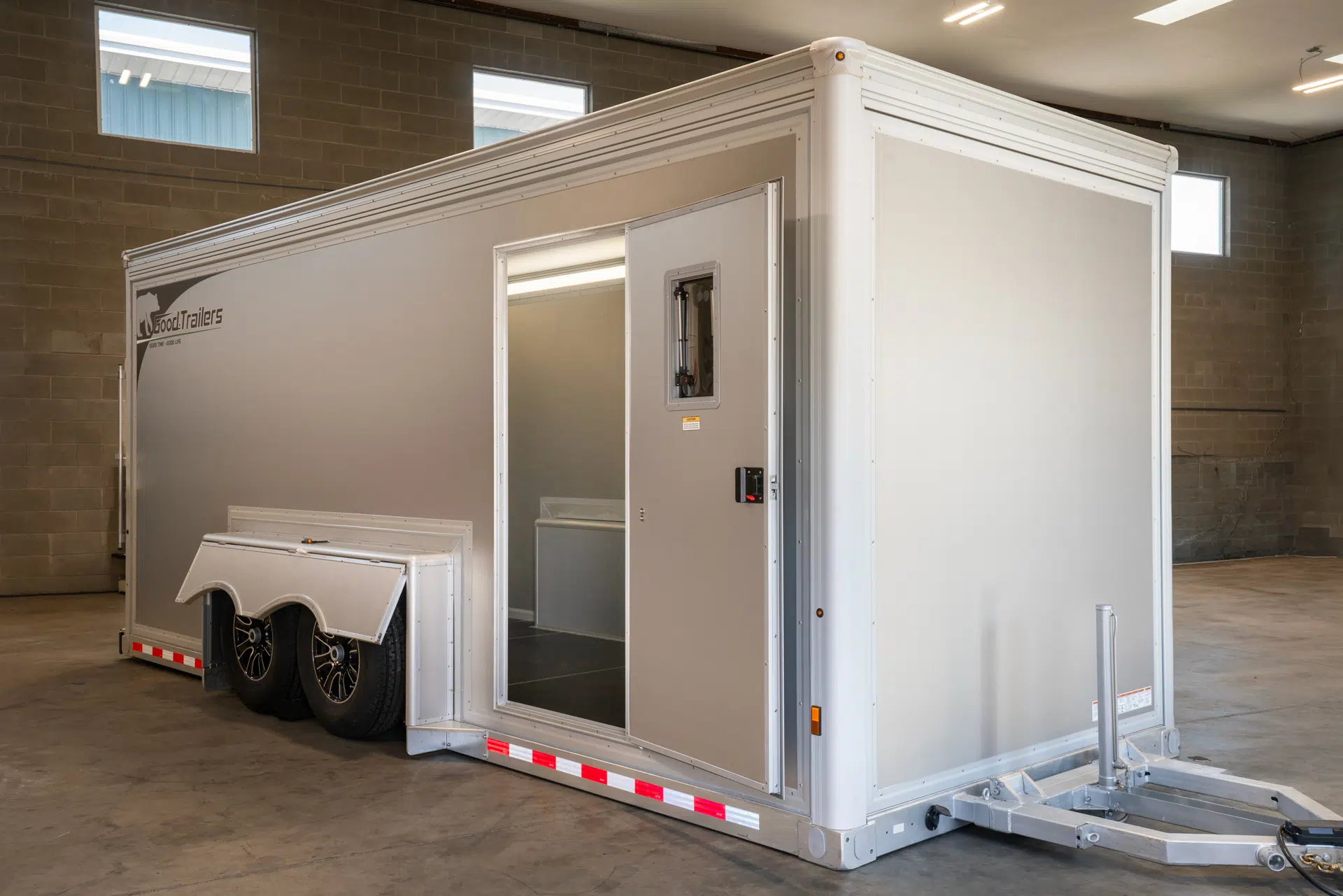
GoodMFG® flatbed drop deck trailers approach that problem differently: instead of making the mini excavator climb to normal trailer height, the hydraulic system lowers the deck close to the ground.
This guide covers what to compare before choosing a mini excavator trailer and where the GT13FL and GT19FL fit.
Table of Contents
What Makes Mini Excavators Tricky to Haul?
Mini excavators combine considerable weight with tracks, a rotating upper structure, a boom, a blade, and attachments that all have to fit and travel appropriately.
That creates several separate transport questions.
Loading
The operator has to move the machine from ground level onto the trailer while maintaining the appropriate alignment. Always follow your manufacturer’s loading instructions.
A steeper or narrower loading setup can make that process more demanding.
Ramp angle, deck height, ramp width, machine dimensions, and operator procedure all matter.
Transport Position
The excavator’s boom, arm, bucket, blade and any other attachments need to be placed in the manufacturer’s approved transport position.
Overall loaded height also matters. Consider the height of your total load around bridges, trees, and power lines.
The excavator may fit on the deck, but that doesn’t mean it’s ready for the road.
Loading Geometry Matters
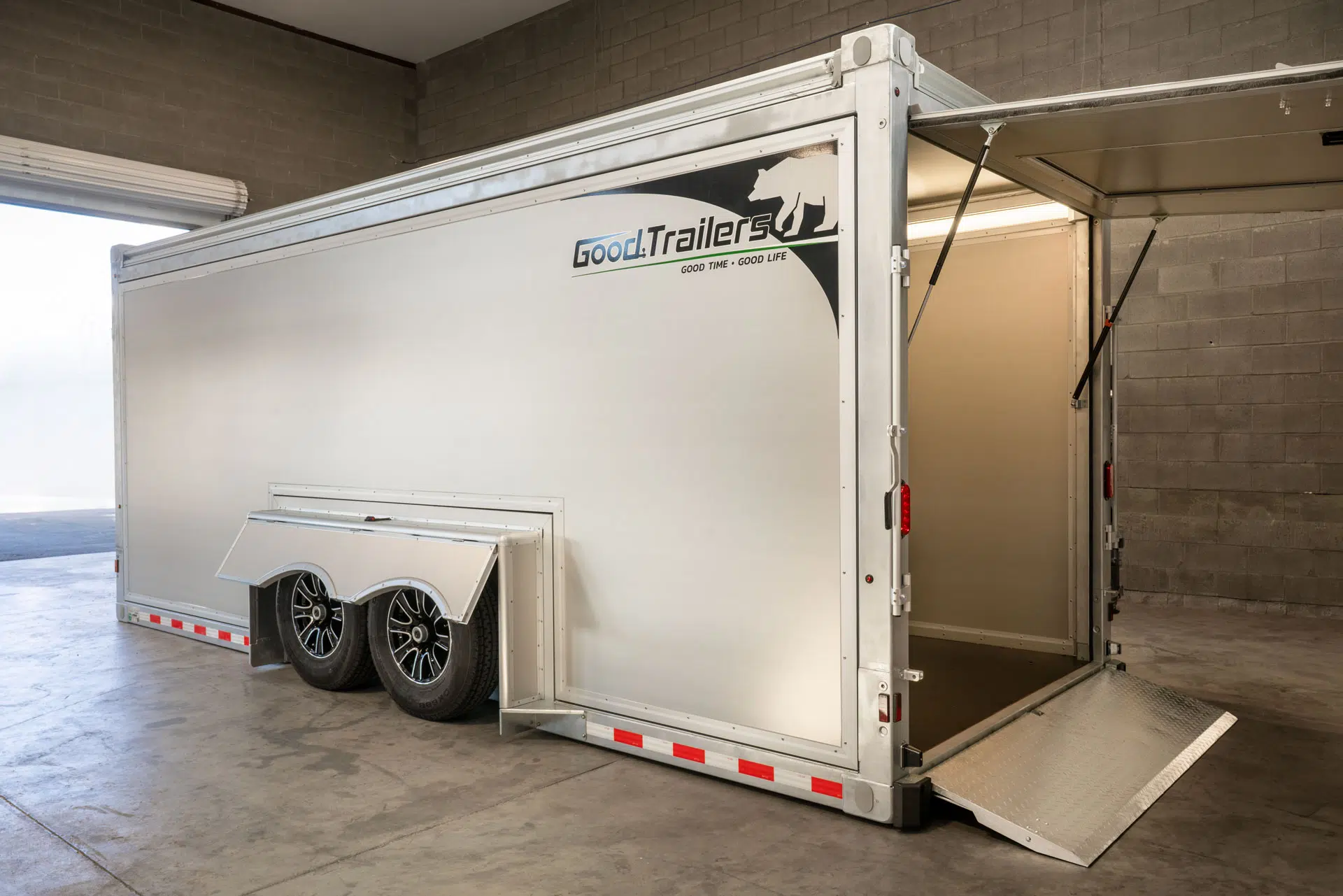
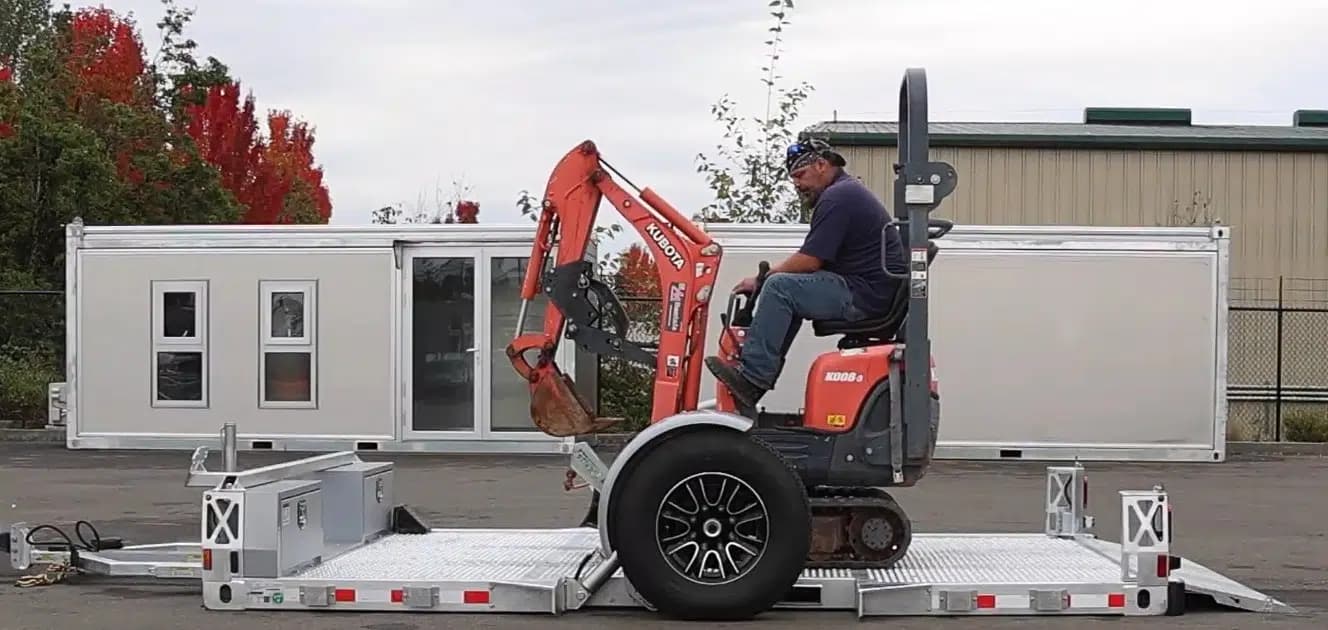
While Good Trailers can’t solve all these problems, we can solve the big one. Our GT19FL trailer lowers the deck to 5.4 inches and gives your operator a wide, full-deck ramp to ascend.
This video from Ranchie’s Rigs shows the process in real time.
As long as the bucket is placed correctly, it’s more than possible to just drive the mini ex right onto the deck of the trailer. This gives more space and mental bandwidth for the operator to focus on tucking the boom and securing the mini excavator properly.
For a compatible mini excavator, the lower approach can:
- Reduce the vertical climb onto the trailer
- Reduce the severity of the ramp-to-deck transition
- Provide a wide, continuous loading surface for the tracks
- And make much of the deck accessible while standing near ground level.
Bringing the deck down instead of sending the excavator up is a meaningful mechanical advantage.
Secure the Machine for the Actual Load
It’s vital that you secure your mini-excavator properly.
- Follow the excavator manufacturer’s designated transport and tie-down instructions.
- Use properly rated chains, straps, binders, and attachment points for that load.
- Account for the working load limits of the complete securement system.
- Make sure the bucket, boom, blade and other attachments are placed and restrained as required.
- Follow any additional commercial vehicle rules that apply to your operation.
If you add our optional D-ring stake pockets to the trailer you can just walk on and secure the trailer using built-in tie-down points.
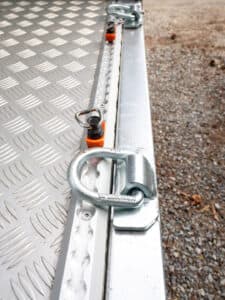
That means your operator now has less to contend with.
Which Mini Excavator Trailer Should You Choose?
Our GT13FL makes the most sense for compact machines whose complete transport length and weight leave reasonable room within its 11’8″ of usable deck space and estimated 5,055 lbs. carrying capacity.
Our GT19FL provides substantially more deck length and an estimated 8,000 pounds of carrying capacity.
That opens the door to a much wider range of mini excavators, but 8,000 pounds of carrying capacity doesn’t mean you want to roll an 8,000-pound mini excavator up there. You’ve still gotta account for buckets, thumbs, augers, couplers, other attachments, securement equipment, and any other cargo you want to carry.
Mini Excavator Dimensions & Weights
Here are several current manufacturer examples to show how quickly the decision moves from “weight” to weight plus length.
These are published manufacturer figures for specific configurations. They are not guaranteed trailer-ready weights. Buckets, couplers, tracks, counterweights, cabs, attachments, and manufacturer definitions of “operating weight” vary.
Examples that should fit comfortably within the GT13FL’s basic published deck dimensions and capacity
| Mini Excavator | Published Operating Weight | Transport Length | Published Width |
|---|---|---|---|
| Bobcat E10 | 2,593 lbs | 110″ / 9′2″ | 28″ retracted |
| Kubota K008-5 | 2,315 lbs | 9′0″ | 2′10″ standard |
| Kubota U10-5 | 2,646 lbs | 9′9″ | 3′3″ standard |
Always check the exact machine and attachments.
Machines where the GT19FL provides a more practical fit
| Mini Excavator | Published Operating Weight | Approx. Transport Length | Why GT19FL Makes More Sense |
|---|---|---|---|
| John Deere 17 P-Tier | ~3,790 lbs | 11′6″ | Almost consumes the GT13FL’s entire usable length |
| Kubota U17-5 | 3,902 lbs | 11′7.7″ | Essentially the full GT13FL deck length |
| Kubota KX018-4 | 3,747 lbs | 12′2.1″ | Longer than GT13FL usable deck |
| Cat 301.5 | 3,913 lbs | ~11′9″ | Slightly longer than GT13FL deck |
| Cat 302 CR | 4,987 lbs | ~12′9″ | Requires additional deck length |
| John Deere 26 P-Tier | 5,795 lbs with cab | 13′9″ | Needs GT19FL length and capacity |
| Kubota KX030-4 | 6,272 lbs | 15′1.1″ | Well beyond GT13FL length/capacity |
| Cat 302.7 CR | up to 6,725 lbs | ~14′0.5″ | Fits GT19FL envelope but leaves less payload margin |
Use these numbers as a guideline to help you do your shopping, either for your trailer or for your mini excavator. Always use the most current dimensions from your operators’ manual to decide what to haul.
A few notes about choosing the right mini excavator trailer.
Configuration matters.
The Cat 302.7 CR is a good example.
At a published maximum operating weight of 6,725 pounds, it appears to leave about 1,275 pounds below the GT19FL’s estimated 8000 pound carrying capacity. But that weight excludes the bucket.
So, the 1,275 pounds that are left over are not automatically “extra payload.” The bucket, coupler, thumb, additional attachments, securement equipment and everything else you want traveling on that trailer all have to be counted.
Always check your actual transport configuration.
FAQ
Do I need a CDL to haul a mini excavator on a trailer?
Not automatically.
Under federal rules, a Class A CDL is usually required when the combination reaches 26,001 pounds or more in GCWR or actual combination weight, whichever is greater, and the towed unit exceeds 10,000 pounds GVWR or actual weight, whichever is greater.
Because the GT19FL has an 11,800-pound GVWR, the truck and complete combination determine whether the federal Class A threshold is crossed. Always check your exact tow vehicle and load and verify state requirements and applicable exemptions.
What size truck do I need to tow a mini excavator trailer?
Use the ratings for the specific truck. Check maximum trailer rating, GCWR, payload, rear GAWR, hitch and ball rating, allowable tongue weight, brake controller requirements, and the actual loaded trailer weight.
The tow vehicle and hitch must be appropriately rated for the trailer.
Do attachments count toward trailer payload?
Yes.
The trailer carries the actual complete load, not the excavator’s brochure weight.
Buckets, thumbs, augers, couplers, extra buckets, chains, binders, fuel, and other cargo also contribute to the load.
Always use the actual specifications for the equipment you’re carrying. Do not rely on estimates.
Key Takeaways
Here’s your quick guide to mini excavator trailers.
- Choose a mini excavator trailer around the actual transport configuration—not just the excavator’s model class. Weight, length, width, attachments, and load distribution all matter.
- The GT13FL provides an 11′8″ × 6′10″ usable deck and an estimated 5,055-pound carrying capacity; the GT19FL provides a 17′9″ × 6′10″ deck and an estimated 8,000-pound capacity. GoodMFG® flatbeds lower to 5.4 inches and use a short 22-inch, 11° rear ramp.
- Securement requirements depend on the machine and applicable rules. Four tiedowns are federally required under the specific heavy-equipment rule for machines at or above 10,000 pounds; lighter equipment has additional permitted securement approaches.
- Attachments consume payload. Verify the actual weight of buckets, thumbs, augers, couplers, and other cargo instead of relying on a generic allowance.
Get a Good Mini Excavator Trailer Today
If you’re a project manager or other professional who is tired of big mini-ex headaches, then consider adding our flatbed trailers to your fleet. We can help you get your mini excavators and other equipment from job site to job site with ease.
If you’re an If you’re an equipment rental company who wants to present your construction clients and backyard DIY clients with a safer, easier solution, then reach out! We’re actively looking for partners in Oregon and California, and we’d love to talk to you.
See also:
How to Transport a John Deere Gator Safely
Hauling Skid Steers Safely: A Guide to Weight, Straps, & Trailers
This resource was compiled by the GoodMFG® Product Team, drawing on 75 years of combined experience in hydraulic systems, heavy-duty transport, trailers, and modular structures.
P.S. – We build trailers every day, but we don’t run your crews. If there’s a specific logistical headache or a “field reality” we’ve missed, we want to hear about it. Help us refine the equipment that makes your day easier! Email our Marketing Lead at devan-h @ goodrv.com and let us know what we should solve next.