Moving stone and concrete pavers is one of the most physically demanding and logistically frustrating tasks in hardscaping.
Because of their extreme weight and fragile nature, transporting these materials on traditional trailers introduces constant safety risks and product damage.
For contractors and distributors looking to streamline their operations, hydraulic drop deck trailers have emerged as a superior alternative to older, conventional hauling methods.
table of contents
Prevent Loading & Unloading Accidents
A single pallet of pavers can easily weigh up to 3,500 lbs. The load is top-heavy and susceptible to tipping, especially when navigating steep ramps or tight turns.
If you’re using a standard trailer you’ve got a problem waiting to happen, because driving a heavy forklift, skid steer, or pallet jack up a 15° incline while balancing a fragile, multi-ton pallet of stone is incredibly dangerous. One move can cause the equipment to tip, spilling and destroying the stone or injuring the operator.
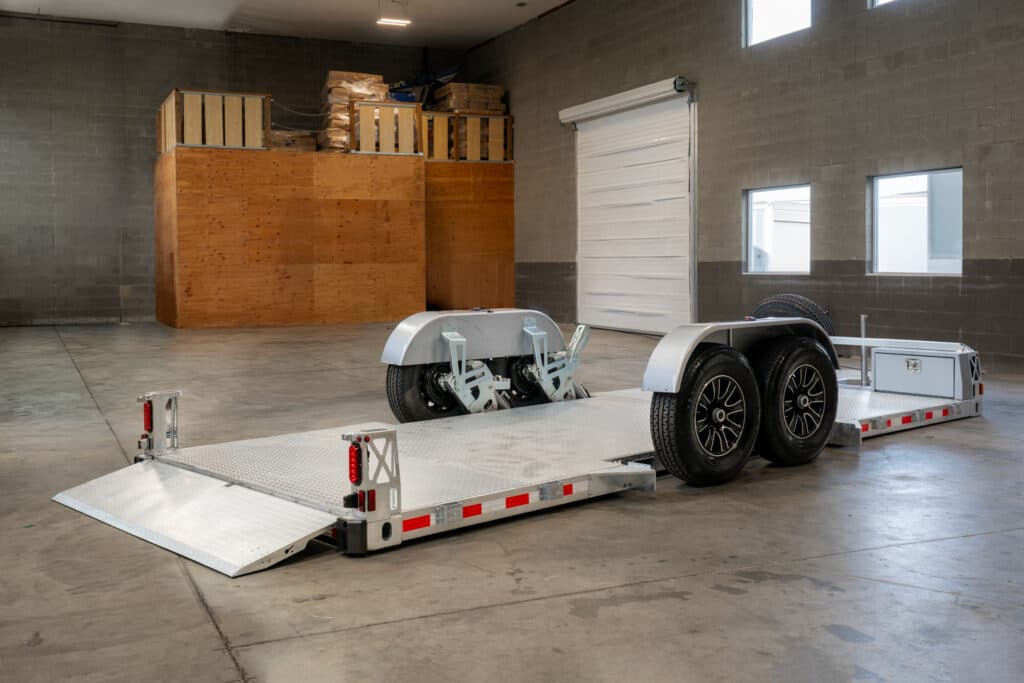
Instead of forcing you to bring your cargo up to the trailer, a Good Trailer brings the deck down to your cargo. At the touch of a button, a Good Trailer’s hydraulic drop deck system lowers the entire deck flush to the ground, leaving a tiny 5.4-inch clearance met by an ultra low-angle folding ramp.
You can roll a manual pallet jack, a motorized skid steer, or a forklift straight onto the trailer bed at sidewalk level. This eliminates the risk of top-heavy paver pallets tipping over during loading.
Because the deck sits flat on the ground during loading, there is no risk the trailer tongue will pop up. There’s no risk the trailer will shift as you place your pallets.
Prevent Shift & Breakage
Pavers are prone to shifting, scratching, or cracking during transport. Securing them at ground level helps to prevent this problem.
We also recommend tie-down system add-ons that will let you anchor straps tightly across the paver pallets, preventing them from shifting.
Reduce Wasted Time
If a jobsite doesn’t have a forklift, your workers are forced to hand-unload thousands of pounds of individual stones off the trailer bed, leading to worker fatigue, high labor costs, and massive project delays.
Is a Hydraulic Drop Deck Trailer the Only Solution for Paver Hauling?
No, and we’d be lying to you if we told you it was.
However, we do believe drop deck trailers are the best trailers for hauling stone pavers.
A tilt trailer forces you to battle gravity. A lift gate forces you to battle mechanical leverage.
A hydraulic drop deck trailer eliminates both variables. By lowering the deck flat to the asphalt, you remove the physical stress of lifting or climbing entirely.
We’ll offer a more thorough comparison of each option in the sections below.
Tilt Trailers vs. Pavers
A tilt trailer uses a pivoting hinge (either gravity-fed or powered by a hydraulic ram) that tilts the entire flatbed backward, turning the trailer deck itself into one long ramp. They’re good for some use cases, but they present challenges when you’re trying to haul pavers.
- The “Teeter Totter” effect. Gravity tilt trailers require you to drive equipment past the pivot point to force the deck back down. When you are carrying a 3,000-pound pallet of stone on a forklift, the exact second the trailer tips forward, the sudden shift in momentum, can cause the heavy pallet to jerk violently. This can crack fragile pavers or can cause the machine to lose traction.
- Slippage on the incline. Even a powered hydraulic tilt trailer still leaves the deck at an angle (usually between 10 to 15 degrees). Rubber-tired forklifts or pallet jacks trying to push thousands of pounds of stone up a smooth, tilted metal or wood deck frequently experience spinning tires or dangerous backward slides.
- Imperfect weight distribution. Because the axles on a tilt trailer must be placed further forward to allow the bed to pivot without hitting the tires, it restricts where you can place the heaviest cargo. If you can’t push the paver pallets far enough forward, you end up with poor tongue weight, causing a dangerous trailer sway on the highway.
The verdict? Tilt trailers can be great for loading wheeled or tracked machinery if that’s what you already have to work with (drop decks are great for loading those items, too). But they’re highly stressful and very risky if you want to try to balance a dense, top-heavy, damage-prone pallet of stone.
Lift Gates vs. Pavers
Lift gates use hydraulics to bring cargo from ground level up to the truck bed. This type of solution also offers serious challenges when you’re dealing with pavers.
- Severe weight limitations. This is the primary failure point. Standard commercial lift gates max out at a lifting capacity of 1,500 lbs. to 3,000 lbs. A heavy-duty pallet of concrete pavers can easily push past 3,500 lbs. Operating a lift gate at or near its maximum capacity with a dense load causes the hydraulic pumps to strain, slow down, or completely fail.
- Platform cantilever and tipping. Lift gates extend out past the rear bumper of the truck. When you roll a massive pallet of stone onto that extended platform, the leverage exerts tremendous downward force. If the ground is slightly unlevel, the lift gate platform will flex or tilt downward at the edge, causing a top-heavy pallet of pavers to slide off or tip over.
- Small working footprint. Lift gate platforms are typically narrow. Trying to maneuver a manual pallet jack or a motorized walkie-stacker onto a 4×4 platform with a massive pallet leaves zero margin for error.
Lift gates are designed for boxes, barrels, and light commercial pallet deliveries. Using them for multi-ton stone paver haulers can be a recipe for broken haulers, strained hydraulics, and serious job site injuries.
Which GoodMFG® Trailer is Best for Hauling Stone Pavers?
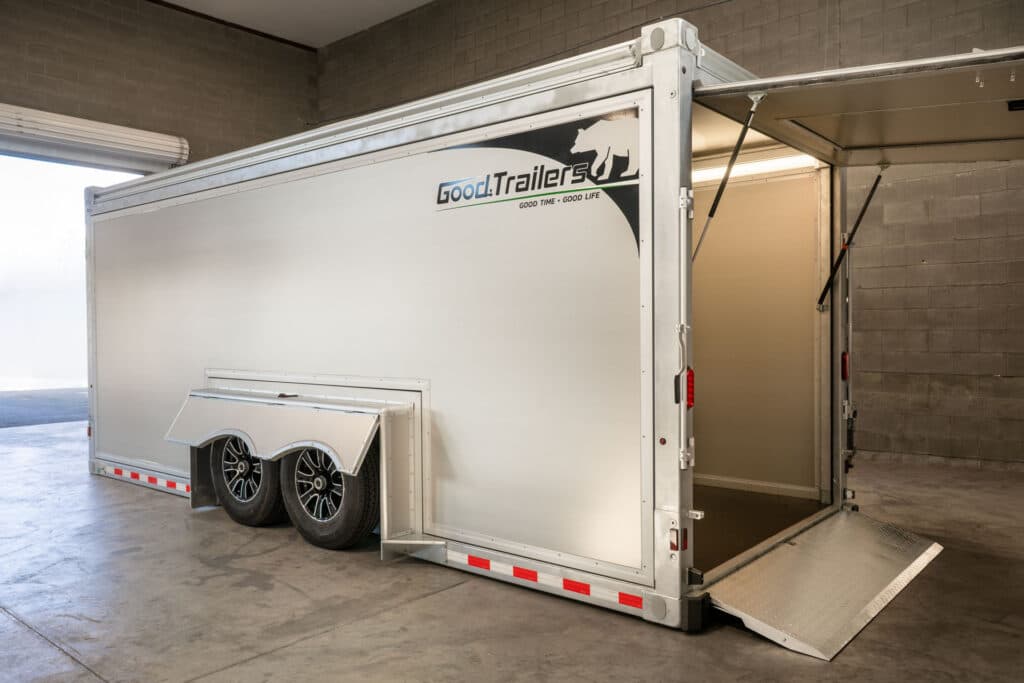
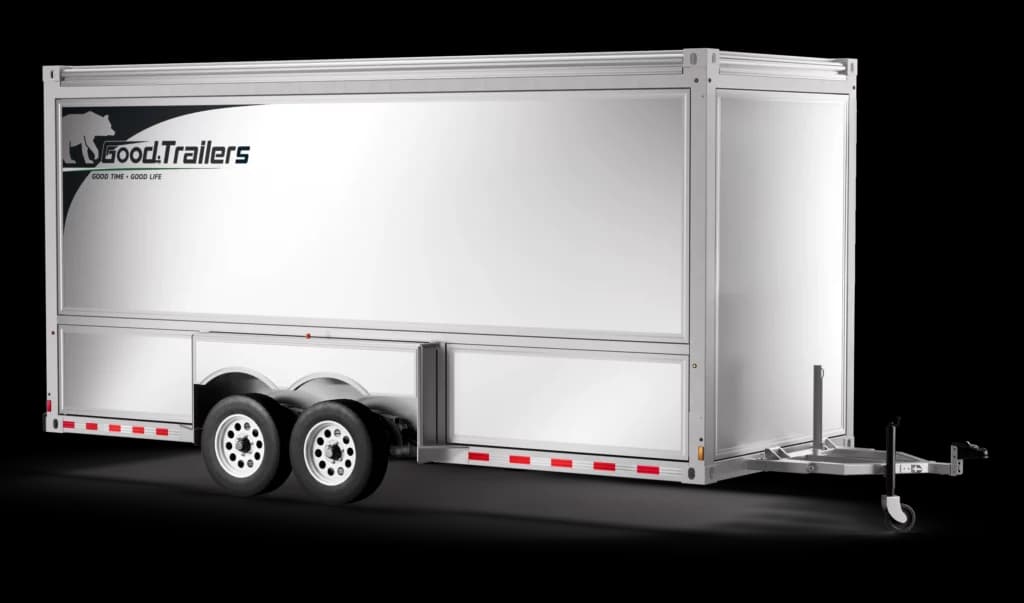
We recommend any of our enclosed cargo trailers. GoodMFG® is one of the only companies to offer a hydraulic lift trailer with a fully enclosed cargo option. For example, the GT19HDX offers 6,662 lbs. of carrying capacity.
Why enclosed?
Because our patent-pending, insulated composite aluminum panels and secure enclosed walls protect high-end pavers from weather elements and road debris. An enclosed trailer also prevents individual stones from shifting and bouncing out onto the highway, reducing liability risks while you haul your pavers down the highway.
The 360° interior lighting is another boon. It allows you to see exactly how your load is balanced, even if you’re loading early in the morning or late at night.
Key Takeaways
As you make decisions about which trailers will support your work this year, consider the following if you consider nothing else.
- Eliminate incline danger. A single pallet of stone can weigh up to 3,000 lbs. Lowering the trailer to a 5.4-inch deck height allows forklifts and pallet jacks to load completely level, eliminating steep ramp tipping risks.
- Ditch the teeter-totter. Unlike gravity tilt trailers that jolt violently when weight transfers past the pivot point—cracking fragile stone—a hydraulic drop deck maintains a completely stable, flat plane.
- Bypass lift gate limits. Standard commercial lift gates max out near 3,000 pounds and flex under heavy leverage. A heavy-duty drop deck maintains a completely stable, flat plane.
- Bypass lift gate limits. Standard commercial lift gates max out near 3,000 pounds and flex under heavy leverage. A heavy-duty drop deck easily handles multi-ton pallets without hydraulic strain or platform sagging.
- Secure at ground level. Tie down your load safely without fighting gravity or awkward ramp angles, allowing you to anchor straps tightly across pallets to prevent shifting and scratching in transit.
- The enclosed advantage. Using an enclosed model like the GT19HDX protects premium pavers from weather and road debris, while preventing individual stones from bouncing out onto the highway.
Load Low, Haul Good
Ready to secure the right trailer for your stone pavers?
- Call us right now at (360) 889-9789.
- Find a dealer near you.
- Click the green icon to the lower right to chat with Tow-Bot.
- Or contact us to send a message using the form below!
See also:
Moving Heavy Toolboxes Safely: The One-Operator Solution
Mobile Workshop Trailers for On-Site Equipment Repair
Good Trailer Buyers’ Guide: Which Good Trailer is Right for You?
This resource was compiled by the GoodMFG® Product Team, drawing on 75 years of experience in hydraulic systems, heavy-duty transport, trailers, and modular structures.
P.S. – We build trailers every day, but we don’t run your crews. If there’s a specific logistical headache or a “field reality” we’ve missed, we want to hear about it. Help us refine the equipment that makes your day easier! Email our Marketing Lead at devan-h @ goodrv.com and let us know what we should solve next.