Can you transport a scissor lift on a trailer?
Yes! You absolutely can. And with the right trailer, you can avoid many of the risks and headaches that come with transporting a scissor lift.
Here’s how to transport a scissor lift without damaging it.
table of contents
FAQ
How do you transport a scissor lift?
Trailers are the most common way to transport a scissor lift, but not all trailers are created equal. Traditional trailers require you to align across two narrow ramps, then drive slowly up an incline, hoping nothing goes wrong.
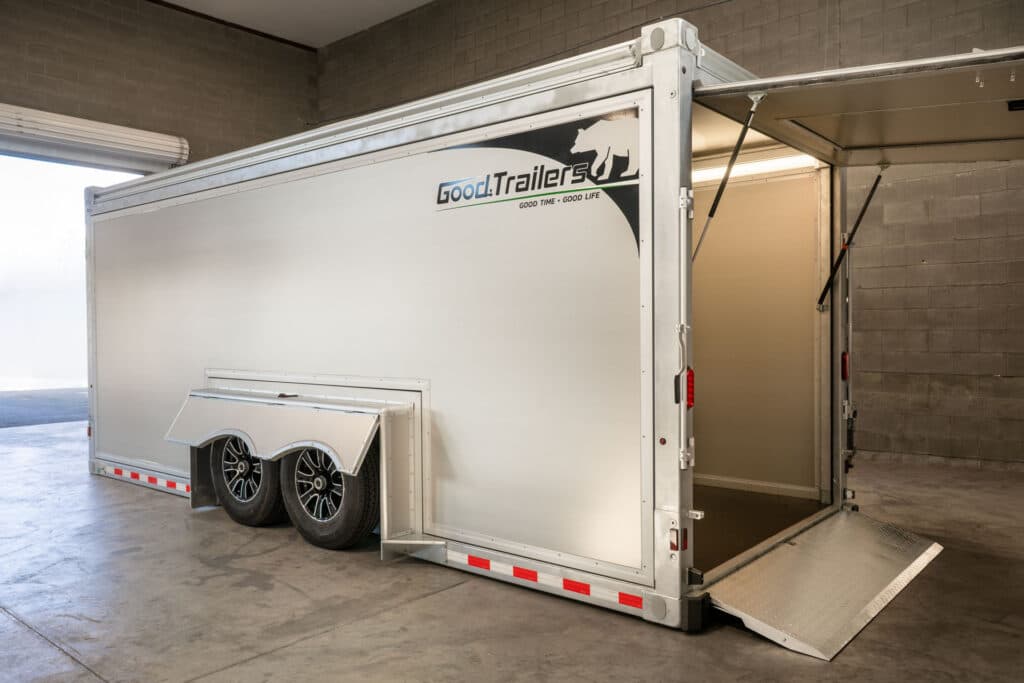
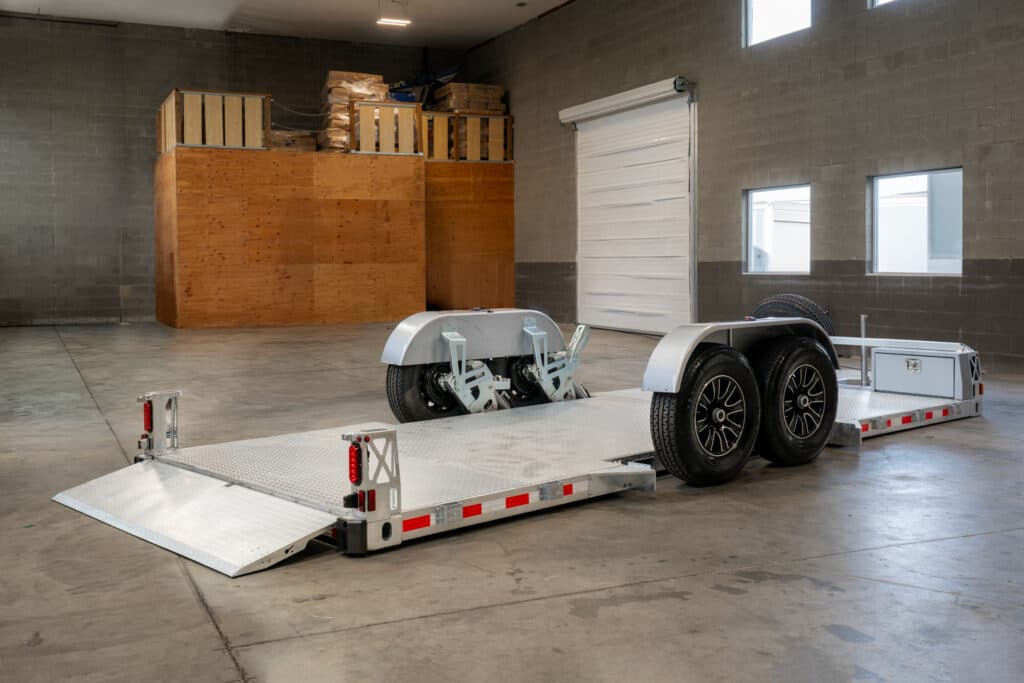
A drop deck trailer eliminates the biggest headache of this process by allowing you to roll or drive your scissor lift directly onto the trailer. Ground level loading and the wide, 74.4″ ramp we place on the back of our drop decks makes it easy to get the scissor lift on board with a minimum of fuss.
We recommend adding the D-ring stake pocket customization to our flatbeds to make it easy to strap down your scissor lift with robust ratchet binders.
No matter what kind of trailer you use, it’s imperative that you load it with the proper weight distribution. Make sure that the weight does not exceed the trailer’s carrying capacity, and then make sure 60% of the weight is towards the front and 40% is towards the back, using the axle as your dividing line.
Can you transport a scissor lift on a trailer?
Yes, but you need to pay close attention to dimensions and weight.
To get the carrying capacity of your trailer, subtract the trailer’s curb weight from the trailer’s GVWR. For example, our GT19FL flatbed trailer has a curb weight of 3,800 pounds and a GVWR of 11,000 pounds. That leaves you 8,000 pounds of carrying capacity.
That means you can transport most 10-19 ft platform height mciro or small scissor lifts with ease, as they only weigh roughly 1,600 to 2,800 lbs., as well as most medium scissor lifts with a 25 to 32 ft platform heights. If you have a large, rough-terrain scissor lift you’ll need a different, more specialized form of trailer.
As for width, you’re in good shape with a Good Trailer for both of these scissor lift options, as our trailers are 82″ wide and most medium scissor lifts do not exceed 46″ in weight.
You also have to watch stowed length, of course. For example, a Genie 2632 has a stowed length of roughly 8 feet, whereas our GT19FL trailer deck is 17’9″ long. You get 8 feet of deck space to spare as well as some weight capacity to play with: the Genie 2632 weighs ~4,729 pounds, so you might even be able to fit another, smaller scissor lift on there.
It’s important that you check the weight vs. your owners’ manuals so that you keep your haul legal.
What size trailer do I need for a scissor lift?
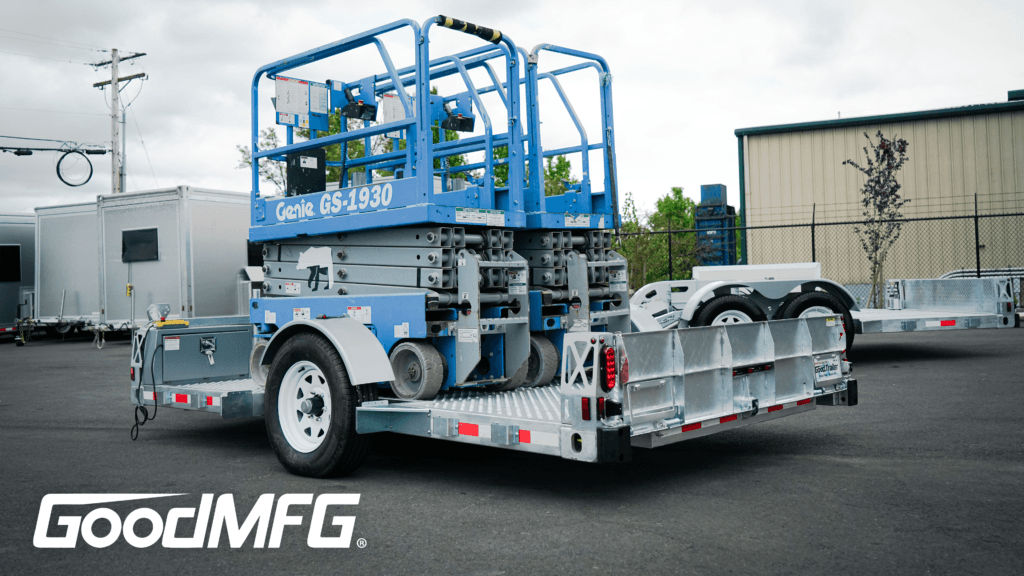
If you’re hauling a micro lift like a Genie GS-1930 or a Skyjack 3219, then you can use one of our 13′ flatbed trailers. If you’re hauling a medium slab lift like the Genie 2632 or the Skyjack 3226 then you’ll need to upgrade to one of our 19′ trailers.
If you’re using large, rough terrain lifts you will need a much larger trailer, something with around 25,900 lbs. of GVWR, and a full 102″ width. That means you’ll be looking at something like a gooseneck. We don’t offer those, but there are many reputable brands which do.
Do you need a CDL to haul a scissor lift?
It depends on the GVWR of your hauling vehicle and your trailer. You can haul mini and medium scissor lifts without a CDL as long as your trailer and towing vehicle are light enough.
A standard F-250 truck hauling a GT19FL is just under the 26,000-pound limit that a CDL requires. Be careful, because some F-350 models weigh a little too much and will push you over that limit.
A major advantage of Good Trailers drop deck trailers is your ability to haul them without resorting to a CDL, so long as the transport vehicle hits that sweet spot between a vehicle that’s tough enough to tow and a vehicle that’s light enough to keep you off the 26,000-pound threshold. Go over by even one pound, and you must use a CDL.
Scissor Lift Safety Risks
Hauling scissor lifts traditionally means struggling with problems like:
- Tip-overs. Scissor lifts are top-heavy and loading them onto a high deck trailer using long, steep ramps is inherently dangerous. Any misalignment can lead to costly accidents.
- Bottoming out. Low ground clearance meets high-breakover angles on steep ramps. You get thousands of dollars in damage when the lift’s chassis or motors bottom out.
In the past, these safety risks have necessitated a long, slow loading process that could take up to an hour in wet, slippery conditions.
Check out this demo video.
Scissor Lift Weights, Lengths, and Widths
As the weight, length, and width of your scissor lift will determine whether you can transport a scissor lift on a trailer that might be in your fleet, we wanted to take the time to give you the dimensions of the top three brands and models, and to match them to the trailer that is best suited to carrying them. This guide gives you a starting point for shopping. You should always double check manufacturer specifications and/or your owners’ manual to ensure the listed information is accurate or up-to-date.
Use the GT13FL for:
- ES1530M: 1,940 lbs., 4’10” long, 2’6″ wide
- GS-1432m: 1,984 lbs., 4’7″ long, 2’8″ wide
- SJ3213: 1,987 lbs., 5′ long, 2’8″ wide
- GS-1932m: 2,600 lbs., 4’7″ long, 2’8″ wide
- SJ3219: 2,675 lbs., 5’8″ long, 2’8″ wide
- ES1930M: 2,910 lbs., 4’10” long, 2’6″ wide
- SJ3226: 4,135 lbs., 7’7″ long, 2’8″ wide
- ES2632: 4,400 lbs., 7’10” long, 2’8″ wide
- GS-2632: 4,413 lbs., 8′ long, 2’8″ wide
- SJ4632: 4,700 lbs., 7’7″ long, 3’10” wide
Use the GT19FL for:
- SJIII 4632: 5,075 lbs., 7’6″ long, 3’8″ wide
- GS-3246: 5,211 lbs., 8′ long, 3’10” wide
- GS-3246: 5,218 lbs., 8′ long, 3’10” wide
- GS-3232: 5,367 lbs., 8′ long, 3’10” wide
- ES3246: 5,620 lbs., 8’2″ long, 3’10” wide
Moving Scissor Lifts: Good Solutions
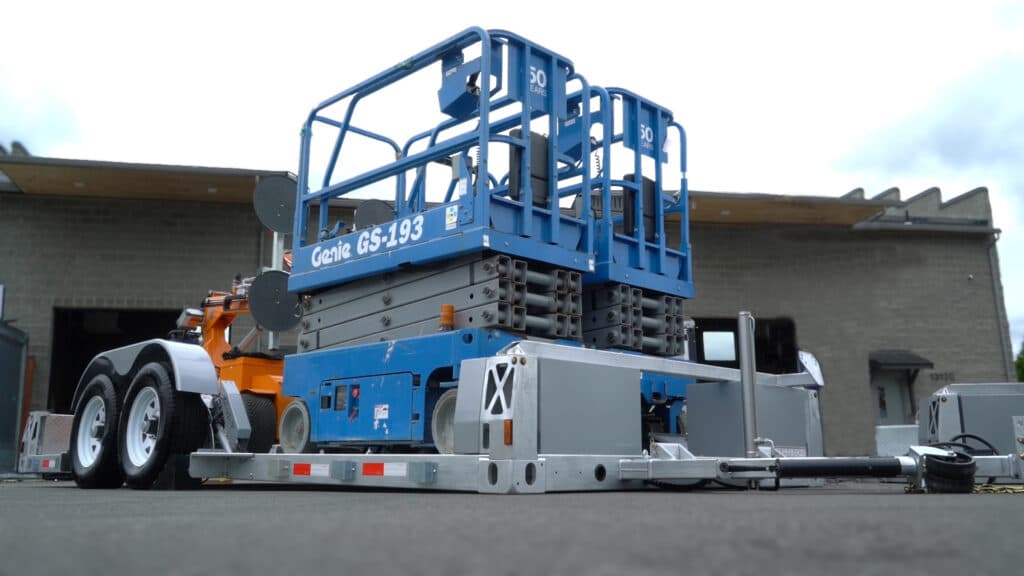
The GT19FL is inherently designed to help you solve all of the problems associated with moving scissor lifts. It’s the number one answer to how to transport a scissor lift without damaging it.
- Ground-level loading. The deck drops to just 5.4″ and the gap between the deck and the ground is addressed with a near zero-angle ramp. This prevents bottoming out, and protects battery packs, controllers, and wiring harnesses. No more expensive scraping damage. Good Trailers pay for themselves on this feature alone.
- Speed & efficiency. Load your lift in minutes, no matter what the weather is doing. Reduce non-productive time for your highly paid crew members.
- Haul most mid-sized lifts. The GT19FL has 8,958 lbs of carrying capacity, perfect for the most commonly rented and owned mid-range lifts. This means you can safely carry a 32-foot electric scissor lift (average weight 4,800 lbs) or a 26-foot Rough Terrain Scissor Lift (average weight 8,000 lbs). The 17’9″ deck easily handles the footprint.
- Easy alignment. The ramp is nice and wide at 75″, providing ample room for the operator to maneuver the lift without being forced onto a narrow path. Better side-to-side tolerance ensures safe loading, especially in tight jobsite conditions.
By making the loading process safe, quick, and predictable, you are investing in:
- Injury prevention. You mitigate one of the most common causes of heavy equipment accidents on the jobsite.
- Insurance savings. Reducing accident frequency and severity can positively impact your Experience Modification Rate (EMR) over time.
- Compliance. Investing in Good Trailers helps demonstrate a proactive commitment to safety standards and efficient equipment handling.
Control Your Logistics
For fleet operations, the GT19FL is more than just a trailer. It’s a logistics tool that gives you control.
Hauling mid-sized lifts often means relying on third-party transports, or waiting for a specialized lowboy trailer.
The GT19FL’s robust 8,958 lbs carrying capacity and its ability to be towed by a common, heavy-duty pick-up truck means you can detach your lift from a subcontractor’s schedule. Need to move a lift across town at 6 AM?
No problem.
The GT19FL gives your crew the independence to manage their own assets quickly and legally, maximizing the utilization of both your lift and your human capital.
By allowing for easy, single-operator loading, the GT19FL effectively turns two-person loading into a safe, one-person task, further boosting efficiency.
Transform Transport
If you’re looking for the right solution for scissor lift transport, now you know a hydraulic drop deck from Good Trailers is the way to go.
If you’ve been handling scissor lift transport with a traditional trailer, you now know that’s the source of many frustrations, and that there is a better way to handle scissor lift hauling.
It’s an investment that pays for itself—not just in preventing a single catastrophic bottom-out event, but also through consistent, daily savings in crew time, liability exposure, and operational efficiency.
Ready to transform the way you move scissor lifts? Call us today!
See also:
Hauling Heavy Equipment at Highway Speeds
Hauling Skid Steers Safely: A Guide to Weight, Straps, & Trailers
Hauling Mini-Excavators with Good Trailers
This resource was compiled by the GoodMFG® Product Team, drawing on 75 years of experience in hydraulic systems, heavy-duty transport, trailers, and modular structures.
P.S. – We build trailers every day, but we don’t run your crews. If there’s a specific logistical headache or a “field reality” we’ve missed, we want to hear about it. Help us refine the equipment that makes your day easier! Email our Marketing Lead at devan-h @ goodrv.com and let us know what we should solve next.