Food trailer or food truck?
Neither is automatically better for every operator. A food truck combines the vehicle and service space into one unit. A food trailer separates the business from the tow vehicle, which can create useful flexibility in how you transport, set up, organize, and operate your mobile food business.
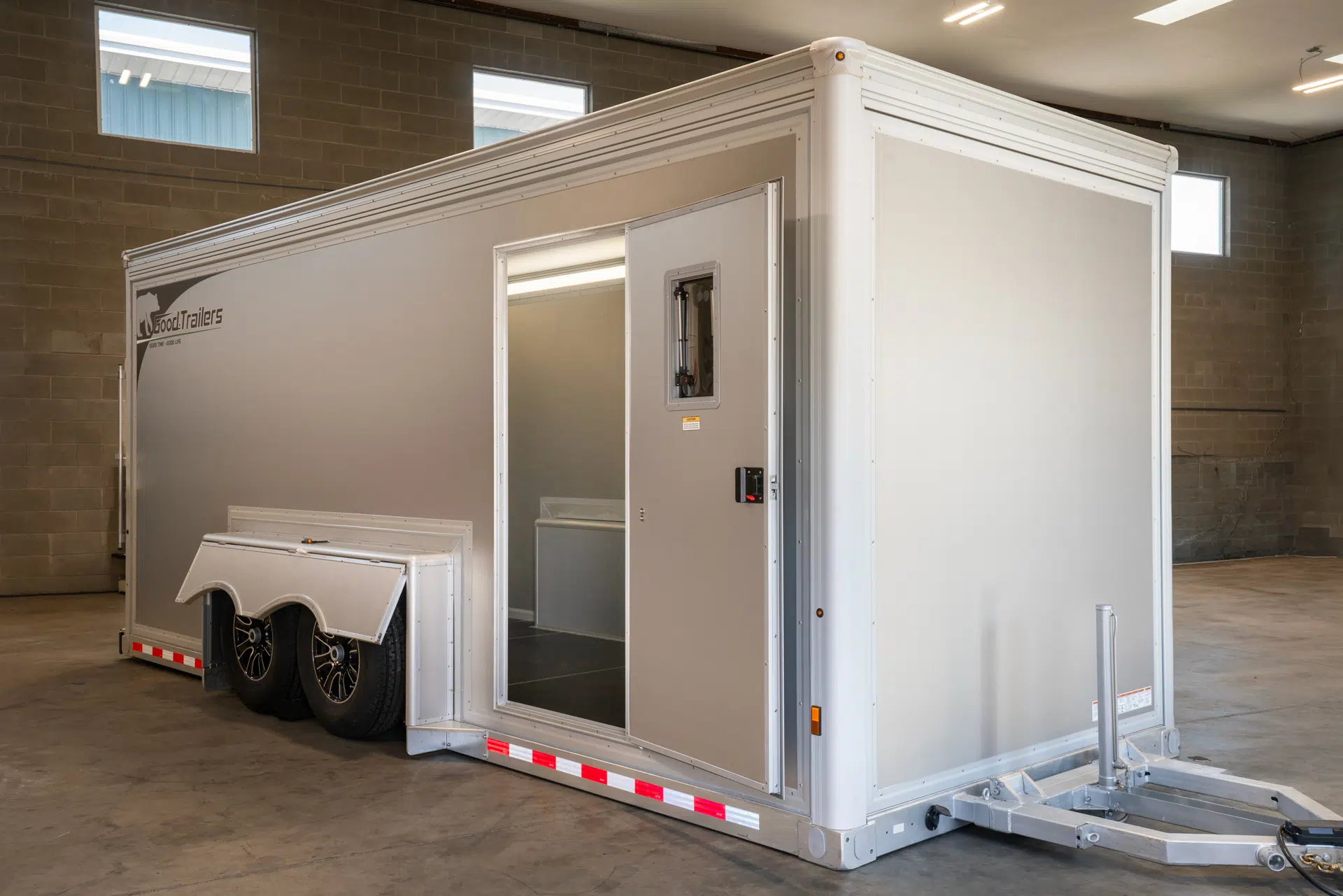
GoodMFG® concession trailers add another difference: hydraulic drop deck technology lowers the trailer for ground-level service and loading.
Note: our concession trailers are currently classified as food warming trailers, not as conventional food trailers. To transform them into an L&I approved food trailer, you’ll need further customization. Contact us!
Table of Contents
- Separate Your Business from the Tow Vehicle
- Compare the Workspace
- Plan Your Storage
- Make Loading & Service Easier
- Build Branding into the Food Trailer
- Thank About Interior Comfort
- Know What Your Food Trailer is Approved to Do
- FAQ
- Key Takeaways
- Explore GoodMFG® Food Trailers
Separate Your Business from the Tow Vehicle
The biggest structural difference between a food truck and a food trailer is simple.
A food truck combines the kitchen or service space with the vehicle that drives it.
A food trailer does not.
That can matter when something happens to your tow vehicle. If it needs service, you may be able to move the trailer with another properly rated and equipped tow vehicle rather than taking the entire food-service unit out of operation.
It can also give you flexibility once you reach a location. Depending on the venue and your operating arrangement, the tow vehicle does not necessarily have to remain part of the customer-facing setup.
That does not mean a trailer is maintenance-free. Tires, brakes, hydraulics, electrical components, and other trailer systems still require inspection and service.
But separating the food-service space from the vehicle means a problem with the truck does not automatically have to be a problem with the trailer.
For operators who spend long periods serving from one location, that separation can be useful.
Compare the Workspace
A food trailer is not automatically larger than every food truck. Compare the actual interiors of the units you are considering.
GoodMFG® offers its concession trailers in 13-foot and 19-foot models.
The GT13AL-C provides an interior measuring 12′7″ long, 6′10″ wide, and 7′7″ high. The larger GT19AL-C extends the interior length to 18′7″ while maintaining the same interior width.
That gives you two different footprints to work with depending on the scale of your operation.
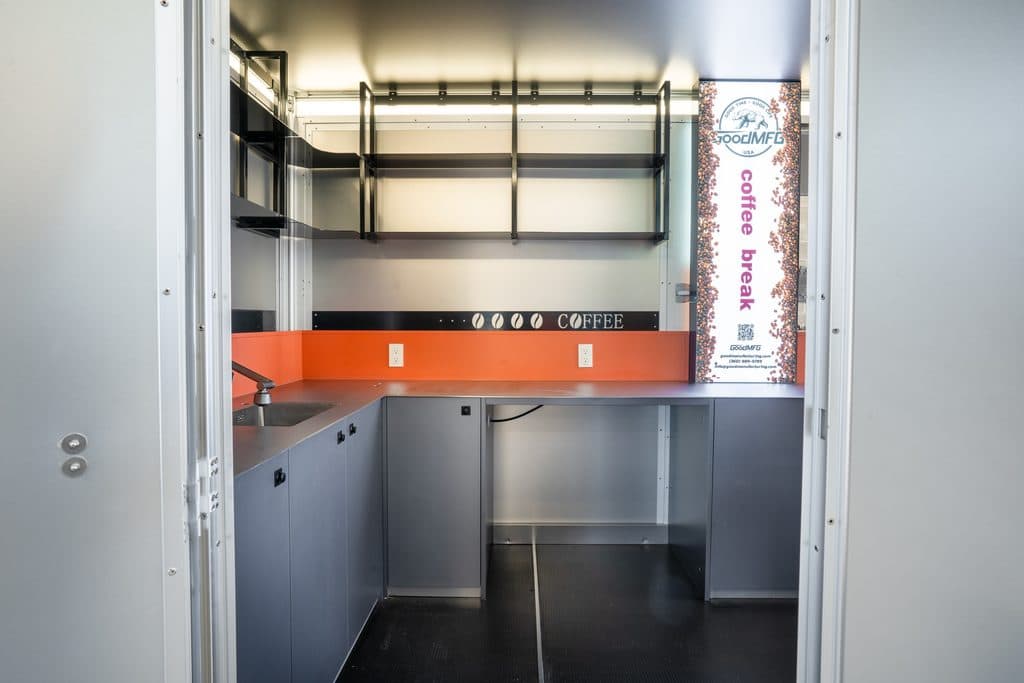
Think about:
- how many people will normally work inside;
- where customers will be served;
- which equipment must remain accessible;
- how much counter space you need;
- where inventory will be stored;
- whether workers can move around each other without constantly rearranging equipment.
The right amount of space is not simply the largest trailer you can tow. It is the layout that works for your menu, staffing, and service model.
Plan Your Storage
Cups. Napkins. Packaged food. Beverages. Cleaning supplies. Small equipment.
Mobile food service creates a surprising amount of stuff.
Both current GoodMFG® concession models include 304-grade stainless steel counters and cabinets, electrical outlets, and sinks as part of their standard food-service configuration.
That built-in storage gives you a starting point for organizing supplies instead of relying entirely on portable bins or equipment stacked wherever it fits.
Before ordering, think through a typical service day.
What needs to stay within arm’s reach?
What can remain in a cabinet until needed?
Where will clean items go?
Where will used or dirty items go?
What food-service equipment needs its own dedicated space?
Storage does not, by itself, make food handling safe. Refrigeration, sanitation, separation, temperature control, and local health requirements still need to be addressed for the foods you serve.
But a planned storage layout can make it easier to keep the workspace organized.
Make Loading & Service Easier
This is where a GoodMFG® concession trailer differs substantially from a conventional raised trailer.
The hydraulic drop deck system lowers the trailer for service rather than leaving the floor at its normal towing height.
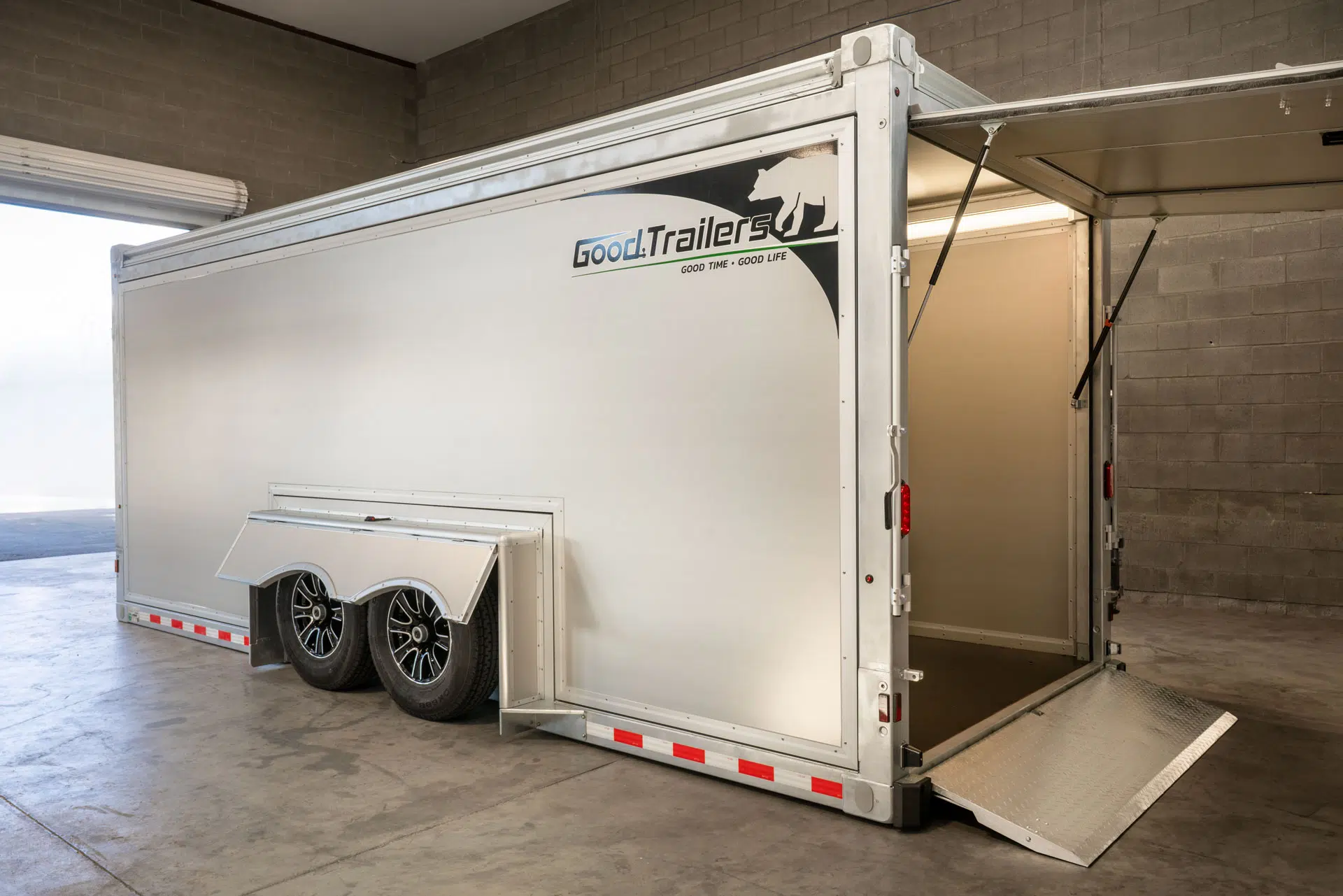
On the GT13AL-C, the deck lowers to 5.4″, with a compact 22-inch-long rear ramp bridging the remaining transition. The ramp covers the entire back of the trailer.
hat gives carts, supplies, cases, and compatible wheeled equipment a short approach into the trailer instead of requiring them to travel up a long ramp to a raised deck.
The same lowered position also changes the service experience.
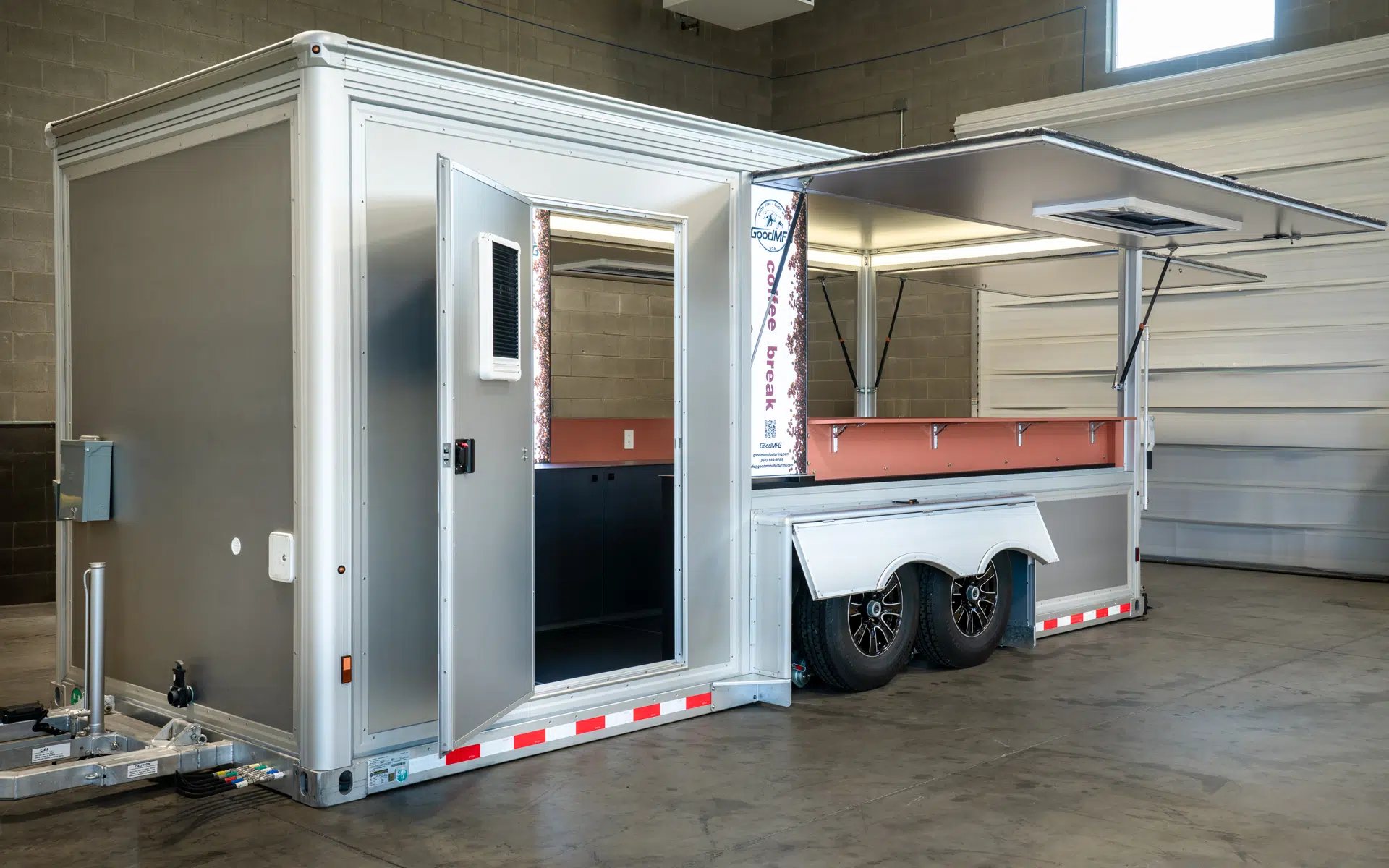
GoodMFG® concession trailers use locking lift panels that can open on up to three sides. With the trailer lowered, staff can serve customers closer to eye level instead of reaching down from a high service window.
That can make face-to-face interaction feel more natural and can reduce the amount of repeated downward reaching required during service.
It does not eliminate every loading or ergonomic concern. Loads still need to be handled appropriately, walkways need to remain clear, and the trailer must be operated according to its instructions.
But lowering the service floor addresses one of the basic challenges created by a raised mobile platform: the height difference between the trailer and everything happening around it.
Build Branding Into the Trailer
Your trailer is not only a place to serve food. At a fair, stadium, market, business park, or special event, it is also one of the largest pieces of branding your customers see.
GT13AL-C 13′ food trailers include folding LED screens. Both versions of the trailer include LED-backed signage.
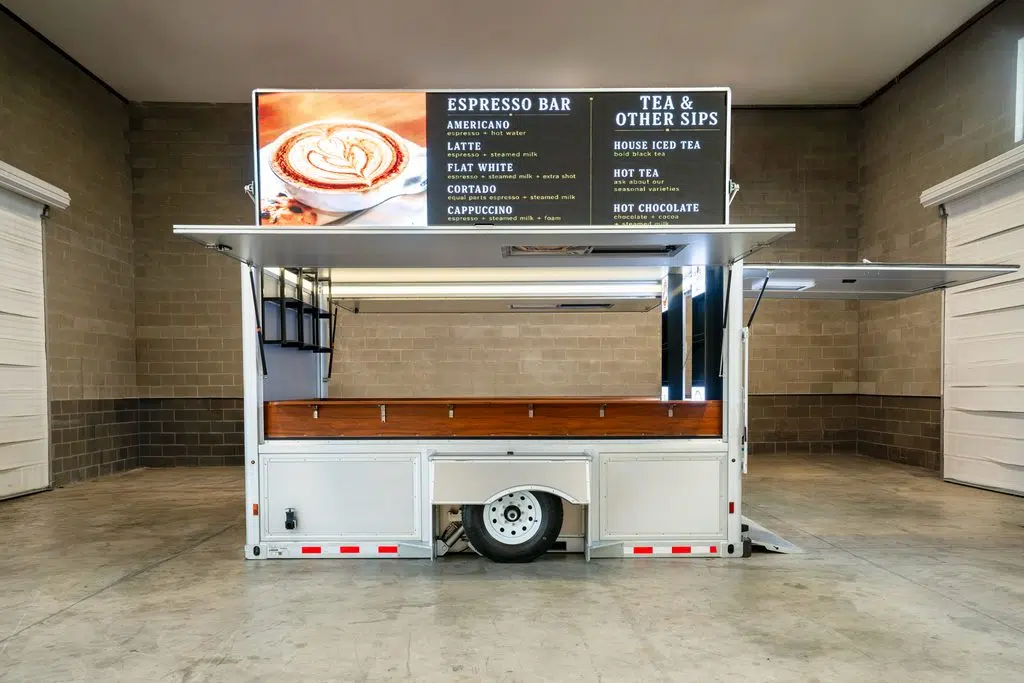
Digital signage can be especially useful when your operation changes throughout the day or season.
You might:
- update menu items;
- change pricing;
- switch between breakfast and lunch offerings;
- advertise a special;
- highlight an item that needs more attention;
- replace an unavailable item without reprinting a board.
That flexibility does not guarantee more sales. It does give you a faster way to change the information customers see.
Before using illuminated or digital signage, check the rules for the venues and jurisdictions where you plan to operate. Local requirements may regulate sign size, brightness, motion, or placement.
Consider Interior Comfort
Mobile food-service spaces can get warm.
People generate heat. Equipment generates heat. Sun exposure and outside temperatures matter, too.
GoodMFG® concession trailers use insulated composite aluminum panels rather than a simple uninsulated metal shell.
The practical benefit is that insulation slows heat transfer through the trailer envelope, helping moderate the effect of outside conditions compared with an otherwise similar uninsulated enclosure.
The lift panels offer another option when conditions allow. Opening them creates large service openings on multiple sides, which can increase natural airflow through the trailer.
Actual interior comfort will still depend on the weather, sun exposure, equipment running inside, the number of people working, ventilation, and your particular configuration.
Know What Your Food Trailer is Approved to Do
The standard, unmodified GoodMFG® food trailer is designed as a food-warming trailer. It should not automatically be treated as a fully equipped commercial cooking kitchen.
If you want to bring it into L&I compliance for other sorts of food, you’ll need further customization, which we can provide.
If your business centers on coffee, warming pre-cooked foods, packaged products, cold beverages, or another relatively simple service model, the requirements may be different from those of an operation frying, grilling, or preparing food from raw ingredients inside the unit.
Talk with GoodMFG® about the configuration you need, and confirm your intended setup with the authorities that regulate food service where you plan to operate.
FAQ
Is a food trailer cheaper to maintain than a food truck?
Not necessarily in every case.
A trailer does not have its own engine or transmission, which removes some of the major systems found in a self-propelled food truck. But trailers still require maintenance of tires, brakes, bearings, electrical systems, hydraulics, and other components.
The more useful distinction is that the food-service unit and tow vehicle are separate assets. A problem with one does not necessarily require taking the other out of service.
Which GoodMFG® concession trailer should I choose: 13-foot or 19-foot?
Choose around your layout.
The GT13AL-C provides a more compact footprint, while the GT19AL-C adds approximately six feet of interior length. Both use the GoodMFG® drop deck concept and food-service configuration.
Key Takeaways
Here’s the TL;DR of things to think about when deciding between a food trailer and a food truck.
- Food trailers and food trucks solve the mobility problem differently. A trailer separates the food-service space from the tow vehicle, which can provide additional operational flexibility.
- Ground-level service offers a meaningful advantage. The hydraulic drop deck reduces the height that supplies must travel during loading and puts the serving area closer to customer height.
- Insulated construction can help moderate interior conditions. Actual comfort still depends on weather, equipment, ventilation, occupancy, and the final configuration.
- Branding can change without rebuilding the trailer. LED-backed signage and available digital-display options give operators additional ways to present menus and branding.
- Match the trailer to the menu. Standard GoodMFG® food trailers are food-warming units; additional cooking equipment may require customization and regulatory approval.
Explore GoodMFG® Food Trailers
A food truck may be the right fit when you want your transportation and food-service space permanently combined into one vehicle.
A food trailer deserves a closer look when you want the flexibility of a separate tow vehicle, more control over your workspace, ground-level loading and service, and a trailer that can be configured around the way you operate.
Ready to choose yours? Find your nearest authorized dealer or contact us to get started today!
Loading form…
See also:
Hydraulic Drop Deck Trailer Maintenance, Because Nobody Has Time for Breakdowns
The Top 4 Advantages of Drop Deck Concession Trailers
How to Create an Incredible Concession Trailer
This resource was compiled by the GoodMFG® Product Team, drawing on 75 years of combined experience in hydraulic systems, heavy-duty transport, trailers, and modular structures.
P.S. – We build trailers every day, but we don’t run your crews. If there’s a specific logistical headache or a “field reality” we’ve missed, we want to hear about it. Help us refine the equipment that makes your day easier! Email our Marketing Lead at devan-h @ goodrv.com and let us know what we should solve next.