Need to know how drop deck trailers handle extreme weather because your jobsites aren’t always friendly or comfortable?
Heavy equipment moves don’t stop just because the weather is bad. If you’re still stuck with a standard trailer, then you already know the toll extreme job-site conditions can take.
Find out how drop deck trailers handle extreme weather and learn whether upgrading may be right for you and your crew.
Table of Contents
Ice & Snow
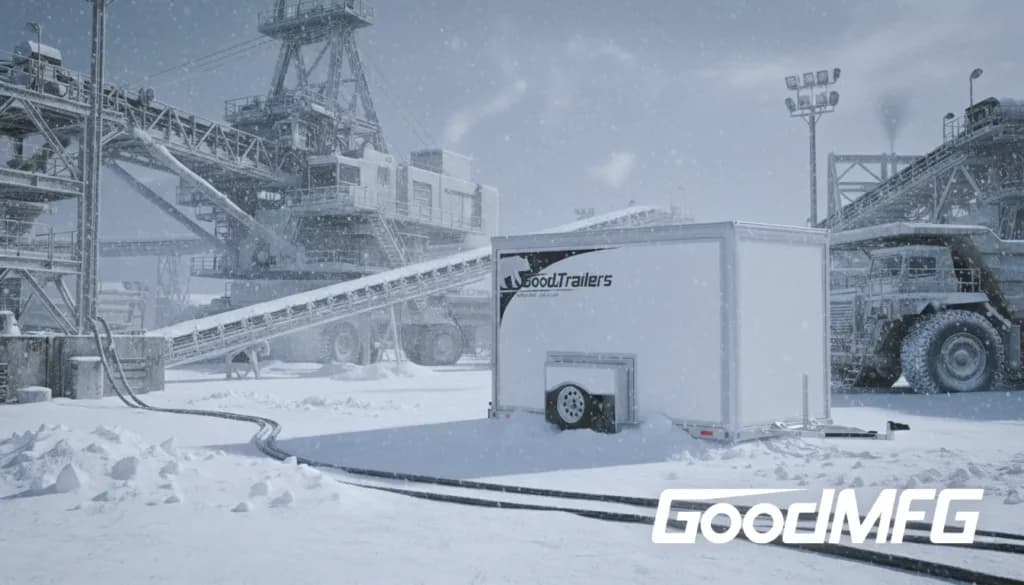
Traction loss on a 16° to 20° incline? Bad scene. Machines can slide sideways or backward. They can slip. And they can do all that while a sluggish, cold operator struggles to keep up.
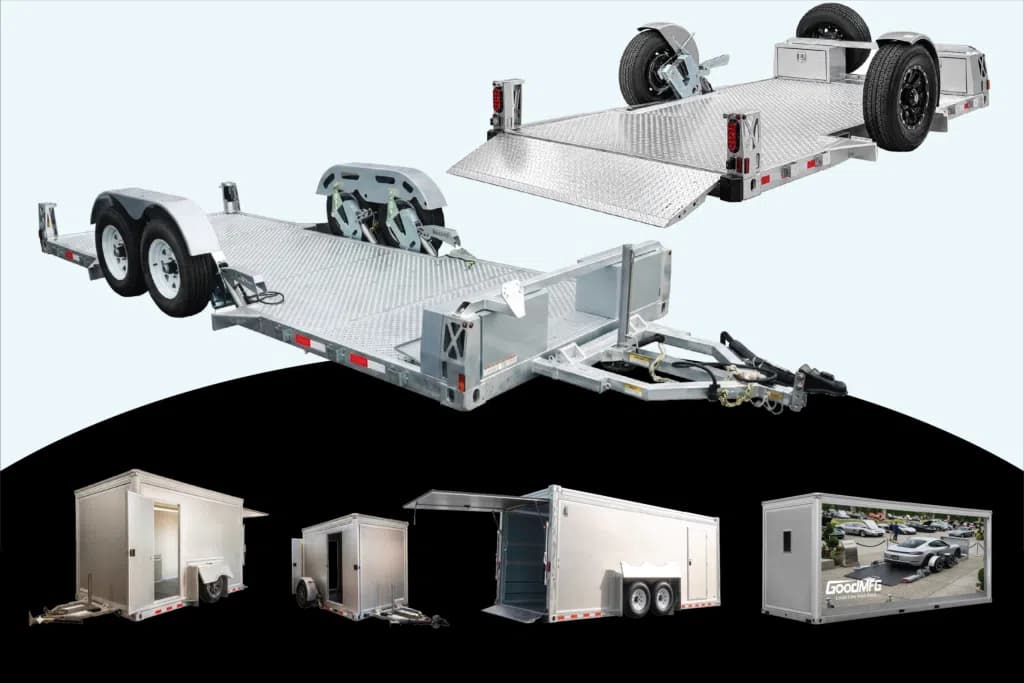
Fortunately, when a Good Trailer is lowered all the way to the ground the fold-out ramp sits at an 11° angle, is short at 22”, and is wide at 74.4”. That means you don’t need much momentum to get that piece of equipment onto the deck.
While dropping the deck doesn’t eliminate every hazard (see Hydraulic Drop Deck Winter Safety) it does significantly reduce risks. Taking a few additional mitigating measures like adding anti-slip tape to your ramp can reduce them even more.
Mud & Soft Soil
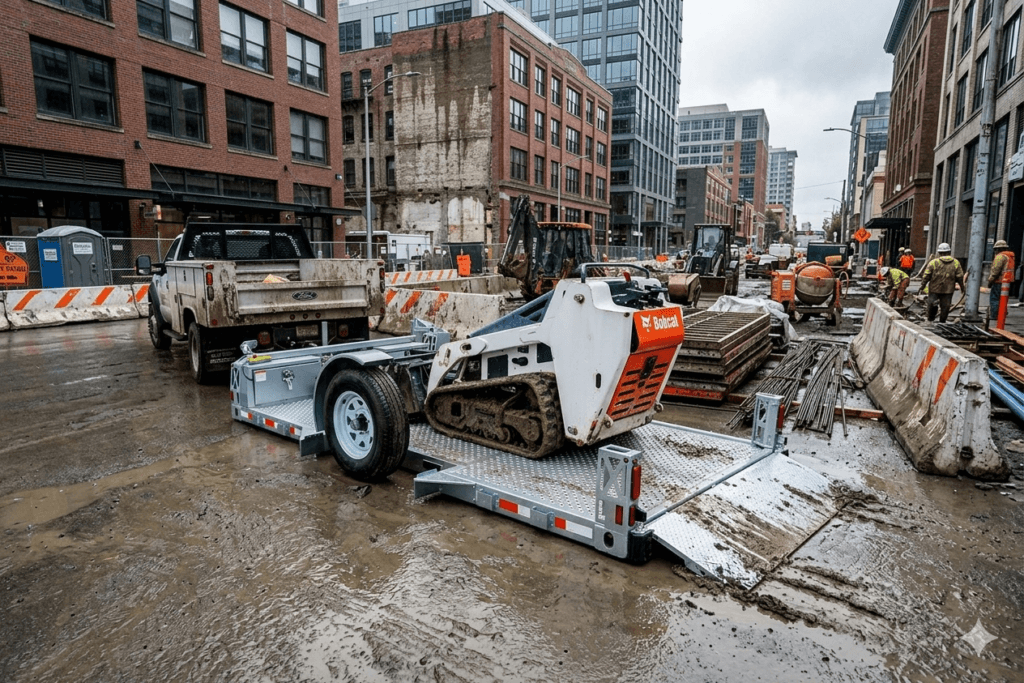
No construction professional needs us to tell them what it is like to slog through a mud pit on days when thunderstorms rage and work still has to get done. You already know what it’s like to drive a piece of heavy equipment up narrow, slick ramps when the machine is already dragging 500 pounds of mud in its track hardware.
When you load with a Good Trailer the 74.4” ramp offers stable access, giving machinery a wide, solid footprint to climb onto. You stop having to fight gravity, which makes the load easier, faster, and more efficient.
Salty Conditions
Road salt in the winter. Sea salt on the coast. Many crews contend with salt constantly, which of course means corrosion.
While dropping the deck doesn’t help with salt, the galvanized steel frame on a Good Trailer does. The process helps reduce rust on your trailer, making it last longer even if you constantly find yourself working in salty environments.
FAQ
Do hydraulic systems on drop deck trailers freeze or slow down in extreme cold?
When ambient temperatures fall below 18 degrees, it’s important to switch to N32 anti-wear low condensate hydraulic fluid. As long as you take this step, the hydraulic systems should perform well enough for you to continue about your work day. During warmer months, you should use N46 anti-wear hydraulic fluid instead.
What happens if mud, ice, or debris gets caught underneath the deck when lowering a drop deck trailer?
Remove any objects that may cause an uneven operating surface, including large rocks. Otherwise, it will be difficult to get your trailer to sit flat for a true ground-level loading experience.
How does hot-dip galvanizing protect the trailer frame compared to standard powder coat paint?
Standard powder coat or spray paint easily chips when scraped by mud-caked tracks, rock-filled tire treads, or heavy boots, exposing raw steel to rust and road salt. Hot-dip galvanizing completely submerges the steel frame in molten zinc, bonding inside and out to create a self-healing barrier that prevents rust and chemical corrosion for years in salt-heavy environments. Every chassis on every one of our trailers features this sort of galvanized steel framing.
Key Takeaways
Here’s your TL;DR as you consider how drop deck trailers handle extreme job site conditions.
- Shallow 11° incline for ice. A 5.4” deck height and low-angle fold-out ramp prevent machinery from losing traction or sliding backward in winter conditions.
- 74.4” full-width mud stability. A full-width fold-out ramp gives heavy, mud-caked tracks a solid platform, eliminating narrow-track ramp slips.
- Hot-dip galvanized corrosion protection. Galvanized structural steel frames resist rust and chemical degradation from road salt, liquid de-icers, and coastal environments.
- All-weather operational velocity. Ground-level loading keeps single-operator delivery schedules on track regardless of rain, mud, ice, or snow.
Load Low, Haul Good
If you need to know how drop deck trailers handle extreme weather because you’re constantly battling the elements, then never fear. The truth is they work quite well! In fact, if you work in extreme environments, then ground-level loading is an even greater gamechanger than it will be for most people, and they are a total gamechanger for almost everyone who tries them. If you’re ready to upgrade, don’t wait. Find your nearest dealer or contact our office for options today.
See also:
The Top 4 Advantages of Trailers that Lower to the Ground
Risk Mitigation on the Ramp: Seamless Loading & Unloading Solutions
Drop Deck Trailer vs. Tilt Trailer: Complete Comparison Guide
This resource was compiled by the GoodMFG® Product Team, drawing on 75 years of experience in hydraulic systems, heavy-duty transport, trailers, and modular structures.
P.S. – We build trailers every day, but we don’t run your crews. If there’s a specific logistical headache or a “field reality” we’ve missed, we want to hear about it. Help us refine the equipment that makes your day easier! Email our Marketing Lead at devan-h @goodrv.com and let us know what we should solve next!