You’ve decided drop deck trailers may be a good choice for your company fleet, but aren’t sure which trailer is the best drop deck trailer for your business?
Choosing the right trailer means doing some payload math, thinking about some loading geometry, considering the durability and lifespan of the trailer, and thinking about long-term serviceability. This guide breaks down the core criteria to help you choose the best trailer for your business.
Table of Contents
What Drop Deck Trailers Accomplish
Investing in a hydraulic drop-deck trailer directly impacts four critical operational areas:
- Make low-clearance equipment easier to load. A lower deck and gentler approach can reduce the risk of scraping or high-centering equipment during loading and unloading.
- Reduce ramp handling. Instead of positioning long removable ramps, the trailer lowers and uses a short, attached ramp to bridge the remaining transition to the deck.
- Simplify repeated loading and unloading. For equipment that can roll or drive aboard, a lower approach can make frequent stops less cumbersome.
- Help protect the equipment you already own. If steep loading geometry is a recurring problem for your fleet, reducing that angle can help reduce exposure to loading-related damage.

5 Questions to Ask Before Buying
These questions will help you evaluate any drop deck trailer, not just ours (though of course, yes we are biased and yes we do believe we offer the best drop deck trailer on the market).
Evaluate these core criteria across every manufacturer before making a purchasing decision:
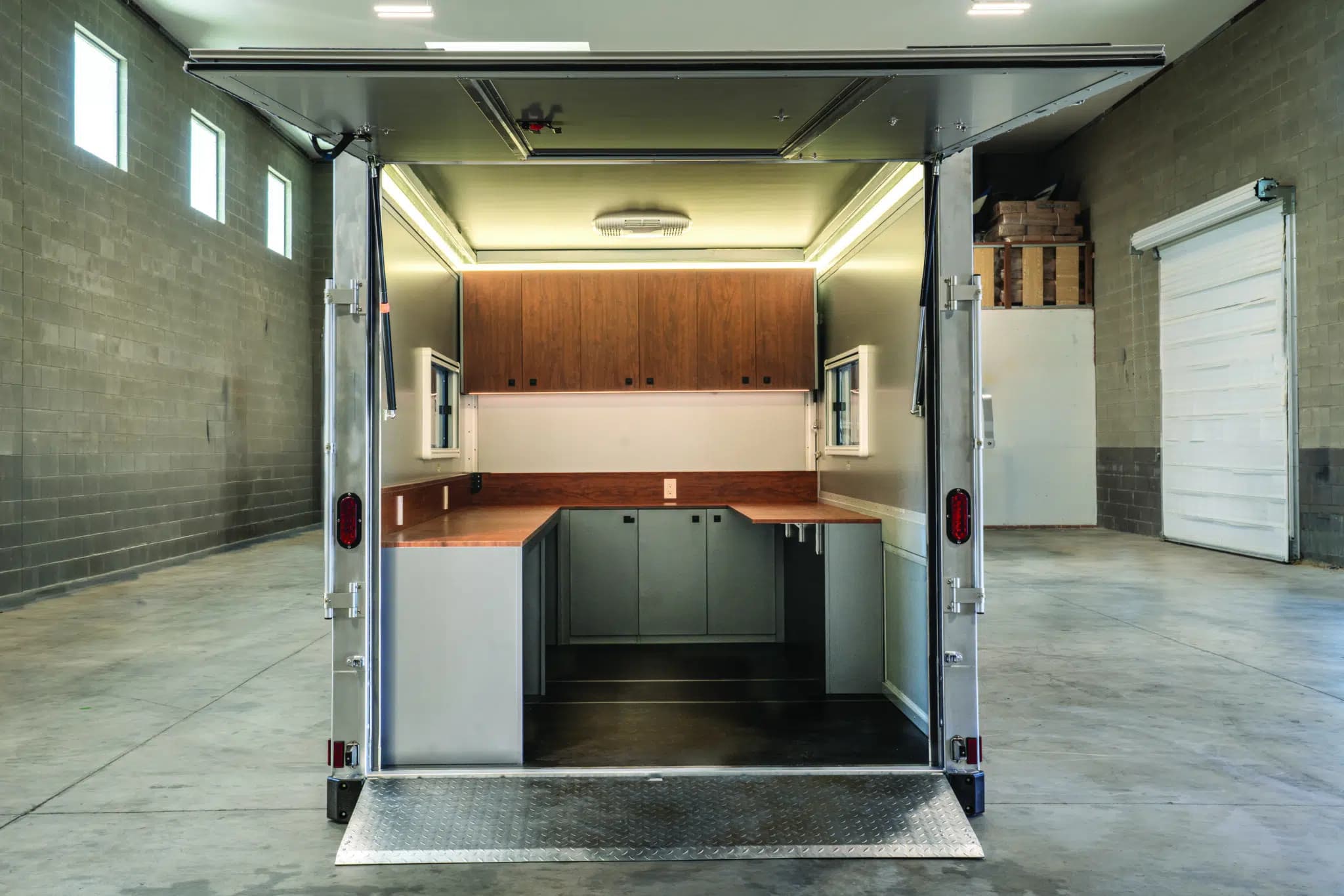
- What primary equipment or cargo are you hauling? Open flatbeds are best for machinery like skid steers and mini-excavators. Enclosed composite models protect high-value tools, electronics, materials, or mobile workshops from harsh weather.
- What is your heaviest typical payload? Always calculate net carrying capacity: GVWR- Curb Weight = Payload capacity. For example, our GT19FL features an 11,800 lb. GVWR and a 3,800 lb. curb weight, ultimately delivering 8,000 lbs of net payload capacity.
- What are the exact length and width dimensions of your loads? Remember to account for excavator buckets, hydraulic attachments, or secondary toolboxes when calculating deck length.
- How easily can the trailer be serviced? Verify component accessibility. Good Trailers can be serviced at many trailer service centers, and our modular hydraulic systems use standard components that any fluid power technician can maintain. We recommend checking the NATM member directory first.
- Is the manufacturer part of the NATM Compliance Verification program? Third-party National Association of Trailer Manufacturers (NATM) checks the manufacturing process every two years and certifies compliance with Federal Motor Vehicle Safety Standards (FMVSS).
Key Use Cases
You of course always want to match the trailer to the use you’ll be putting it to. You’ll also want to match it to your most common operational challenges. For example, if you’re routinely running down rough rural roads then you might want to skip over the medium-duty enclosed option in favor of one of our heavy-duty enclosed options.
| Operational Need | Configuration to Consider | GoodMFG® Options | Example Applications |
|---|---|---|---|
| Low-clearance or drive-on equipment | Hydraulic flatbed | GT13FL or GT19FL | Equipment rental, scissor lifts, compact equipment, landscaping or construction equipment |
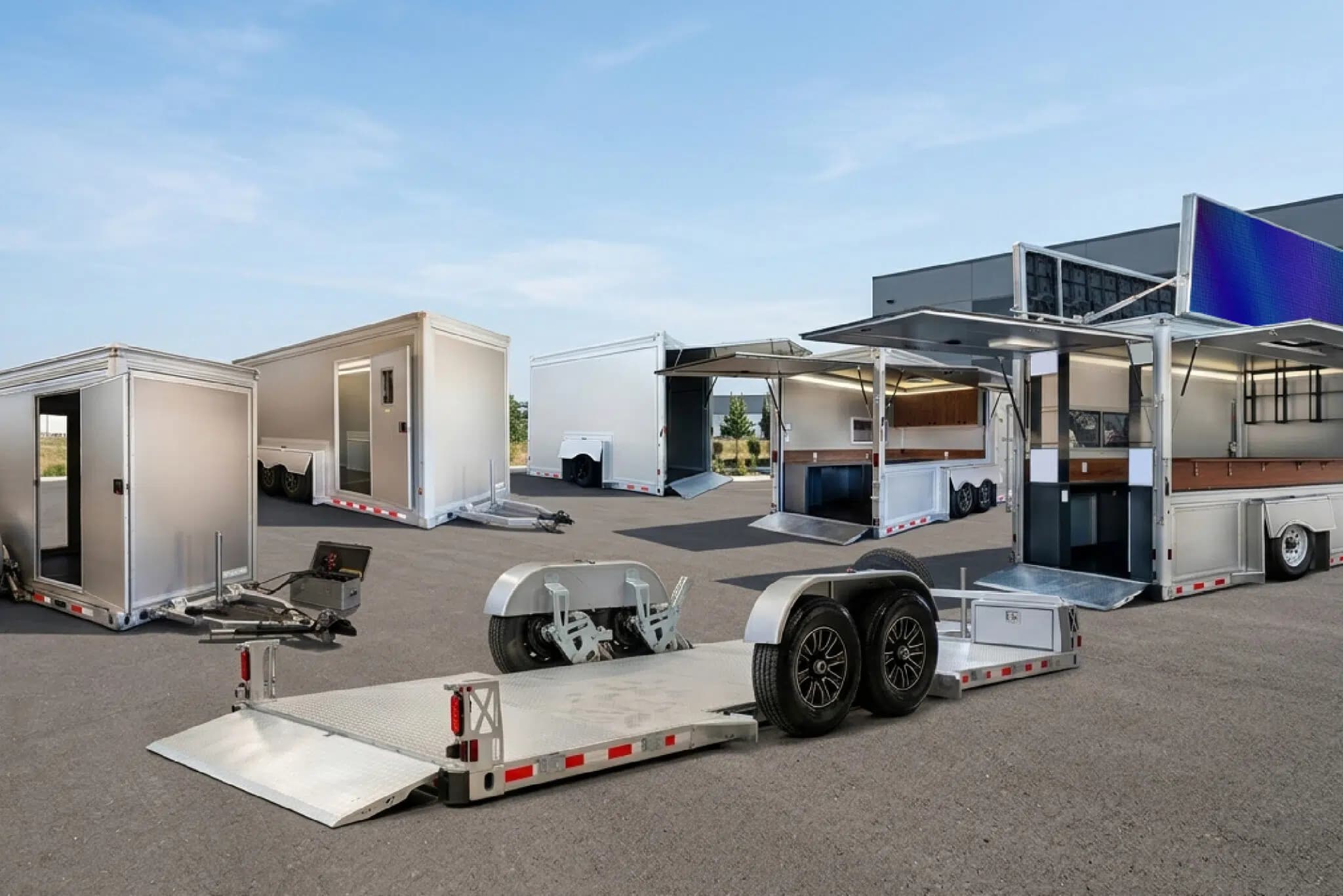
| Weather-protected enclosed hauling | Medium-duty enclosed | GT09AL, GT13AL or GT19AL | Mobile tools, service equipment, inventory and materials |
| More demanding routes or taller enclosed loads | Steel-post HD or HDX | GT13HD, GT19HD, GT13HDX or GT19HDX | Contractors, municipal fleets, rural service work and mobile workshops |
5 Things to Bring to the Dealership
To ensure your local dealer sets up the ideal trailer configuration, bring the following specs:
- Maximum Load Dimensions: Exact length, width, height, and wet operating weight of your heaviest machine.
- Minimum Ground Clearance: The lowest breakover ground clearance across your fleet (e.g., scissor lift specs).
- Tow Vehicle Specifications: Bring the GVWR, GCWR, hitch rating and towing capacity for the vehicles that will actually pull the trailer. If CDL requirements are a concern, confirm the rules that apply to your specific vehicle-and-trailer combination rather than relying on trailer GVWR alone.
- Hitch & Electrical Receiver Class: Receiver size and brake controller availability on your tow vehicles.
- Primary Travel Route Conditions: Percentage of transit time spent on highways vs. urban streets vs. rough gravel/dirt job sites.

Evaluating Whether a Drop Deck Trailer is a Worthwhile Fleet Investment
A drop deck trailer can be a worthwhile fleet investment, but there is no universal payback calculation. The value depends on what your current loading process is costing you.
Start with your own operation.
Loading and setup time: How much time does your crew currently spend deploying ramps, positioning equipment and packing everything back up? If that happens several times each day, even a modest improvement can matter over the life of the trailer.
Equipment damage exposure: Look at your own repair history. If low-clearance equipment regularly scrapes, bottoms out or struggles with your current loading angle, gentler loading geometry may address a real recurring cost.
Ramp handling: GoodMFG® trailers use a short, attached, spring-assisted ramp rather than separate long ramps that need to be positioned and stored. Whether that changes your staffing needs depends on what you are loading and how your crew operates.
Fleet utilization: A trailer is more valuable when its dimensions and carrying capacity allow it to handle a large share of the loads your fleet actually moves. Buying too little trailer can create operational problems; buying more trailer than you need can add unnecessary size and weight.
Maintenance and service: Hydraulic systems, tires, brakes, bearings and other trailer components still require inspection and maintenance. Consider service access and parts support as part of the lifetime cost of ownership.
FAQ
What is the difference between a step deck trailer and a ground-level drop deck trailer?
A traditional step deck, or single-drop trailer, uses a lower deck primarily to accommodate taller freight while remaining at transport height. A ground-level drop deck is designed to lower its loading surface before loading or unloading.
GoodMFG® hydraulic drop deck trailers lower to a 5.4-inch height and use a short ramp to bridge the remaining transition from the ground to the deck.
What is the loading angle on a ground-level drop deck trailer?
Loading angles vary by trailer design, so compare actual specifications rather than relying on the term “drop deck” alone.
GoodMFG® flatbed trailers use a 22-inch ramp with an 11° approach when lowered. That gentle transition is particularly useful when loading equipment with limited ground clearance or breakover clearance.
Key Takeaways
If you remember nothing else while choosing the best drop deck trailer, remember these key takeaways.
- Buy for the load you actually haul. Check wet operating weight, attachments, dimensions and required carrying capacity rather than relying on GVWR alone.
- Loading geometry matters. GoodMFG® flatbeds lower to 5.4 inches and use an 11° approach to make low-clearance loading more manageable.
- Usable payload matters more than the biggest number on the spec sheet. The GT19FL, for example, combines an 11,800-lb GVWR with an estimated 3,800-lb curb weight for an estimated 8,000 lbs of carrying capacity.
- Match construction to your routes and work. Open flatbeds, medium-duty enclosed trailers, steel-post heavy-duty models and high-cube models solve different problems.
- Think beyond the purchase date. Service access, replacement parts, tow-vehicle compatibility and the jobs the trailer can cover all affect its long-term usefulness.
The Best Drop Deck Trailer is Waiting
There isn’t one trailer configuration that’s best for every business.
The right choice is the one that can carry your real equipment, fit your regular routes, work with your tow vehicles and make the difficult part of your current loading process easier.
Ready to get started? Find your nearest dealership or contact us for options today!
See also:
The Ultimate Drop Deck Trailer Buyers Guide
Who Sells Zero Degree Trailers? The Ground-Level Loading Truth
The Top 4 Advantages of Trailers that Lower to the Ground
This resource was compiled by the GoodMFG® Product Team, drawing on 75 years of combined experience in hydraulic systems, heavy-duty transport, trailers, and modular structures.
P.S. – We build trailers every day, but we don’t run your crews. If there’s a specific logistical headache or a “field reality” we’ve missed, we want to hear about it. Help us refine the equipment that makes your day easier! Email our Marketing Lead at devan-h @ goodrv.com and let us know what we should solve next.