Owning a Kubota means you’ve invested in world-class engineering, but finding the best trailer for Kubota equipment can be a challenge.
A smaller 7,000-pound-GVWR trailer may be enough for some Kubota L-Series configurations, but tractor weight alone doesn’t determine the right trailer. Loaders, rear implements, ballast, loaded tires, deck length, load distribution and the tow vehicle all matter.
For owners who regularly transport an L-Series tractor with attachments, the GT19FL’s 17′9″ usable deck and 8,000-pound estimated carrying capacity provide substantially more flexibility than the GT13FL. Its hydraulic drop deck also lowers the loading surface to 5.4 inches, reducing the climb onto the trailer.
This post covers general Kubota construction equipment. We also did an in-depth post on hauling Kubota tractors you might find interesting.
Table of Contents
Ground Level Loading for Kubota Equipment
Loading construction equipment onto a trailer requires attention to ramp angle, traction, ground clearance, machine dimensions, and the manufacturer’s loading instructions.
With a conventional fixed-height trailer, the machine may have to climb a longer or steeper ramp to reach the deck. Low-clearance equipment can also encounter a more pronounced transition where the ramp meets the trailer.
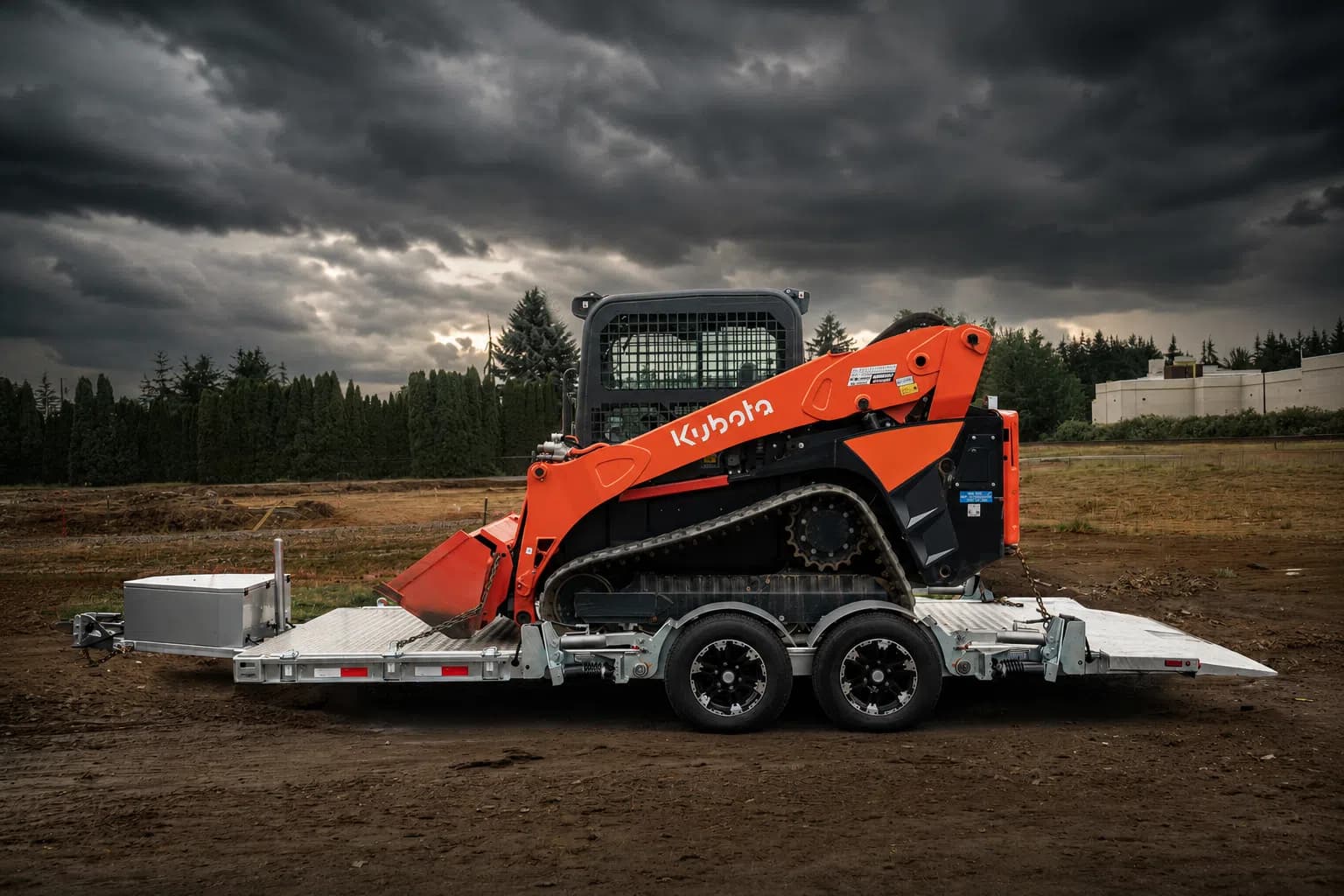
A GoodMFG® hydraulic drop deck takes a different approach. The deck lowers to 5.4 inches above the ground, and a short 22-inch, 76.5-inch-wide ramp with an 11° approach bridges the remaining transition. The GT13FL and GT19FL both use this loading geometry.
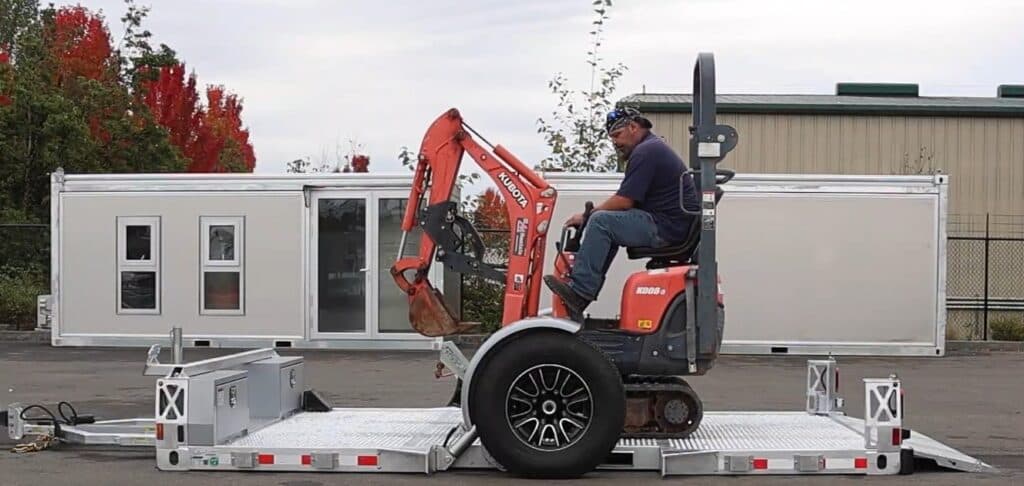
That significantly reduces the vertical climb onto the trailer and the severity of the ramp-to-deck transition. For compatible Kubota equipment, that can make loading more straightforward and help reduce scraping or high-centering.
Of course, you should always follow Kubota’s loading and operating instructions for the specific machine, and use a safe, level loading area.
Best Trailer for SCL 1000 Stand-On Compact Loaders
The SCL1000 has a published transport length of 107.7 inches, a 36-inch width with the standard bucket, and a 3,035-pound operating weight without an operator. That places it comfortably within the GT13FL’s 11′8″ × 6′10″ usable deck and 5,055-pound estimated carrying capacity, making the GT13FL a strong candidate for this machine.
Best Trailers for Kubota Excavators
Best Trailers for Kubota Excavators
The K008-5 is a good candidate for the GT13FL:
- K008-5: 9′0″ L, 2′10″ W, 2,315 lbs
The KX018-4 is better suited to the GT19FL, because its 12′2.1″ transport length exceeds the GT13FL’s 11′8″ usable deck:
- KX018-4: 12′2.1″ L, 4′3.2″ W at full track width, 3,747 lbs
The GT19FL is also a good candidate for:
- KX030-4: 15′1.1″ L, 4′11″ W, 6,272 lbs
- KX033-4: 15′6″ L, 5′1″ W, 7,420 lbs
The KX033-4 leaves substantially less payload margin, so attachments and other cargo need particular attention.
Beginning with the current KX040-4, published operating weights exceed the GT19FL’s 8,000-pound estimated carrying capacity, so those larger models require another transport solution.
Best Trailer for Zero and Tight Tail Swing Excavators
The GT13FL is a good candidate for the U10-5.
The U17-5 is technically almost identical in length to the GT13FL’s 11′8″ usable deck, leaving essentially no longitudinal margin. For that reason, the GT19FL is the more practical recommendation for the U17-5.
The GT19FL is also a good candidate for the U27-4 at 13′6″ long and 5,688 pounds.
The current U35-4 starts at a published 8,129-pound operating weight, putting it above the GT19FL’s estimated 8,000-pound carrying capacity.
Best Trailer for Kubota Skid Steers
The SSV65 is the current Kubota skid steer that fits within the GT19FL’s 8,000-pound estimated carrying capacity. Kubota lists it at 6,790 pounds with an open cab or 7,055 pounds with a closed cab.
Kubota publishes the SSV65 at approximately 135.4 inches long with the standard bucket and 69 inches wide with the standard bucket, so it also fits within the GT19FL’s 17′9″ × 6′10″ usable deck.
The SSV75 starts above the GT19FL’s estimated carrying capacity, so it requires a heavier-capacity trailer.
Which Kubota Models are Too Heavy for Good Trailers?
Good Trailers by GoodMFG® are not the universal answer for every Kubota machine. Wheel loaders offer a good demonstration.
Most current Kubota wheel loaders are clearly above the 8,000 lbs. carrying capacity limit (and that’s the highest carrying capacity we offer).
FAQ
What is a common pitfall when attempting to choose the best trailer for Kubota equipment?
The biggest pitfall is forgetting about the complete transport configuration. Buckets, breakers, thumbs, couplers, ballast, loaded tires, tools and additional attachments all consume payload.
Don’t use a generic allowance such as “400 pounds for tire fluid” or “400 pounds of mud.” Ballast and attachment weights vary substantially. Use the actual specifications for your machine and equipment, and clean excessive accumulated material from the machine before transport.
Will Kubota attachments scrape on an 11° ramp, even with ground level loading?
The GT13FL and GT19FL use a short 11° loading approach, which reduces the severity of the transition compared with many higher-deck arrangements. That can help reduce scraping or high-centering for low-clearance equipment.
We would not guarantee that every Kubota factory attachment will clear. Ground clearance, wheelbase, attachment position and machine configuration all matter.
Put buckets, booms, arms and other attachments into the transport/loading position specified by Kubota for the exact machine before loading.
Will rubber tracks wear out or slip on the hydraulic trailer deck?
The shallow 11° approach reduces the incline the tracks have to climb, but it does not make slipping or track wear impossible.
Traction depends on the track condition, loading surface, debris, mud, water, ice and other factors. Keep the ramp and deck reasonably clean, avoid loading on unstable or excessively slippery surfaces, and follow Kubota’s operating guidance for the machine.
Key Takeaways
Consider these important points as you attempt to ascertain which trailer is the best trailer for Kubota equipment.
- Reduce the climb. GoodMFG® flatbeds lower to a 5.4-inch deck height and use a short 11° approach, reducing the vertical climb and severity of the ramp-to-deck transition. That can help reduce scraping or high-centering, but proper loading procedures still matter.
- Know your model. Weight, length, and width help determine which hydraulic drop deck trailer is the best option for your Kubota equipment.
- Built for demanding work. GoodMFG® flatbeds use a galvanized steel chassis, helping protect the frame against corrosion during regular service.
- Don’t forget the “extras.” Always account for the weight of attachments, cab upgrades, and tire fluid. These “hidden” weights can require a trailer with a higher carrying capacity.
Get Ground-Level Loading for Your Kubota
Protect the Orange with ground-level loading and choose the best trailer for Kubota equipment by contacting us today!
- Call us right now at (360) 889-9789.
- Find a dealer near you.
- Click the icon to chat with Tow-Bot.
See also:
Best Trailer for Kubota L-Series: Towing, Weight, and Length Guide
The Ultimate Guide to Skid Steer Trailers
The Ultimate Mini Excavator Trailer Guide
This resource was compiled by the GoodMFG® Product Team, drawing on 75 years of combined experience in hydraulic systems, heavy-duty transport, trailers, and modular structures.
P.S. – We build trailers every day, but we don’t run your crews. If there’s a specific logistical headache or a “field reality” we’ve missed, we want to hear about it. Help us refine the equipment that makes your day easier! Email our Marketing Lead at devan-h @ goodrv.com and let us know what we should solve next.