Looking for the perfect compact sweeper trailer?
Many Public Works Directors, Fleet Managers, and Facilities Officers would rather bust out the leaf blowers than try to haul a pathway street sweeper. Models like the Bucher CityCat V20, The Green Machine 400, the Hako Citymaster, or the Dulevo DZero are incredible tools, but they can be total divas the moment they have to leave the depot.
Between low ground clearance, the delicate broom actuators, and the logistical nightmare of water weight, these six-figure investments often sit in the shed while the bike paths stay dirty.
But what if your trailer was actually designed for the machine? We’ve spent some time looking into the headaches you deal with every day so we could build a compact sweeper trailer that solves your biggest hauling problems. You can stop sighing every time the work order hits your desk…and get more productive use out of the sweeper your organization has already invested in.
We won’t sweep the problems under the bushes. Let’s go through them one by one.
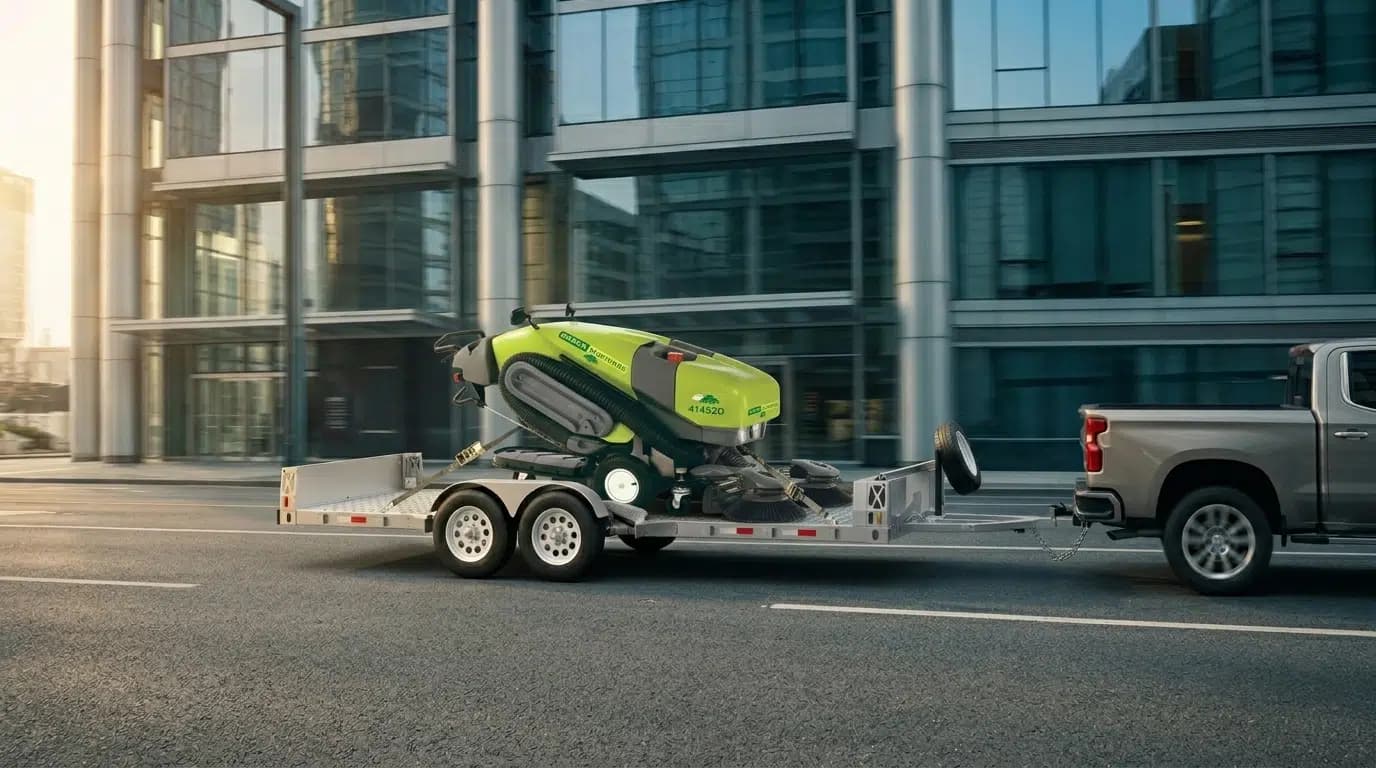
Pictured above: Green Machine 400. Other models also discussed.
Table of Contents
- The Compact Sweeper Trailer that Protects Your Chassis
- The Compact Sweeper Trailer that Reduces Loading Hazards
- Why Trailer Ratings Matter More than Trailer Labels
- Recommended Add-On: D-Ring Stake Pocket
- Data to Appease Your Budget Office
- FAQ
- Key Takeaways
- Load Low, Load Clean, Haul Good
The Compact Sweeper Trailer that Protects Your Chassis
High centers. Low clearance. Compact street sweepers are absolutely no fun to load. They’re designed for flat sidewalks, so the minute you need to drive them up a 20°, 6-foot ramp, let alone a narrow “double plank ramp” onto an 18″ to 24″ deck?
You clench your teeth every time you load. So does your operator. You both know a single mistake scrapes $80,000 of chassis aluminum across those ramps. The repairs are expensive…$1,500 for the scraping, $2,500 to $5000 if your operator damages the hydraulic pump or the nozzle. Then there’s your broom motor shaft. A single impact on the trailer ramp can bend the entire mechanism, leading to leaks and costly downtime.
So, let’s talk about the alternative.
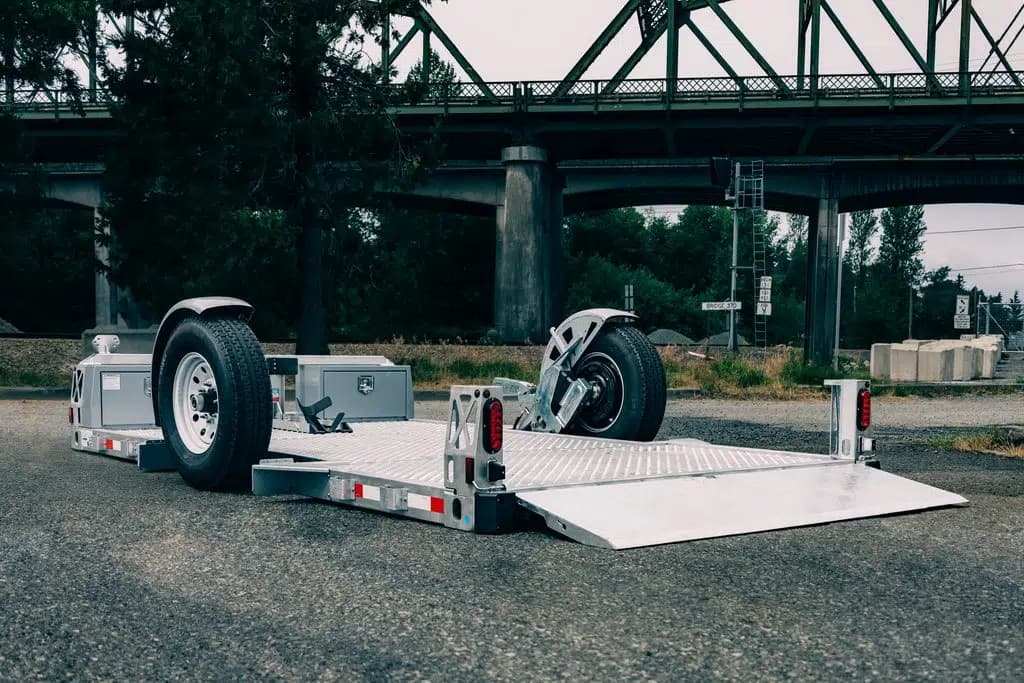
- Hydraulic drop deck power that lowers the bottom of the trailer all the way to the ground, placing the deck at just 5.4 inches.
- A 22” long single ramp sitting at an 11° angle which covers the entire loading deck, so you can drive your sweeper right on board. Position it correctly and give low-clearance components a much gentler path onto the deck, helping reduce the risk of scraping or bottoming out.
- Easy securement. Stand on the ground and get it done. Your operator shouldn’t have to climb under the trailer or the machine to keep it safely in place.
- Raise. Hook the trailer to the truck. Go.
Consider it: one investment into a compact sweeper trailer tone investment that can help reduce avoidable loading-related repair costs.
The Compact Sweeper Trailer that Reduces Loading Hazards
The last thing your city, university, medical center, transport hub, or factory needs is a preventable loading incident adding injuries, equipment damage, downtime, or higher workers’ compensation costs to the budget.
That is where the GT19FL’s loading geometry becomes a real advantage.
Instead of asking an operator to climb a long, steep ramp with a low-clearance sweeper, the hydraulic drop deck lowers the trailer until the deck sits just 5.4 inches above the ground. A 22-inch-long, 76.5-inch-wide ramp with an 11° approach angle bridges the remaining transition.
That gives your operator:
- A much shorter climb. The machine is not traveling from ground level to a raised trailer deck over a long, steep incline.
- A wide loading surface. The ramp spans the rear of the trailer, giving the operator more room to line up the sweeper than a pair of narrow individual ramps would.
- A gentler approach for low-clearance equipment. The 11° transition can help reduce the risk of scraping or bottoming out compared with steeper loading arrangements.
- A more manageable loading routine. Once the trailer is positioned on a safe, level surface, chock the wheels, uncouple the tow vehicle, lower the deck, load and secure the sweeper, then raise and reconnect the trailer for transport.
That does not make loading risk-free. Wet equipment, debris, poor footing, and operator error can still create hazards. But reducing the height and steepness of the loading path removes two of the factors that can make compact sweeper transport more difficult in the first place.
The diamond-plate deck and ramp surfaces also provide a textured walking and loading surface—an especially useful feature when the sweeper comes back wet from washing streets, paths, or parking areas.
For fleet managers, the benefit is practical: a lower, wider loading approach gives crews a more controlled way to move an expensive, low-clearance machine on and off the trailer without hiding the fact that safe procedures still matter.
Why Trailer Ratings Matter More than Trailer Labels
A compact sweeper may have a small footprint, but that does not make it a light load.
Don’t choose a trailer simply because the machine physically fits on the deck. Compare the sweeper’s actual transport weight with the trailer’s carrying capacity, then check usable deck dimensions, loading geometry, securement options, and the towing requirements of the complete combination.
A trailer designed primarily around lighter recreational equipment may not provide the capacity or loading arrangement required for a heavier municipal sweeper. Choose by the numbers—not by appearance.
Recommended Add-On: D-Ring Stake Pocket
Though they don’t come standard, the D-Ring Stake Pocket add-on (available for less than $500 at time of writing) can turn a “Good” solution into a great one.
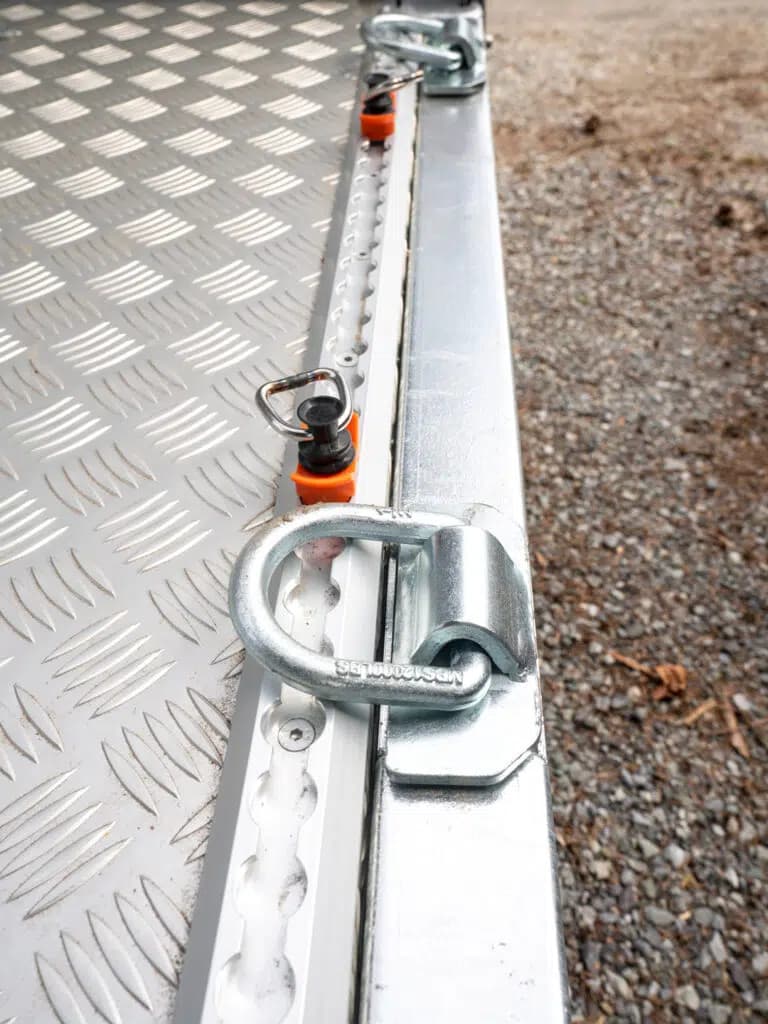
You essentially get a perimeter-mounted logistical track system that lets you get right to the sweeper’s tie-down points. Additional attachment locations can help reduce awkward strap routing around the machine.
You reduce the risk of even more incidents because your team doesn’t have to crawl under the vacuum suction head or reach through the side-brooms in order to secure the load. Ground-level positioning can make many securement points easier to reach without climbing onto a raised trailer.
Data to Appease Your Budget Office
A Good Trailer can be an investment for your city Parks & Rec department, campus, transport hub, commercial center, healthcare complex, or manufacturing facility—not simply another expense.
Here’s one way to think about the potential return.
Prices are subject to change, and dealers in different regions may offer different pricing. Pricing on everything from eggs to trailers is volatile as of this writing, so treat the following as an illustrative example—not a guaranteed ROI calculation. Always get a current quote from your local dealer. If you need help finding one, contact us.
For the sake of the example, we’ll use an estimated GT19FL purchase price of about $12,000.
- Chassis and nozzle repairs: Suppose your operation is currently spending about $20,000 per year on four loading-related incidents. If an easier loading setup helped reduce that from four incidents to one, that would represent approximately $15,000 in avoided repair costs.
- Broom repairs: If an operator damages a gutter broom about once every two months, that works out to approximately six incidents per year. At up to $2,000 per replacement, that could represent as much as $12,000 annually. Cutting that frequency in half would mean avoiding three replacements, or up to $6,000 in additional costs.
- Then there’s downtime. If a bike path doesn’t get swept because equipment is waiting on repairs, somebody gets to answer all those emails from the local Cycling Coalition. We won’t try to put a price on your sanity—but downtime has a real operational cost too.
What does that look like?
Using those hypothetical numbers:
$15,000 in reduced chassis/nozzle repairs
+ up to $6,000 in reduced broom replacements
= up to $21,000 in potential annual avoided costs
Against a hypothetical $12,000 trailer purchase, that would leave roughly $9,000 in first-year net savings in this scenario.
And in later years, once the trailer has already been purchased, the avoided repair costs could continue contributing to the budget.
FAQ
How do I choose between the GT13FL and the GT19FL for a compact sweeper?
Start with the sweeper’s actual transport weight and dimensions, then compare those numbers with the trailer’s usable deck and estimated carrying capacity.
The GT13FL provides an 11′8″ x 82″ deck and an estimated 5,055-pound carrying capacity. The GT19FL provides a 17′9″ x 82″ deck and an estimated 8,000-pound carrying capacity.
Do not choose solely by the machine’s basic model name. Options, attachments, water, collected material, and other equipment carried on the trailer can change the load. If the sweeper itself already approaches the trailer’s carrying capacity, move up to a configuration that leaves appropriate room for the complete load.
Do water and debris in a street sweeper count toward my trailer load?
Yes. Plan around the machine as it will actually be transported, not simply a brochure’s empty or base weight.
That can make a meaningful difference with sweepers. For example, Bucher lists the CityCat V20 with 425 liters of onboard water capacity and a 2.0 m³ hopper. Those systems mean the machine’s transport condition can vary depending on what remains aboard.
Follow the sweeper manufacturer’s transport instructions and include the entire load when comparing it with the trailer’s capacity. If your operation routinely transports a sweeper with water, attachments, or additional equipment, plan around that normal configuration rather than the lightest possible one.
Can I lower and load the trailer on a sloped bike path or uneven job site?
Choose a safe, level loading location instead.
For Parks & Rec and public-works crews, this may mean loading at the depot or selecting an appropriate staging area near the work rather than lowering wherever the sweeper happens to finish its route.
Does the low-angle ramp make wet-weather loading slip-proof?
No. The ramp offers a textured, gently angled loading surface, but water, mud, leaves, and other debris can still create slip hazards. Keep the ramp as clean as possible, and, to the extent that it is feasible, dry.
Key Takeaways
Consider these TL;DRs as you consider whether to upgrade to a drop deck compact sweeper trailer.
- A lower loading approach can help protect low-clearance equipment. GoodMFG® flatbeds lower the deck to 5.4 inches and use a short, 11-degree ramp, reducing the steep transition a compact sweeper must negotiate compared with many raised-deck loading arrangements.
- Choose the trailer around the complete transport load. Compare actual sweeper weight and dimensions—including relevant water, attachments, and other cargo—with the trailer’s usable deck and carrying capacity.
- Ground-level loading can make loading and securement more manageable, but it does not eliminate risk. Correct positioning, clean surfaces, appropriate securement, and the sweeper manufacturer’s instructions still matter.
- Plan securement before the machine is aboard. Optional stake-pocket D-rings can provide additional attachment locations, while the final restraint system still needs to meet the requirements of the equipment and applicable regulations.
- Treat ROI as operation-specific. The repair-cost example in this article illustrates how avoided loading incidents could offset trailer cost. Your own repair history, downtime, equipment, and operating practices determine the actual return.
Load Low, Load Clean, Haul Good
Ready to have a better experience with your compact street sweepers? Visit your nearest dealer today! Can’t find one near you? Call our office: we’ll help you out.
We are looking for new dealers! If you want to grow your fleet with trailers that solve real problems for real people, call or contact us to start the process today.
You can also contact us using the form below.
Loading form…
See also:
The Facilities Manager’s Guide to Rapid Deployment Modular Structures
Does GoodMFG® Make Durable Trailers?
Hydraulic Drop Deck Trailer Maintenance, Because Nobody Has Time for Breakdowns
This resource was compiled by the GoodMFG® Product Team, drawing on 75 years of combined experience in hydraulic systems, heavy-duty transport, trailers, and modular structures.
P.S. – We build trailers every day, but we don’t run your crews. If there’s a specific logistical headache or a “field reality” we’ve missed, we want to hear about it. Help us refine the equipment that makes your day easier! Email our Marketing Lead at devan-h @ goodrv.com and let us know what we should solve next.