Everyone wants to know how to load heavy equipment in a safer, more efficient, less labor-intensive way.
Unfortunately, traditional trailers make the job pretty hard. Blind spots. Shifted ramps. Slipping tracks. What a nightmare!
If you are still loading mini-excavators, skid steers, or compact track loaders using a pair of narrow, steep ramps while you rely on a spotter to get the job done, you’re gambling with your equipment, your crew’s safety, and your bottom line.
The traditional loading method is dangerous, slow, and needlessly labor-intensive. It typically ties up to two to three workers for an excruciating 20-to-30-minute process where one wrong move can cause thousands of dollars in machinery damage, injure an operator, and destroy your jobsite schedule.
Fortunately, there is a faster, safer way to load heavy machinery solo without relying on a spotter.
Table of Contents
- The Hidden Costs of Traditional Equipment Loading
- Safety Hazards: Traditional Solo Loading
- Essential Equipment for Safe Solo Loading
- Ground Level Drop Deck Trailers
- Step-by-Step: How to Load Heavy Equipment Solo
- FAQ
- Key Takeaways
- Lower the Deck, Raise Your Profits
The Hidden Costs of Traditional Equipment Loading
Labor Drain: Why 3-Man Loading Burns $18,000 Annually
In the Pacific Northwest, prevailing construction wages average around $30 an hour per worker. When your team loads trailers using traditional ramps, three workers spend roughly 30 minutes setting up ramps, guiding the operator, driving the machine, securing the load, and stowing the gear.
- Labor per load: 1.5 man-hours ($45 in direct labor cost)
- Daily site moves: Loading and unloading twice daily reaches $90 to $135 per machine move
- Annual impact: Over a standard 200-day work year, traditional loading methods waste $18,000 per year in lost labor alone
Safety Hazards: Eliminate the “Inch-and-Check” Loop
When crew members are split across jobsites, operators are often forced to load heavy equipment onto a trailer without a spotter. This creates the hazardous “inch-and-check” cycle:
- Drive the machine forward a few inches.
- Set the brake and climb down to check track alignment.
- Climb back into the cab and make minor adjustments.
- Repeat the process until the equipment is safely balanced.
This process is glacially slow and extremely dangerous. If a narrow ramp shifts while an operator is in the cab, the machine can slip off the edge, leading to catastrophic tip-overs, scraped undercarriages, pinched hydraulic lines, and costly workers’ compensation claims.
Essential Equipment for Solo Heavy Equipment Loading
Full-Width Ramp Systems vs. Traditional Dual Ramps
Standard trailer ramps sit at steep 16° to 25° angles to reach an 18″ deck height. These narrow, dual ramps leave almost zero margin for error.
To load heavy equipment safely by yourself, upgrade to a full-width, low-angle ramp system. A continuous 74″ to 76″ ramp surface eliminates the gap between tracks, allowing you to drive straight on without worrying about track slippage or precision placement.
Ground-Level Drop Deck Trailers
Want to see how to load heavy equipment solo? Watch the video below!
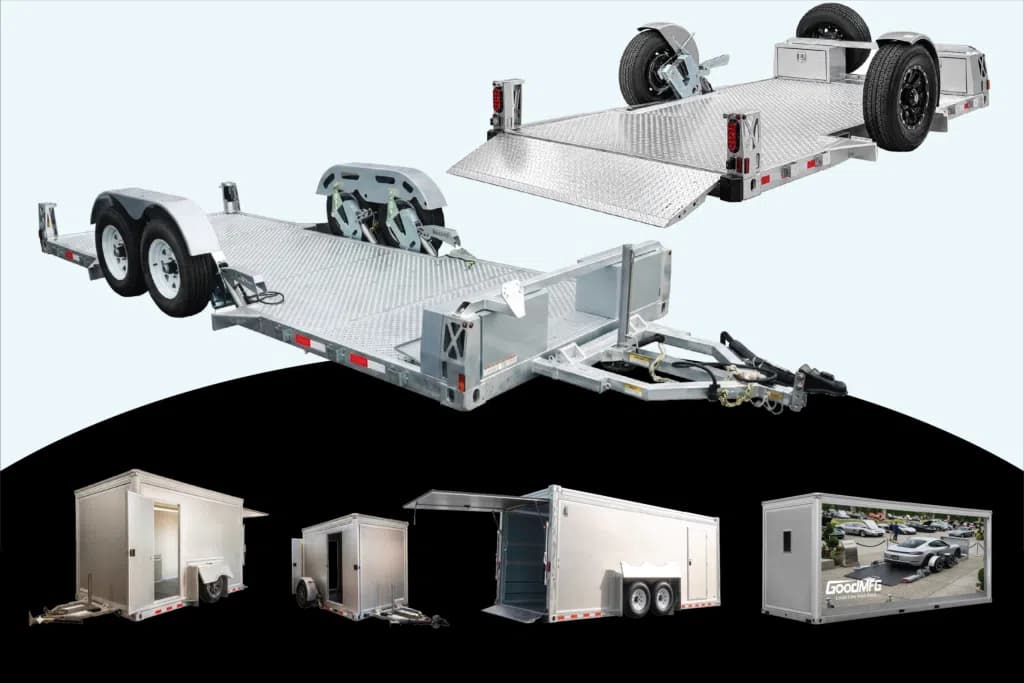
The most efficient solution for solo operators is a hydraulic drop deck trailer. Instead of forcing heavy machinery up steep incline balance beams, hydraulic drop-deck trailers lower the entire deck directly to the ground at the push of a button.
- Ultra-low deck height. The deck drops until it is just 5.4″ off the ground.
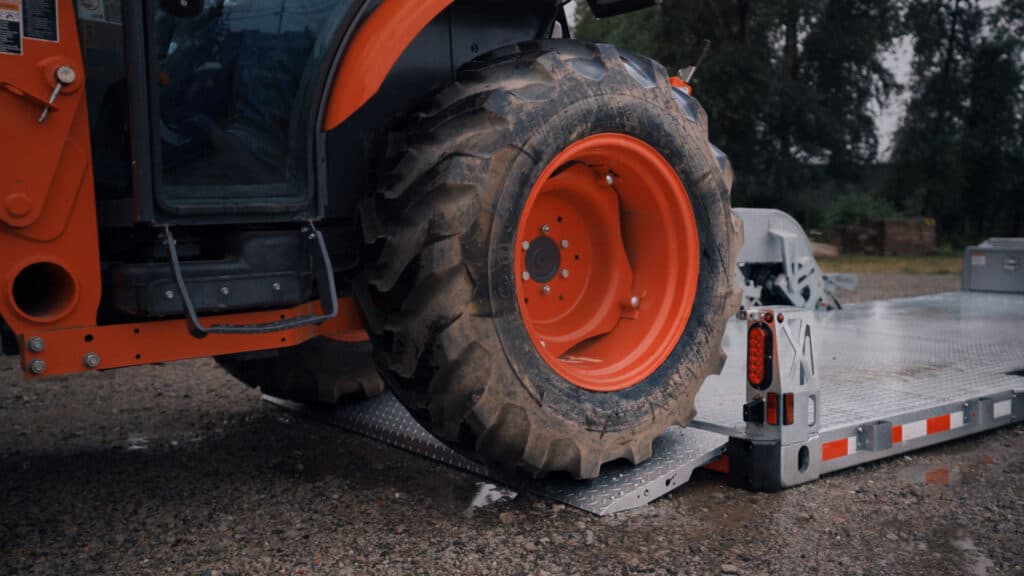
- A gentle transition angle. Features a short 22″, 74.4″ wide at a shallow 11° incline. Now that’s how you load heavy equipment without needing a spotter! The drive-on load is as easy as moving from the street into a gentle low-slope driveway.
- Solo-load efficiency. One person lowers the deck, drives the machine on, secures the load, and raises the deck in under 5 minutes.
Step-by-Step: How to Load Heavy Equipment Solo
- Park on level ground. Position your truck and trailer on a flat, solid surface.
- Take the trailer off the hitch. Taking it off and putting it back on again is quick and easy, but you don’t want to lower the trailer without taking this step first.
- Lower the deck. Lower your hydraulic trailer deck completely to ground level.
- Unfold the spring-assisted ramp. Flip down the short, full-width ramp.
- Drive on straight. Approach the deck at a slow, steady speed. Because the deck sits flat on the ground with a full-width ramp, track alignment errors are virtually eliminated.
- Secure the machinery. Apply the parking brake, shut off the engine, and tie down your equipment using standard four-point chain or binder protocols.
- Raise and lock. Raise the deck to transit height (18″), hitch it up to your truck again, and hit the road.
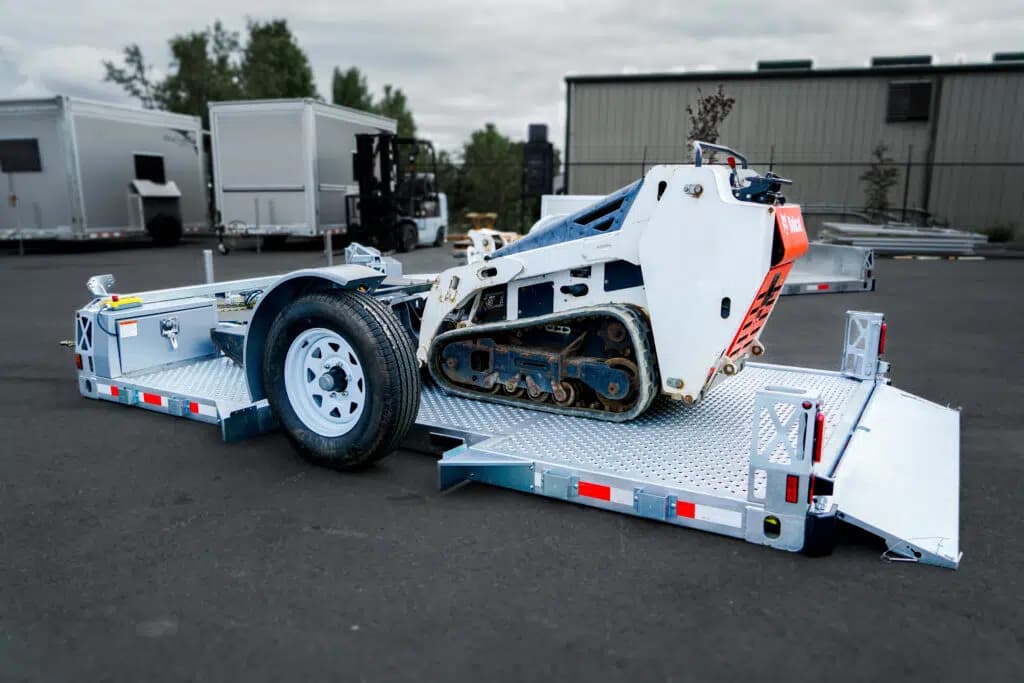
By swapping to a solo-operator drop-deck trailer system, your labor costs drop from $45 per load to roughly $2.50—saving your business up to $18,000 annually while completely eliminating spotter risk.
FAQ
Can one person safely load a mini excavator or skid steer without a spotter?
Yes, but doing so using traditional dual, narrow ramps is extremely dangerous due to track alignment blind spots. To safely load heavy equipment alone, operators should use a ground-level hydraulic drop-deck trailer or a full-width ramp system. This eliminates the gap between ramps and allows direct, straight-on driving without the risk of slipping off the edge.
What is a hydraulic drop-deck trailer, and how does it work?
A hydraulic drop-deck trailer uses an onboard hydraulic system to lower the entire trailer bed directly flush with the ground. This reduces the loading incline angle from a steep 16°-25° down to a shallow 11° slope, allowing single operators to drive machinery directly onto the deck in under a minute without using long, steep ramps.
Why are steep, narrow loading ramps dangerous for heavy machinery?
Narrow dual ramps offer almost zero margin for error. If equipment tracks or tires misalign by just a few inches, the machine can slip, pinch hydraulic lines, scrape undercarriages, or tip over completely. Additionally, narrow ramps can shift under heavy weight if not anchored perfectly to the trailer bed.
How much labor time does a drop-deck trailer save per load?
Traditional loading methods usually tie up 2 to 3 crew members for 20 to 30 minutes (equating to ~1.5 man-hours or roughly $45 per load in labor costs). A ground-level drop-deck trailer allows a single operator to load and secure machinery in around 5 to 6 minutes, cutting direct labor costs down to around $2.50 per load.
Key Takeaways
Here are the most important things you need to remember about how to load heavy equipment onto a trailer without needing to use a spotter, as well as how to load heavy equipment while using drop deck trailers.
- Eliminate the multi-man labor drain. Traditional ramp loading ties up two to three crew members for 20 to 30 minutes, burning roughly 1.5 man-hours ($45) per load. Upgrading to a solo hydraulic system slashes labor costs to about $2.50 per load.
- Stop the risky “inch and check” loop. Loading alone on narrow dual ramps forces operators to repeatedly park, climb down, check track alignment, and re-enter the cab. This process wastes time and drastically increases tip-over risks.
- Widen your safety margin. Dual split ramps leave zero room for error. Switching to a full-width 74.4″ ramp surfaces gives tracks total coverage, eliminating the gap where expensive slipping accidents occur.
- Flatten the entry angle. Standard trailer ramps create steep 16° to 25° inclines. Ground-level drop decks reduce the incline to an ultra-shallow 11° slope over a short 22″ spring-assisted ramp, protecting low-clearance undercarriages.
- Recapture $18,000 in annual overhead. Reducing loading delays, eliminating spotter requirements, and avoiding undercarriage damage or L&I claims can save a standard crew up to $18,000 per year across a 200-day work schedule.
Lower the Deck, Raise Your Profits
At GoodMFG®, our hydraulic drop-deck trailers are engineered specifically to eliminate ramp liability, reduce jobsite downtime, and allow single operators to move heavy machinery effortlessly.
- Call us directly: (360) 889-9789
- Find a local dealer: Visit our Dealer Locator to view inventory near you.
- Chat with us. Click the blue icon to chat with Tow-Bot or submit a request online.
See also:
Drop Deck Trailers for Daily Equipment Moves
Drop Deck Trailers vs. Liftgate Trucks
Drop Deck Trailers vs. Tilt Trailers
This resource was compiled by the GoodMFG® Product Team, drawing on 75 years of combined experience in hydraulic systems, heavy-duty transport, trailers, and modular structures.
P.S. – We build trailers every day, but we don’t run your crews. If there’s a specific logistical headache or a “field reality” we’ve missed, we want to hear about it. Help us refine the equipment that makes your day easier! Email our Marketing Lead at devan-h @ goodrv.com and let us know what we should solve next.