Knowing how to read the specs on a trailer makes it much easier to determine whether a trailer, tow vehicle, and load actually belong together.
Unfortunately, trailer spec sheets come with an alphabet soup of terms: GVWR, GAWR, GVW, GTW, GCWR, curb weight, carrying capacity, tongue weight, and more.
Then there are the dimensions.
A trailer described as “19-foot” may not have a 19-foot usable deck. An enclosed trailer can have an interior width that is wider than its rear door opening. And a coupler rated for 14,000 pounds does not turn an 11,800-pound-GVWR trailer into a 14,000-pound trailer.
So let’s decode the numbers.
This article is a general guide to understanding trailer specifications. For operating requirements, loading procedures, and the exact ratings on your Good Trailer, use the certification/VIN label on the trailer and your Owner’s Manual.
Table of Contents
Where to Find Your Trailer Specifications
You may see trailer specifications in several places, and each source serves a slightly different purpose.
Our product pages are useful when you’re comparing models. We publish specifications such as exterior dimensions, usable deck or interior dimensions, estimated curb weight, estimated carrying capacity, GVWR, coupler rating, ball size, tire size, and loading dimensions.
Once you own the trailer, the certification/VIN label becomes particularly important. It’s the source for several critical ratings, including:
- GVWR
- GAWR
- Tire Size
- Tire inflation information
- VIN
- Date of manufacture
Your tow vehicle has its own set of ratings, so you’ll also need the vehicle manufacturer’s specifications for towing capacity, payload, axle ratings, and GCWR.
Trailer compatibility is never determined by one number alone.
How to Read the Specs on a Trailer: GVWR
This is the trailer spec you’ll probably hear talked about the most. It’s the maximum allowable total weight of the trailer when fully loaded.
Trailer + Cargo + Installed equipment + Other load = Total trailer weight.
For example, the GVWR on our GT13FL is 7,000 pounds.
But this is a rating, not a target. You should not be trying to figure out how to load the trailer all the way up to its GVWR. It’s more like a limit that you never want to exceed.
How to Read the Specs on a Trailer: Estimated Curb Weight
The trailer’s empty weight is what the trailer itself weighs before you add cargo.
On our product pages, you’ll usually see this listed as “Est. Curb/Dry Weight.”
For example, we currently list the GT19FL at an estimated curb weight of 3,800 pounds.
Why does it matter?
Because the trailer’s own weight consumes some of its own GVWR before you load a single piece of equipment.
How to Read the Specs on a Trailer: Estimated Carrying Capacity
Carrying capacity tells you approximately how much cargo weight the trailer can accept.
The basic calculation is:
GVWR – empty trailer weight = available cargo capacity
For example:
GT19FL GVWR: 11,800 lbs
Estimated curb weight: 3,800 lbs
Estimated carrying capacity: 8,000 lbs
That is why an 11,800-pound-GVWR trailer does not carry 11,800 pounds of equipment. The trailer itself is part of that total. Estimated carrying capacity is just that, an estimate. We don’t recommend, usually, loading right up to the limit of that 8,000 pounds. It can be helpful to leave some “carrying capacity wriggle room.”
Keep in mind that carrying capacity isn’t the only thing you have to worry about. A load still needs to fit the trailer, be properly distributed, stay within GAWR and tire limits, maintain the appropriate tongue weight, and be properly secured. A machine that weighs 7,900 pounds is not automatically an appropriate load.
How to Read the Specs on a Trailer: Gross Vehicle Weight (GVW)
GVW is the actual weight of the trailer and everything on or in it at a particular moment.
The difference between GVWR and GVW is easiest to remember this way:
The R means rating.
GVWR = maximum rated total trailer weight.
GVW = what the loaded trailer actually weighs.
If you’re unsure of your actual loaded weight, a commercial scale can give you a much better answer than estimating the weight of every item aboard. And yes, we do recommend visiting a commercial scale if you think you might be near your carrying capacity. Better a detour to check than an accident because your load was a little too heavy.
How to Read the Specs on a Trailer: Gross Trailer Weight (GTW)
GTW also refers to the actual weight of the loaded trailer.
You’ll often see this term in tow-vehicle and hitch information because the tow vehicle has to handle the weight of the complete trailer, not just the cargo.
In practical terms:
Empty trailer + Everything onboard = GTW.
You may see GVW and GTW used in slightly different contexts, but both are discussing actual loaded weight rather than the trailer’s maximum rating.
The important distinction is between what something weighs and what it is rated to handle.
How to Read the Specs on a Trailer: Gross Axle Weight Rating (GAWR)
GAWR is the maximum allowable weight supported by an axle or axle system.
You’ll find GAWR information on the trailer’s certification/VIN label.
Good Trailers look a little different from a conventional fixed-axle trailer because our hydraulic drop-deck design uses an articulating suspension assembly.
For practical purposes, however, we still use “axle” terminology throughout our specifications and Owner’s Manual. And you’ll see axle quantity and axle ratings for each trailer on their individual product pages.
Why does GAWR matter if you’re already below GVWR?
Because total weight and weight distribution are different questions.
You can theoretically remain below the trailer’s total GVWR while concentrating too much weight on one part of the running gear.
Weight distribution matters!
How to Read the Specs on a Trailer: Tongue Weight
Tongue weight is the downward force the trailer tongue places on the tow vehicle’s hitch.
This is not simply “extra weight at the front.”
Proper tongue weight is an important part of trailer stability.
Too little tongue weight can contribute to trailer sway. Too much can overload the tow vehicle’s rear axle and adversely affect vehicle handling.
Use the specific guidance on your model. Roughly 10% is a good rule of thumb. The idea is the load needs to be distributed evenly from side to side with its center of gravity kept appropriately low.
How to Read the Specs on a Trailer: Towing Capacity
Towing capacity belongs to the tow vehicle.
It describes how much trailer weight the vehicle manufacturer permits that particular vehicle to tow.
Check the specifications on your exact tow vehicle. You’ll usually find it on the VIN sticker just inside your driver’s side door.
The tow vehicle and hitch should always be appropriately matched to the trailer’s GVWR.
How to Read the Specs on a Trailer: Hitch, Coupler, & Ball Ratings
These specifications are easy to overlook.
They shouldn’t be.
The towing connection also has ratings.
For example, our current GT13FL and GT19FL both specify:
Ball size: 2-5/16″
Coupler rating: 14,000 lbs
That 14,000-pound coupler rating does not mean the GT19FL suddenly has a 14,000-pound GVWR.
It means the coupler itself has that rating.
The trailer still has an 11,800-pound GVWR.
Likewise, installing a higher-capacity hitch or ball does not increase the towing capacity of the truck or the GVWR of the trailer.
The whole system has to work within all applicable ratings.
How to Read Trailer Dimensions
Weight specifications get most of the attention, but dimensions can disqualify a load just as quickly.
And not all trailer dimensions describe the same space.
Exterior Dimensions
Exterior dimensions tell you how much physical space the complete trailer occupies.
These matter for:
- Parking
- Storage
- Maneuvering
- Building clearance
- Planning the space you need for the trailer.
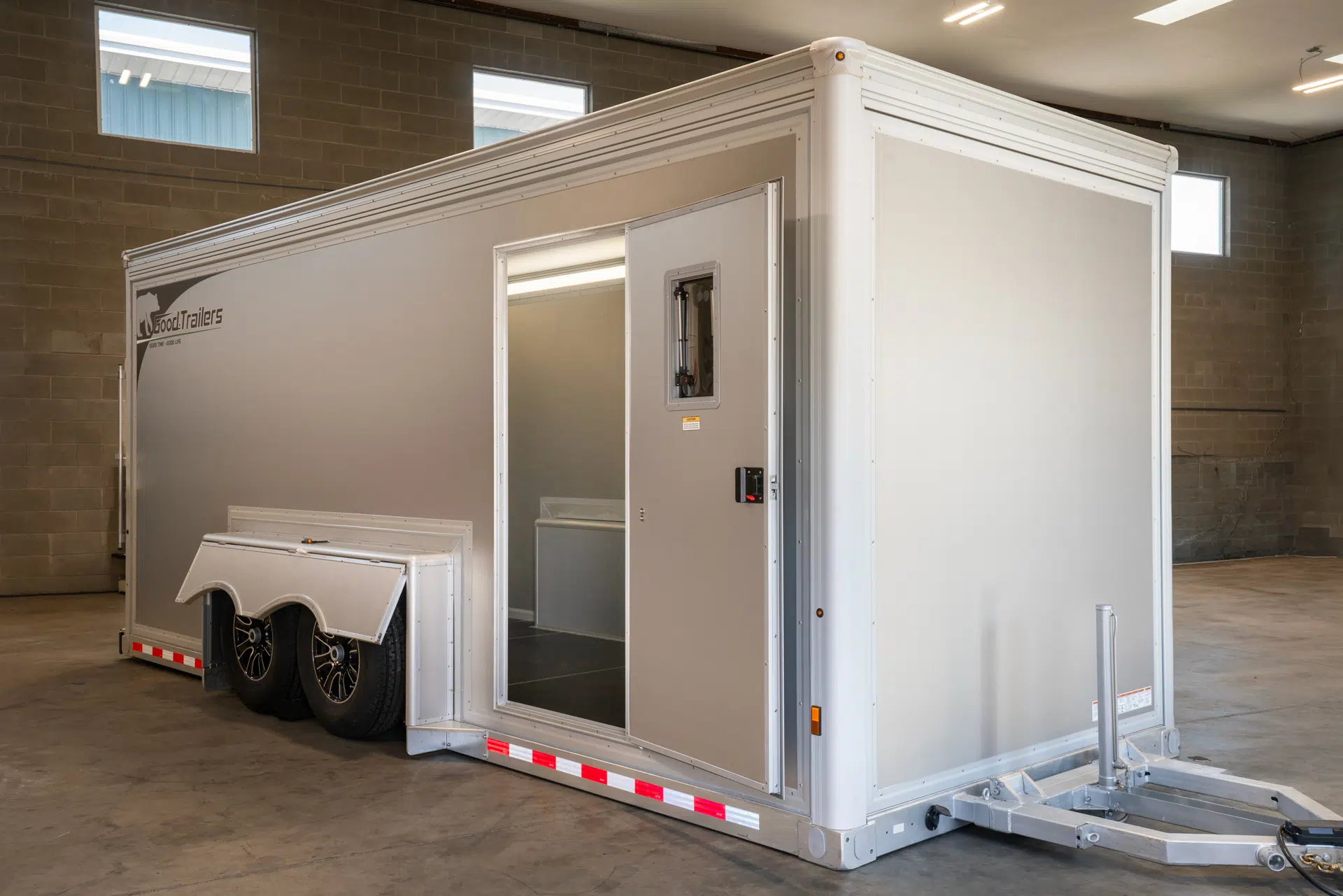
For example, the GT19FL is commonly described as a 19-foot model, but its actual exterior length is approximately 24′1″ from the front of the tongue to the rear of the trailer. The 19′ is the length of the entire exterior trailer bed.
Deck or Interior Dimensions
This is the actual space where you can put things on the trailer. On the GT13FL you have 11’8″L x 6’10” wide usable deck space. The GT19FL has 17’9″L x 6’10” usable deck space. This gives you a true picture of whether you can load a particular machine onto the deck, or whether it’s going to be too long or too wide to work.
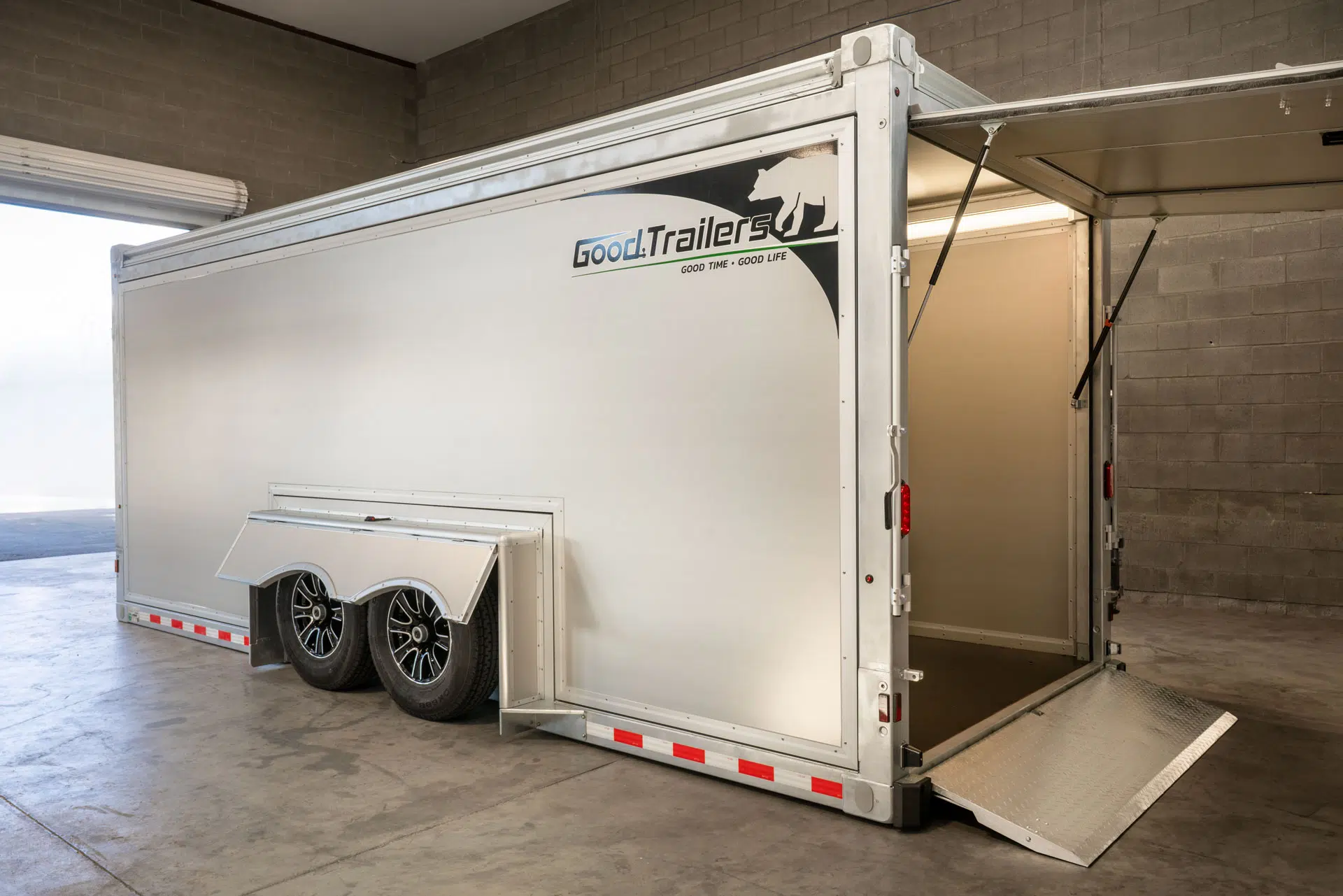
Ramp Width or Rear Door Opening
The opening is a little narrower than the width of the trailer simply because some of that space gets taken up by trailer walls. Even a flatbed has a little bit of a border which means the ramp width is just a little bit shorter than the deck width.
It’s not something to stress over, but you do of course want to think about if there’s any configuration of your equipment that will let you get up and into the trailer.
Raised & Lowered Height
Here are some trailer specs you’re only ever going to see on a drop deck. On one of our flatbeds, the raised height is 18″ and the lowered height is 5’4″. This mostly tells you two things: the height the trailer travels at and how close the deck gets to the ground.
Tire Size & Inflation Pressure
Trailer tires have their own load and inflation requirements.
The certification/VIN label or tire information placard provides the tire size and recommended cold inflation pressure for the trailer.
Use that information rather than assuming the maximum pressure molded into a tire’s sidewall is automatically the correct operating pressure for the trailer.
Load capacity can be impacted by improper inflation, so this really matters!
FAQ
Why do you call it “estimated” curb weight?
We take our trailers to commercial scales to weigh them and get their dry or empty weights. But options and configurations can change the weight. For example, some people really like adding shelves into their trailers so they can keep their gear organized. That’s no problem at all, but those shelves are going to add some weight. They’re not going to add a lot of weight, but they still will add enough that they’ll reduce your carrying capacity.
Why doesn’t a 19′ trailer have a 19′ deck?
Some deck gets eaten simply because trailers have exterior components that jut, just a little, into the deck space. On a flatbed, you also have two toolboxes, one of which holds your hydraulic pump. They eat some deck space, too.
Key Takeaways
Here’s the TL;DR on how to read the specs on a trailer.
- Ratings and actual weights are different. GVWR and GAWR are limits; GVW and GTW describe what the loaded trailer actually weighs.
- GVWR includes the trailer itself. An 11,800-pound GVWR does not mean you can place 11,800 pounds of cargo on the trailer.
- Carrying capacity is based on the difference between GVWR and empty trailer weight. Published figures may be estimates, so use the actual trailer weight when precision matters.
- Payload is only part of trailer fit. Length, width, loading openings, ramp width, weight distribution, tongue weight, and securement matter too.
- Nominal model length is not necessarily usable deck length or overall trailer length.
- On enclosed trailers, interior width and rear-door opening width are different specifications.
- A component with a higher rating does not raise the rating of the rest of the system.
- Check the exact tow vehicle. Truck class or badge alone does not tell you its towing capacity or GCWR.
- When in doubt, use the trailer’s certification/VIN label, our current Owner’s Manual, and the specifications for your exact tow vehicle.
Know Before You Go
We know. Learning how to read the specs on a trailer isn’t the most fascinating part of your day. But knowing these specs are vital to helping you stay safe on the road.
Have more questions? Contact us!
See also:
Hooking Up Good Trailers: A New Owner’s Guide
This resource was compiled by the GoodMFG® Product Team, drawing on 75 years of combined experience in hydraulic systems, heavy-duty transport, trailers, and modular structures.
P.S. – We build trailers every day, but we don’t run your crews. If there’s a specific logistical headache or a “field reality” we’ve missed, we want to hear about it. Help us refine the equipment that makes your day easier! Email our Marketing Lead at devan-h @ goodrv.com and let us know what we should solve next.