Towing a trailer safely takes extra time, care, and attention.
Of course, at GoodMFG®, we innovate with safety in mind: every feature, from our hydraulic drop deck to our folding tow bar, is designed to reduce the chances that our trailers will ever cause an injury.
But no amount of innovation will ever remove all the risks associated with the road.
We hope never to hear that any of our trailers has ever been associated with a tragedy, or any of our customers. In that spirit, we provide these tips for handling our Good Trailers safely while you drive.
Table of Contents
Inspect & Test
Towing a trailer safely begins before you ever leave your parking lot or driveway.
ou may be used to jumping in your car without giving it a second glance, but trailers add a brand new layer of complexity to the drive. It is imperative to inspect your trailer before every trip. You may even want to inspect your trailer several times during longer trips.
At a minimum you should check the following:
- Is the trailer coupling secure and locked?
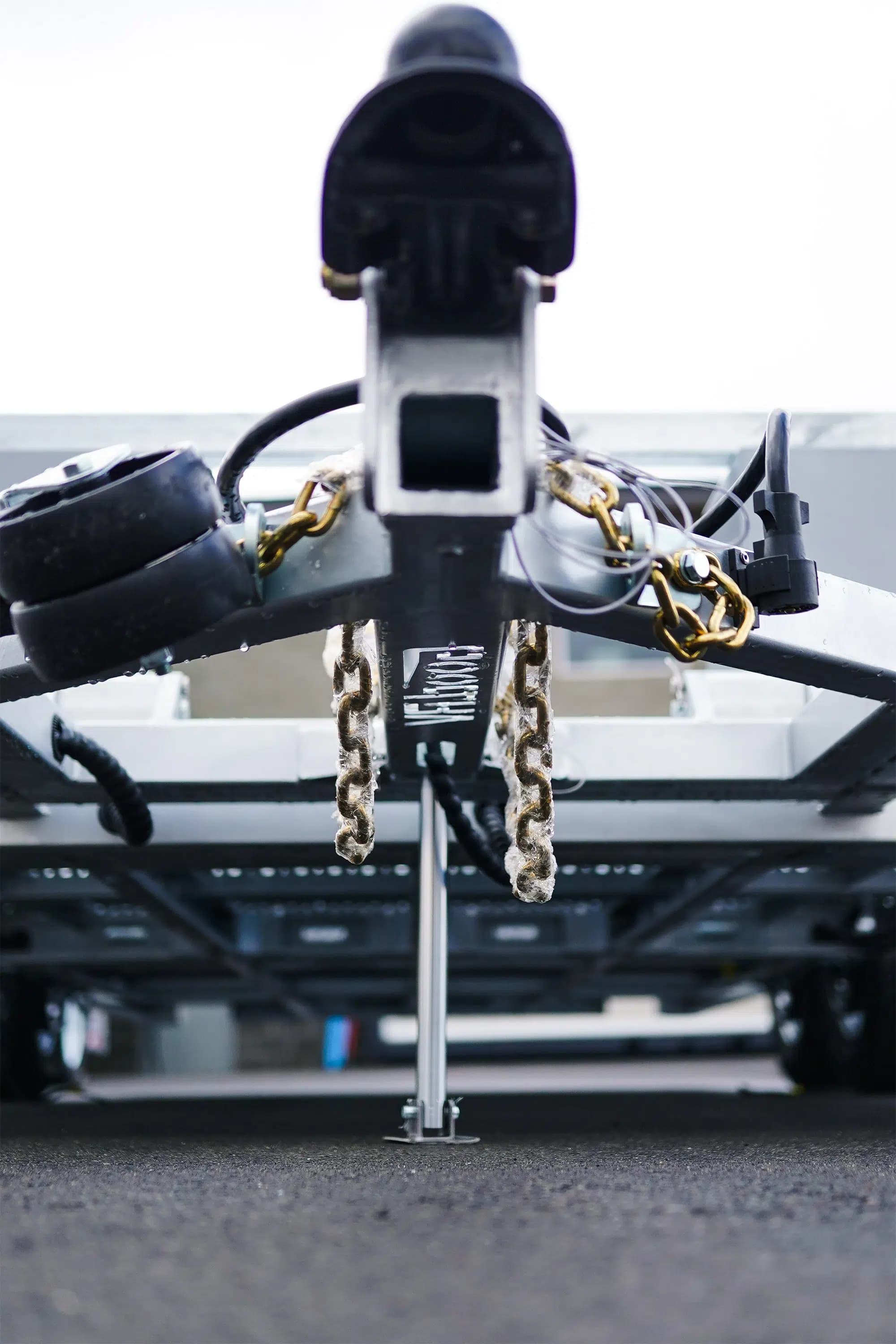
- If your trailer has a folding tow bar, are the locking pins properly installed?
- Are the safety chains securely fastened to the tow vehicle at an approved attachment point?
- Are the safety chains crossed beneath the hitch and coupler, with enough slack for turning but not enough to drag?
- Is the breakaway cable properly attached to the tow vehicle, independently of the safety chains and hitch ball?
- Is the electrical connector securely connected?
- Are the tires in good condition and inflated to the specified cold pressure?
- Are the wheels and lug nuts in good condition and properly tightened?
- Do the tail, brake, and turn-signal lights work?
- Are the trailer brakes functioning properly?
- Is your cargo properly loaded, balanced, and secured?
- Is your tongue weight and weight distribution appropriate for the trailer?
- Are doors, gates, ramps, and other openings securely latched?
- Is the hydraulic suspension fully raised and secured for transport?
You should also test your breakaway brake system at least once before you hit the road.
Practice
If you’re already comfortable with trailer towing basics, you can skip this section. But if trailer towing is brand new to you, we want to encourage you to take a little practice time before hitting the highways.
There’s no shame in taking a trailer out to a big, empty parking lot so you can get used to what acceleration, maneuverability, and braking all feel like. Expect to encounter these differences:
- Slow acceleration
- Wider turn radiuses
- Longer stops
Every trailer and tow-vehicle combination feels a little different, so even experienced drivers may want to take a moment to drive on a low-traffic street before trying tougher maneuvers.
A thorough test will involve the following steps.
- Adjust all of your mirrors so you can see both the trailer and the area behind the trailer.
- Start by accelerating to 5 mph.
- Turn the wheel to feel how the tow vehicle and trailer combination respond.
- Stop the tow vehicle and trailer a few times from speeds below 10 mph.
- Try using different combinations of the trailer brakes and the tow vehicle brakes. Note the effect the trailer brakes have when they are the only brakes used. When properly adjusted, the trailer brakes should adjust just before the tow vehicle brakes.
- Practice backing up the tow vehicle with the trailer attached. Remember: you should always exit your vehicle and inspect the trailer to ensure there are no unseen obstacles before attempting a backing maneuver.
Watch Your Load
Overloaded trailers, and loads with improper tie-downs, are leading causes of trailer-related accidents.
Check your VIN label for two pieces of information.
- Your trailer’s Gross Vehicle Weight Rating (GVWR) tells you the maximum weight your trailer can handle. This includes both your trailer weight and your load weight. If you don’t know the weight, you can use any commercial scale to find out.
- Your trailer’s Gross Axle Weight Rating (GAWR) tells you how much load any given axle can handle.
Once you’ve verified that you’re not carrying too much weight, the next question is where that weight should go.
As a general rule of thumb, National Trailer Safety Week recommends placing approximately 60% of the load forward of the axle and 40% behind it. This is a starting point, not a substitute for proper tongue weight or the instructions for your specific trailer. Different trailers and specialized loads may require different positioning.
Keep heavy items low and generally over or slightly forward of the axle area, balance the load from side to side, and avoid concentrating excessive weight at either end of the trailer.
Most importantly, verify that the finished load produces the proper tongue weight for your specific trailer. Too little tongue weight can contribute to trailer sway, while too much can overload the tow vehicle or hitch. The correct tongue-weight range for your Good Trailer should come from its model-specific literature and current Owner’s Manual rather than from the 60/40 rule alone.
If you’re unsure about the actual loaded weights, a certified scale is the best way to verify them. add-on packages are a great way to make sure you always have an easy, safe way to secure any load.
Slow Down
Towing isn’t the time to treat the speed limit as a target.
Never exceed the applicable towing speed limit or the recommended speed rating of your trailer tires and other components, whichever is lower. Reduce your speed further when road, traffic, weather, visibility, or load conditions call for it.
Higher speeds leave you less time to react and can make trailer sway more difficult to control.
Watch Trailer Sway
Trailer sway can have many causes, including excessive speed, wind, sudden steering inputs, improper load distribution or tongue weight, tire-pressure problems, and shifting cargo.
If sway begins, hold the steering wheel steadily and make only the small steering corrections necessary to remain in your lane. Ease off the accelerator rather than making a sudden speed change. Avoid hard application of the tow vehicle brakes. If your trailer brake controller provides a manual control and its instructions permit it, applying the trailer brakes independently can help bring the combination back in line.
Once the sway has stopped, find a safe place to pull over. Before continuing, check the load and securement, tongue weight and distribution, tires, and other possible causes rather than simply resuming at the same speed.
Watch Mirrors
Your vehicle is now much longer than it used to be. That means you should spend a lot more time making sure you’re aware of who and what’s around your trailer.
If your car has automated blind spot detectors or other technological aids, be aware that they may not help you while towing your vehicle. These systems are not equipped to know when a tow vehicle is attached, and will not account for your Good Trailer.
Signal Earlier
Give cars around you plenty of time to understand that you’d like to change lanes. This gives them time to adjust and make room for you.
Be absolutely certain your blind spot is clear before pulling smoothly into the lane.
If possible, find the lane you need to be in early, and stay in that lane throughout the trip, even if that means acclimating to slower traffic on the trip. Reducing the number of maneuvers you’ll need to make can increase your safety, especially if you’re an inexperienced trailer driver.
Know Your Clearance
When you’re towing a trailer, bridges, drive-throughs, trees, and utility lines can become clearance concerns.
Remain conscious of your trailer height at all times, and pay attention to clearance signs! When in doubt, take another route.
Leave More Following Distance
A trailer increases the distance your combination needs to stop, so give yourself substantially more room behind the vehicle ahead.
National Trailer Safety Week recommends a general following gap of about five seconds, or roughly 325 feet, while towing. Increase that distance when weather, road conditions, traffic, visibility, or the weight of your combination make stopping more difficult.
A time gap is easier to judge than car lengths: when the vehicle ahead passes a fixed point, count the seconds until your tow vehicle reaches the same point.
Adjust Braking
You may be surprised to learn the brakes aren’t always the right choice for slowing your vehicle when you’re towing.
Coasting down a hill? You may be used to riding the brakes a little to reduce speed. If you try that with a trailer, you’ll overheat your brakes and they’ll stop working. Slow down well before you reach the hill so you can maintain appropriate speeds.
If you’re on a curve, you should slow down well before you enter the curve, then apply power through the rest of the curve. This helps ensure your vehicle maintains control of the trailer.
Stay on Top of Trailer Safety
We can all use a reminder every now and then! That’s why we recommend signing up for NATM Trailer Safety Week updates. They’ll give you plenty of insight into the nuts and bolts of towing a trailer safely.
And if you have questions about towing a trailer safely?
We don’t stop caring about you the minute you purchase a trailer from us. If you’re not sure how to handle a problem on the road, need guidance on how to use the trailer system, or need additional help, you can always contact our office at (360) 889-9789.
Our trailer experts are always willing to provide you with advice, guidance, and reassurance so you can make the most of your Good Trailer purchase.
Enjoy the road!
See also:
5 Signs Your Trailer Needs Repair
How to Use Your Hydraulic Drop Deck System
How to Use Your Folding Tow Bar
This resource was compiled by the GoodMFG® Product Team, drawing on 75 years of combined experience in hydraulic systems, heavy-duty transport, trailers, and modular structures.
P.S. – We build trailers every day, but we don’t run your crews. If there’s a specific logistical headache or a “field reality” we’ve missed, we want to hear about it. Help us refine the equipment that makes your day easier! Email our Marketing Lead at devan-h @ goodrv.com and let us know what we should solve next.