Modern retail and restaurant locations rarely come with industrial loading docks. Instead, last mile solutions for downtown deliveries usually present a host of headaches and logistical challenges, especially in tightly packed urban environments.
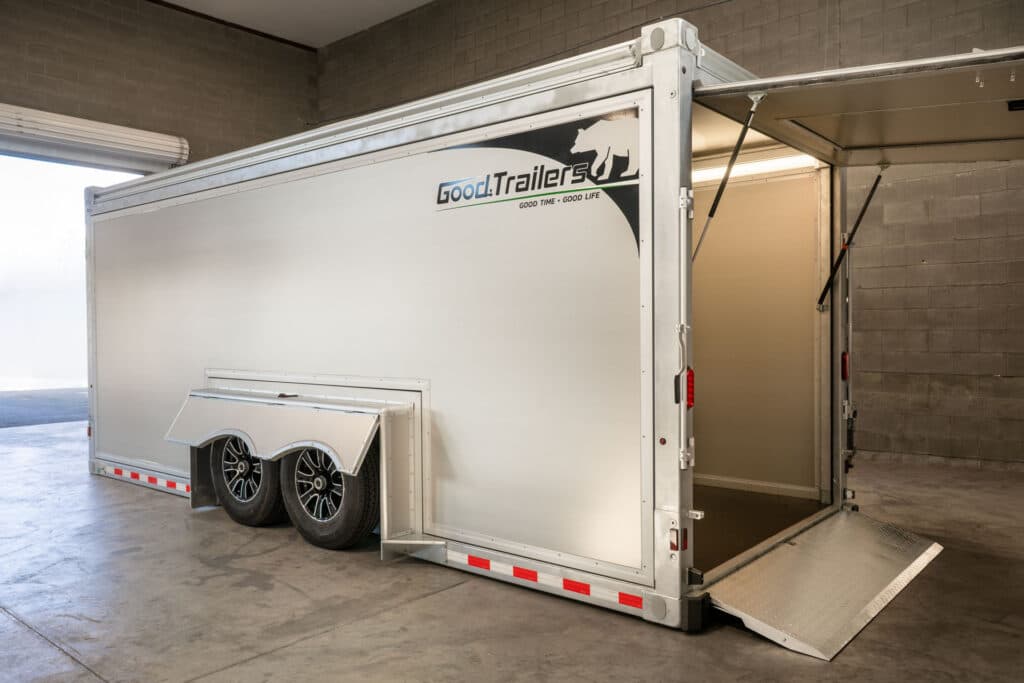
The solution? Swap out traditional lift gate box trucks with enclosed hydraulic drop deck trailers like the GT19AL.
table of contents
Drop Deck Trailers vs. lift gates
Lift gate box trucks are the traditional solution for last-mile deliveries, but they come with significant problems.
- They’re notorious for breaking down.
- They have strict weight limits that top out at 3,000 pounds.
- They are unstable on uneven city streets.
- They temporarily position heavy loads at height.
- They require a great deal of vertical and horizontal clearance which can be difficult to manage in tight spaces.
- TCO (total cost of ownership) is high.
If a lift gate motor dies mid-route, the driver is stuck, deliveries get missed, and downtime skyrockets.
Let’s look at how hydraulic drop deck trailers stack up instead.
- They’re more mechanically reliable than lift gates.
- Even our smallest enclosed trailer offers an estimated carrying capacity of 4,560 lbs.
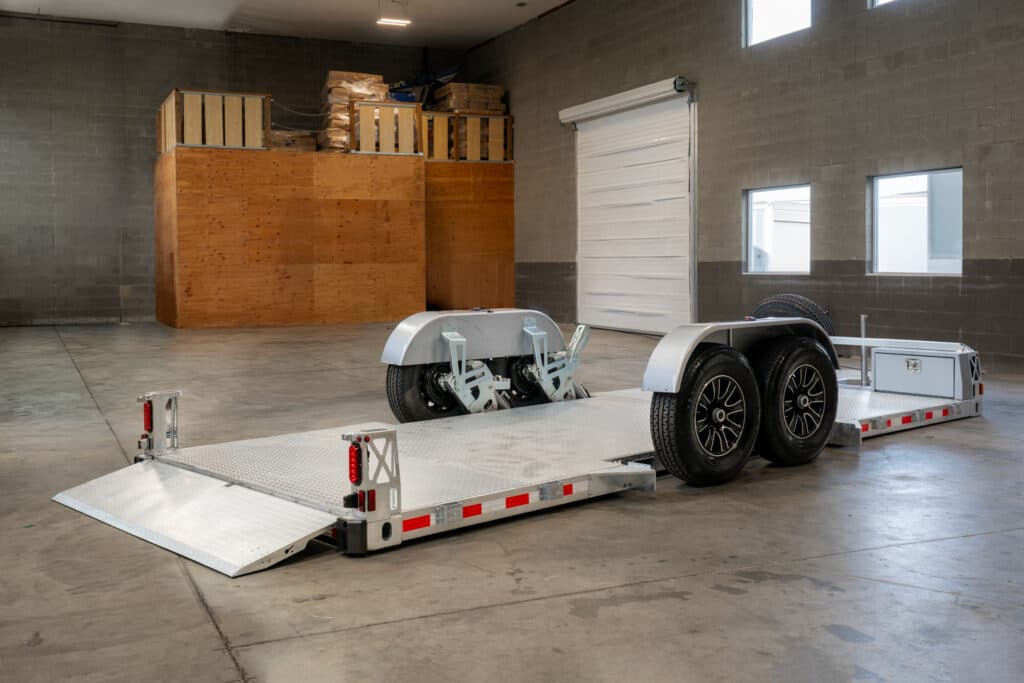
- The entire structure is stable because, once lowered, it sits directly on the ground.
- They require less vertical space.
- TCO is significantly lower.
If you’ve been burned by lift gate trucks before—by the constant maintenance cycles, the blown fuses, and the alignment failures—then Good Trailers by GoodMFG® offer a stand-out solution designed to eliminate these vulnerabilities.
Standard lift gates cantilever heavy loads out in midair. Meanwhile, our ground-level trailers use protected hydraulic systems. Hydraulics do the heavy lifting at the storefront, but our galvanized steel chassis and composite aluminum construction keep your load stable and secure on the highway.
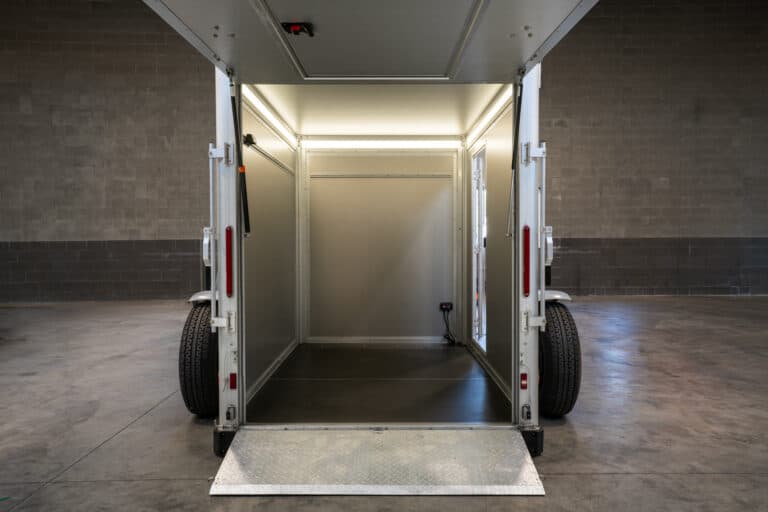
Seamless Mobility for Hand Trucks & Pallet Jacks
Last mile delivery has traditionally skipped trailers as an option simply because nobody wants to push a 2,000-pound pallet jack up a traditional 6-foot 16° to 20° trailer ramp to reach an 18″ deck. Making the attempt only invites disaster: the pallet will tip, the operator might lose control, and the goods might get damaged.
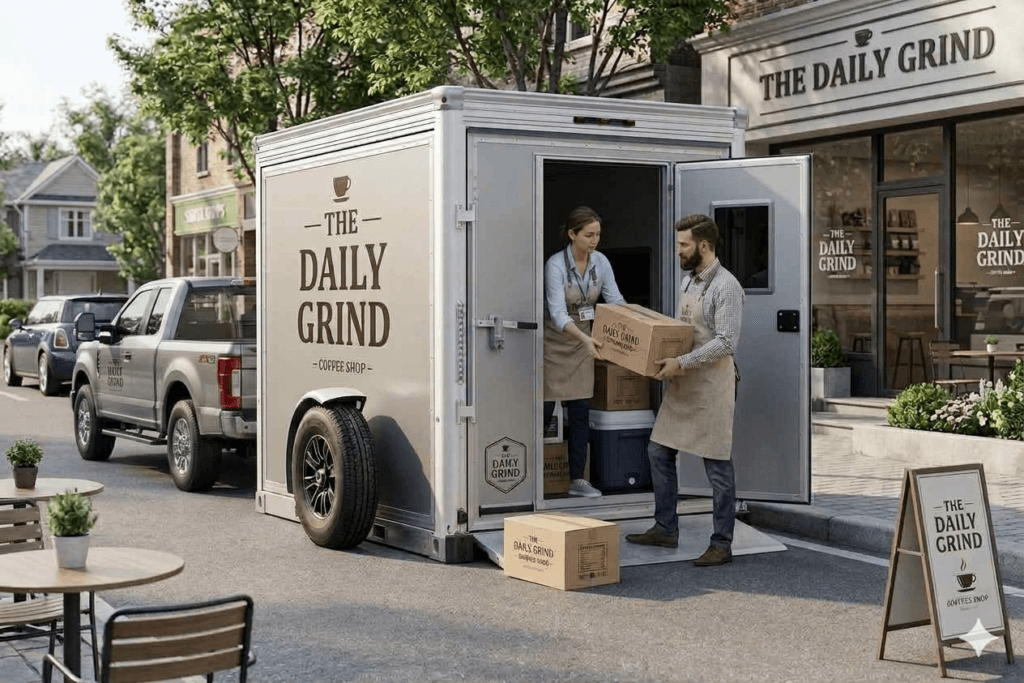
But Good Trailers are different. They lower all the way to the ground. The operator only has to contend with a 1’10” 11° ramp and they only have to reach a 5.4-inch deck. It’s easy to roll pallet jacks or hand trucks off and on the trailer with little risk to the operator or the goods. The transition is as seamless as moving from the sidewalk to the curb via a curb cut, or back again.
Flexible Footprints
Box trucks can get trapped when they encounter low-clearance urban bridges, older drive-thrus, parking garages, or even low tree canopies in residential neighborhoods. They typically need up to 11″ of clearance to get close to their load-out zones.
Meanwhile, a heavy-duty pickup truck pulling a drop-deck trailer will typically remain beneath the 9-foot threshold (choose our standard sizes for this, not our high cube sizes, which add an additional foot of height).
This opens up routes and allows drivers to get much closer to the stores they are supposed to serve.
Key Takeaways
Are you going to replace that old lift gate box truck or invest in enclosed hydraulic drop deck trailers this year? Before you decide, consider:
- Liftgate vulnerability. Traditional liftgates are prone to expensive mid-route motor failures, blown fuses, and cantilever alignment sag. Enclosed drop deck trailers use structurally integrated hydraulic systems that eliminate these mechanical weak points.
- Low clearance urban routing. A commercial pickup paired with a standard-height Good Trailer remains safely under the critical 9-foot urban clearance threshold, avoiding low bridges and overhead branches that trap standard box trucks.
- Stable, ground-level unloading. Lift gates force drivers to balance up to 3,000 lbs. of cargo to an elevated position over uneven city streets. Ground-level drop decks lower the entire chassis flush to the pavement, reducing tipping hazards.
- Effortless material handling. By reducing the loading transition to a short 1’10” ramp with a gentle 11° slope, single operators can smoothly roll 2,000-pound pallet jacks and hand trucks directly into urban storefronts without strain.
- Drastic TCO reductions. Shifting delivery fleets away from specialized box trucks to highly reliable, modular enclosed drop deck systems slashes annual vehicle maintenance costs, simplifies driver staging, and lowers the total cost of ownership.
Solve Last Mile Logistics with GoodMFG®
If you’re ready for a solution that puts an end to your lift gate headaches, then it’s time to start the conversation with our team.
- Call us right now at (360) 889-9789.
- Find a dealer near you.
- Click the green icon to the lower right to chat with Tow-Bot.
- Or contact us to send a message using the form below!
See also:
The Top 4 Advantages of Trailers that Lower to the Ground
Risk Mitigation on the Ramp: Seamless Loading & Unloading Solutions
Hauling Palletized Goods Without a Loading Dock
This resource was compiled by the GoodMFG® Product Team, drawing on 75 years of experience in hydraulic systems, heavy-duty transport, trailers, and modular structures.
P.S. – We build trailers every day, but we don’t run your crews. If there’s a specific logistical headache or a “field reality” we’ve missed, we want to hear about it. Help us refine the equipment that makes your day easier! Email our Marketing Lead at devan-h @ goodrv.com and let us know what we should solve next.