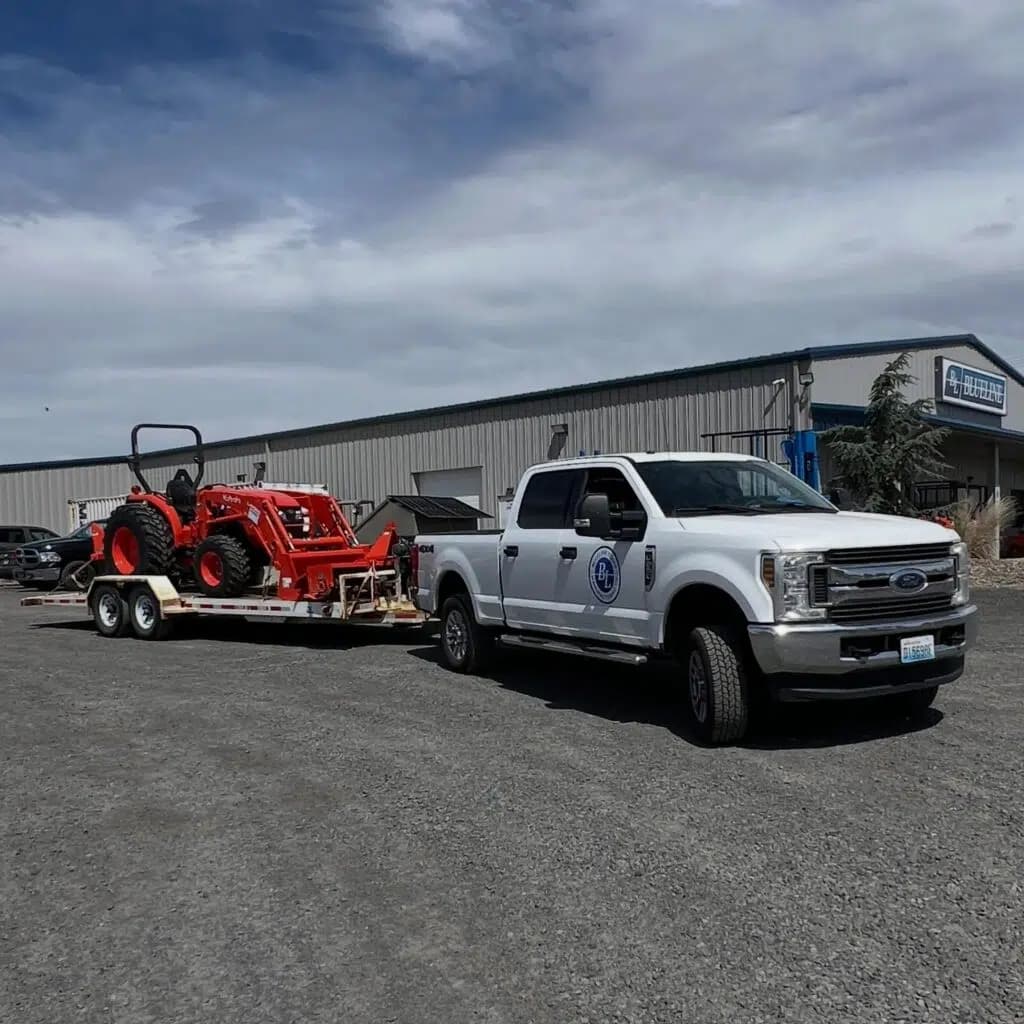
Hauling your tractor should never be an exercise in high anxiety, but steep trailer ramps on traditional tractor hauling trailers can give even the most experienced farmer, landscaper, or property manager some well-earned gray hairs.
Choosing the right tractor hauling trailer is about more than matching the length of your bare machine to a deck or matching a weight to a carrying capacity. You’ll need to factor in heavy attachments. You’ll also need to ask yourself what your current loading practices are costing you.
Want to protect your equipment investment for the long haul? Read on.
Table of Contents
- Why Your Tractor Hauling Trailer Should Eliminate Breakover Angles
- Calculating the Labor Costs of Loading Tractor Hauling Trailers
- Choosing the Right Tractor Hauling Trailer
- FAQ
- Key Takeaways
- Get the Right Tractor Hauling Trailer Today
Why Your Tractor Hauling Trailer Should Eliminate Breakover Angles
The breakover angle is the point where, on a standard trailer with a pair of narrow, high-angle ramps, the machine hits the apex of the angle and then suddenly has to slam flat. It is a recipe for damaging your machine. It’s especially hard on undercarriages.
Tractors equipped with mid-mount mowers, backhoes, box blades, or belly mowers often have minimum ground clearance. The breakover angle leads right to bottoming out, high-centering, tipping, or direct damage to those attachments.
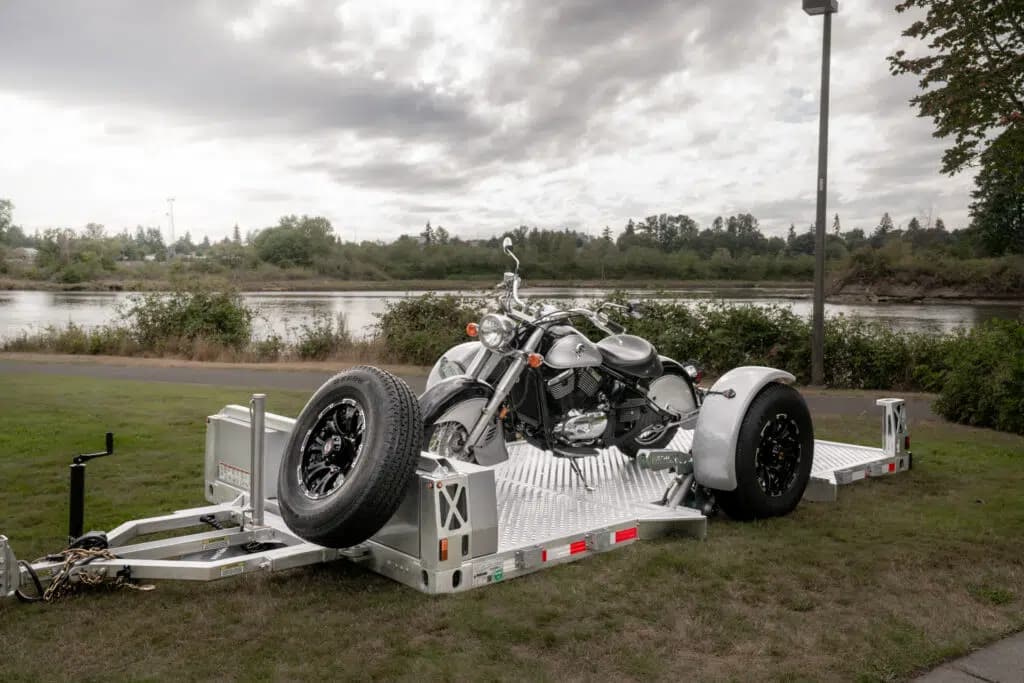
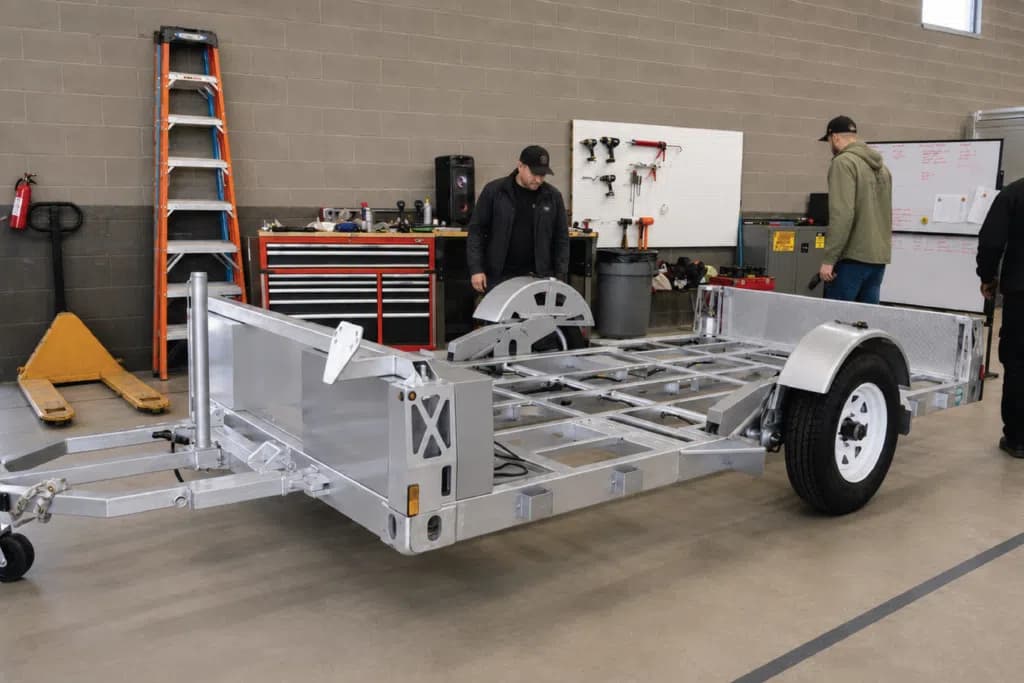
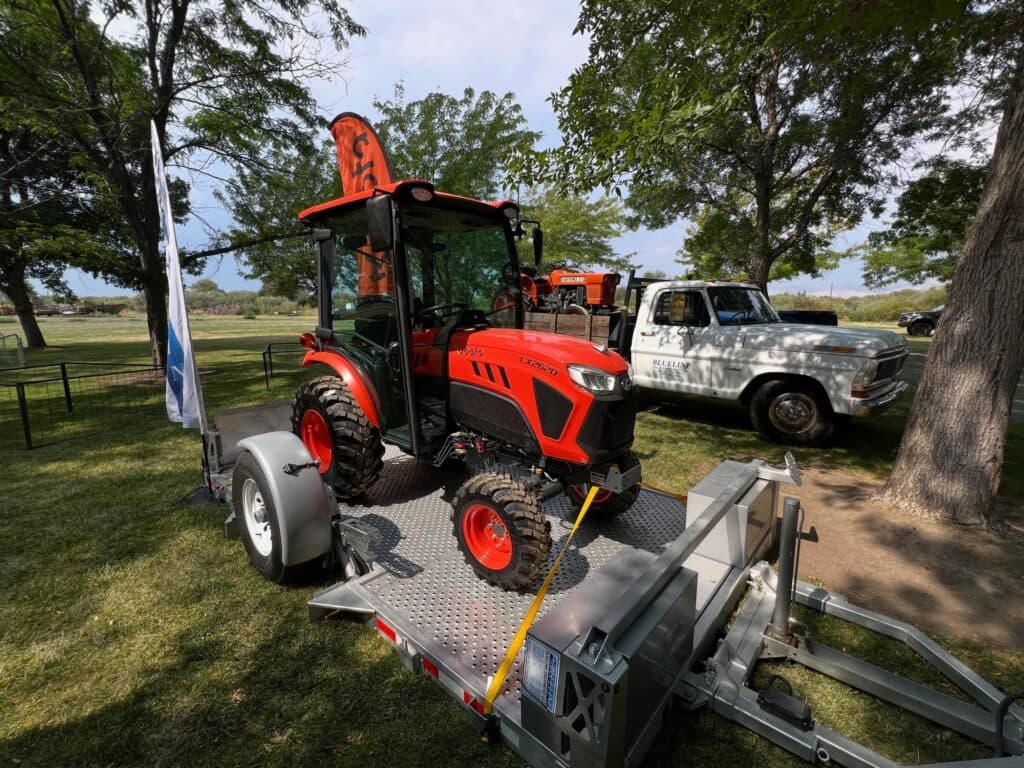
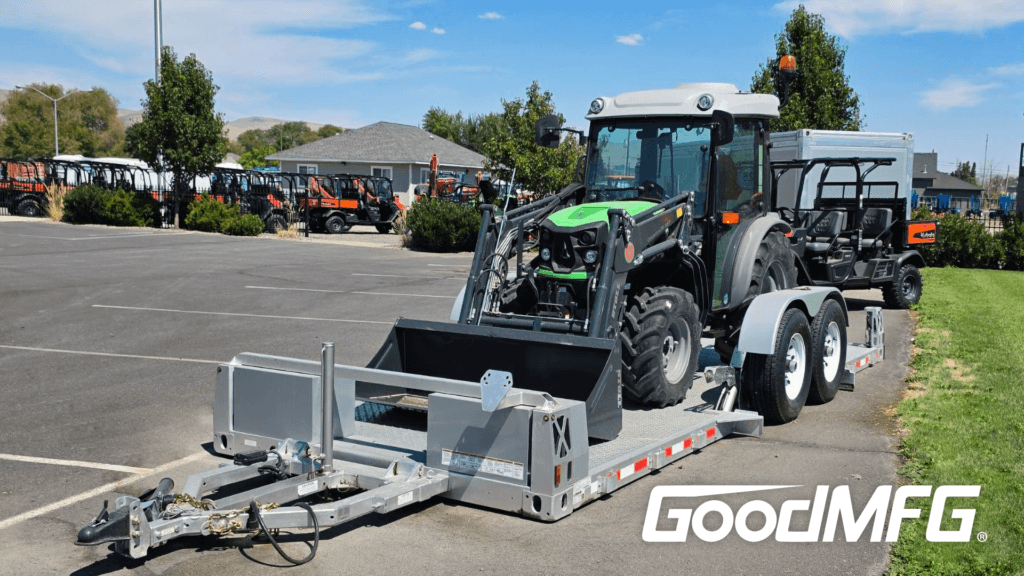
A hydraulic drop deck eliminates those problems altogether, protecting your tractor by giving you smooth, drive-on loading. The trailer lowers flat to the ground. You drive up a gentle, short ramp that spans the entire back of the trailer. Instead of a pair of 20° ramps that feel like balance beams, you travel up an 11° ramp that feels like a driveway.
And if you avoid having to make even one repair this year as a result of switching trailers, your new drop deck tractor hauling trailer has just paid for itself.
Plus, you save your back because there are no ramps to lift, store, or align. You simply fold out our spring assisted ramp and leave it at that.
Calculating the Labor Costs of Loading Tractor Hauling Trailers
When you’re evaluating a trailer investment you need to look beyond the purchase price of the trailer. Standard trailers come with hidden costs: operator fatigue, wasted time, and lost productivity.
Daily Set-up & Stowing Time
A traditional ramp trailer requires an operator to pull pins, manually lift and position heavy steel ramps, adjust ramp spacing to match track or tire width, slow driving, constant inspection, and then the ordeal of lifting, locking, and pinning the heavy ramps back into place. It typically requires two operators, because loading a traditional trailer without a spotter is quite unsafe.
When you factor in the entire process, a standard ramp loading cycle takes 10 to 20 minutes per loading and unloading stop. A hydraulic drop deck trailer can take six minutes or less. That means a drop deck can help you reclaim nearly an hour of billable time every single day, making your team more productive and helping you focus on the work that actually pays the money.
Physical Fatigue & Injury Risks
Heavy steel ramps weigh anywhere from 45 to 80 pounds each. Manually lifting them multiple times a day in rain, mud, or extreme weather is a primary driver of lower back strain and crushed fingers among field crews.
A single L&I claim (workers’ compensation in other states) or missed work cycle due to a lifting injury usually far outweighs the cost of a hydraulic drop deck trailer.
Downtime & Repair Costs
Slamming an expensive mid-mount belly mower deck, box blade, or oil pan on a breakover apex causes structural stress, fluid leaks, and bent mounting brackets. Labor can cost up to $180 per hour and parts can cost up to $2,500.
Some repairs are expensive enough to pay for the initial investment all by themselves, because by eliminating steep loading angles, you eliminate the primary cause of transport-related equipment repair.
Choosing the Right Tractor Hauling Trailer
We’ve taken the dimensions off the three most common trailer brands and have matched them to our flatbed drop deck trailers. This will help you find the right tractor hauling trailer for your needs. However, you should use this guide as a starting point for shopping. You should always check the specifications on the make and model you choose to buy.
GT13FL
The GT13FL is a great tractor hauling trailer for residential acreage owners, home land managers, or commercial landscapers who will be hauling just one attachment.
Example brands & dimensions:
- Kubota BX2380: ~1,330 lbs., 8.0’L x 3.8’W
- John Deere 1025R: ~1,450 lbs., 8.6’L x 3.9’W
- Mahindra eMax 20S: ~1,499 lbs., 7.8’L x 3.5’W
- Kubota BX23S: ~1,570 lbs., 8.0’L x 3.8’W
- Kubota B2601: ~1,632 lbs., 8.2’L x 4.1’W
The GT19FL is a great tractor for landscapers, contractors, and farmers who typically haul two or more attachments. There are exceptions, as some larger tractors will still only leave enough room for one attachment.
- Mahindra Max 26XLT: ~1,819 lbs., 9.1’L x 4.5’W
- John Deere 3038E: ~2,225 lbs., 10.7’L x 4.8’W
- John Deere 2032R: ~2,435 lbs., 9.9’L x 4.8’W
- Mahindra 1626: ~2,459 lbs., 10.7’L x 5.3’W
- Kubota L2501: ~2,600 lbs., 10.6’L x 4.6’W
Attachments
When you’re choosing the right tractor hauling trailer it is vital for you to consider the attachments you’ll need to haul as well. You’ll need to add the width, length, and weight of your most-needed attachments when you’re choosing the trailer model that’s right for you.
Below, you’ll find the six most common attachments and the typical weight, width, and length that you’ll want to add. Always check the specifications on your specific gear before you purchase a trailer and before you haul.
Front-End Loader (FEL) + Bucket
- Weight: 600 – 1,200 lbs (Includes arms, frame, cylinders, and standard bucket)
- Width: 48″ – 72″ (Usually matches or slightly exceeds rear tire width)
- Length Added: 3′ to 5′ beyond the front grill
- Trailer Tip: Always factor in loader length. Leaving the loader on forces the tractor several feet further back on the deck, altering tongue weight balance.
Rotary Cutter (Bush Hog / Brush Mower)
- Weight: 450 – 1,100 lbs (Depending on deck size and duty rating)
- Width: 54″ – 78″ (4 ft to 6 ft cutting width)
- Length Added: 6′ to 9′ hanging off the 3-point hitch
- Trailer Tip: Rotary cutters take up massive deck space. A tractor with a front loader AND a rotary cutter often requires a 20 ft to 22 ft deck minimum, even if the tractor itself is only 10 ft long.
Backhoe Attachment
- Weight: 600 – 1,400 lbs (Subframe-mounted or 3-point PTO driven)
- Width: 48″ – 60″ (Stabilizer pads retracted)
- Length Added: 4′ to 6′ (In transport locked position)
- Trailer Tip: Backhoes make the rear of the tractor extremely heavy. Loading backhoe-first or carefully balancing the deck is crucial for safe towing dynamics.
Box Blade / Rear Blade
- Weight: 300 – 800 lbs
- Width: 48″ – 84″ (4 ft to 7 ft)
- Length Added: 2.5′ to 3.5′ off the rear
- Trailer Tip: Box blades sit low to the ground. On steep ramp trailers, they frequently strike the pavement or ramp edge during loading.
Pallet Forks (Quick-Attach Front Mount)
- Weight: 250 – 450 lbs
- Width: 42″ – 48″ carriage width
- Length Added: 3.5′ to 4′ beyond the front loader arms
- Trailer Tip: Fork tines present a puncture hazard to trailer tires or drop-deck hydraulic lines if not safely rested flat on the deck floor.
Mid-Mount / Belly Mower Deck
- Weight: 250 – 500 lbs
- Width: 54″ – 72″
- Length Added: 0′ (Mounted under machine belly)
- Trailer Tip: High-risk for bottoming out. Belly mowers have only 3″–5″ of ground clearance. Moving up standard trailer ramps almost guarantees high-centering or damage to the deck shell.
FAQ
Can I haul a tractor with a front-end loader on a 13-foot trailer?
Yes, provided the total combined length of the tractor and loader arms does not exceed the deck length and remains within the payload limit. However, if you plan to keep a rear attachment mounted simultaneously (like a rotary cutter or a backhoe) you’ll typically need a 19’ deck.
How do I calculate the total towing weight for my tractor set-up?
Add the bare weight of your tractor, the dry weight of all mounted front and rear implements, and the weight of any fluid-ballasted tires (water or rim guards add up to 600 pounds per rear tire). Ensure the total payload does not exceed your trailer’s rated carrying capacity.
Why are belly mowers and mid-mount attachments so difficult to load on traditional trailers?
Belly mowers hang beneath the middle of the tractor frame, creating a low-ground clearance zone (often only 3 to 5 inches). As the front tires ascend a steep ramp and top the trailer deck, the low-hanging center drops over the high-angle breakover point, scraping or crushing the deck shell.
Key Takeaways
Everyone wants to protect their tractor, because tractors are key to their livelihood. If you’re looking for an excellent tractor hauling trailer, consider these key points.
- Breakover angles cause real damage. Standard high-angle ramps frequently cause low clearance equipment to bottom out, which in turn can cause components to crack.
- Drop decks lower labor costs. Eliminating heavy manual ramps saves time, reduces fatigue, and can save hundreds of labor hours annually.
- Always factor in your attachments. A tractor that is 9’ long on paper can easily become a 16’ tractor once you add a front-end loader and a rear rotary cutter.
- Match your deck size to your workflows. Use a 13’ trailer for single attachment or sub-compact setups. Use a 19’ trailer if you haul multiple attachments or larger compact utility tractor models.
Get the Right Tractor Hauling Trailer Today
Stop stressing over steep ramps, narrow loading margins, and damaged equipment. Upgrade your operations with a heavy-duty hydraulic drop deck trailer built to lower flush to the ground for effortless, push-button loading.
Find your nearest dealer or contact us today!
See also:
The Ultimate Mini Excavator Trailer Guide
The Ultimate Guide to Skid Steer Trailers
How to Transport a John Deere Gator Safely
This resource was compiled by the GoodMFG® Product Team, drawing on 75 years of combined experience in hydraulic systems, heavy-duty transport, trailers, and modular structures.
P.S. – We build trailers every day, but we don’t run your crews. If there’s a specific logistical headache or a “field reality” we’ve missed, we want to hear about it. Help us refine the equipment that makes your day easier! Email our Marketing Lead at devan-h @ goodrv.com and let us know what we should solve next.